

The mountains draw people to Mardi Himal, but the hills below them are home to a people whose culture shapes the whole experience. The Gurung, who call themselves Tamu, have lived in the foothills of the Annapurna range for centuries. Their terraced fields line the slopes around Kande and Siding, their stone houses cluster on ridges above the rivers, and many of the families who run the tea houses along the trail are Gurung. Understanding a little of their history and traditions adds depth to every conversation and every village you pass.
This guide introduces Gurung culture as it relates to the Mardi Himal Trek: who the Gurung are, their language, villages, beliefs, food, festivals and famous Gurkha heritage, and how to engage with their communities respectfully.
Who Are the Gurung?
The Gurung are one of Nepal's many ethnic groups, with their main homeland in the middle hills of central Nepal, especially the districts of Kaski, Lamjung, Syangja, Tanahun and Gorkha. Kaski, the district that includes Pokhara and the Mardi Himal region, has a large Gurung population. Traditionally, Gurung communities lived in villages at middle altitudes, farming terraced fields and herding sheep and other animals on high pastures in summer.
The Gurung call themselves Tamu, and their language Tamu Kyi. They trace their origins to peoples who migrated into the Himalayan foothills from the north long ago, and their culture blends elements of Tibetan Buddhism, older shamanic traditions and Hindu practices from the wider Nepali society around them.
Gurung Language
Gurung is a Tibeto-Burman language, related to languages spoken across the Himalaya and Tibetan plateau rather than to Nepali, which is an Indo-European language. Most Gurung people are bilingual in Gurung and Nepali, and many younger people, especially those working in tourism, also speak good English. On the trail you will mostly hear Nepali, but in villages and among older people you may hear Gurung. Learning a few Nepali phrases is appreciated everywhere; see useful Nepali phrases for the trek.
Gurung Villages Around Mardi Himal
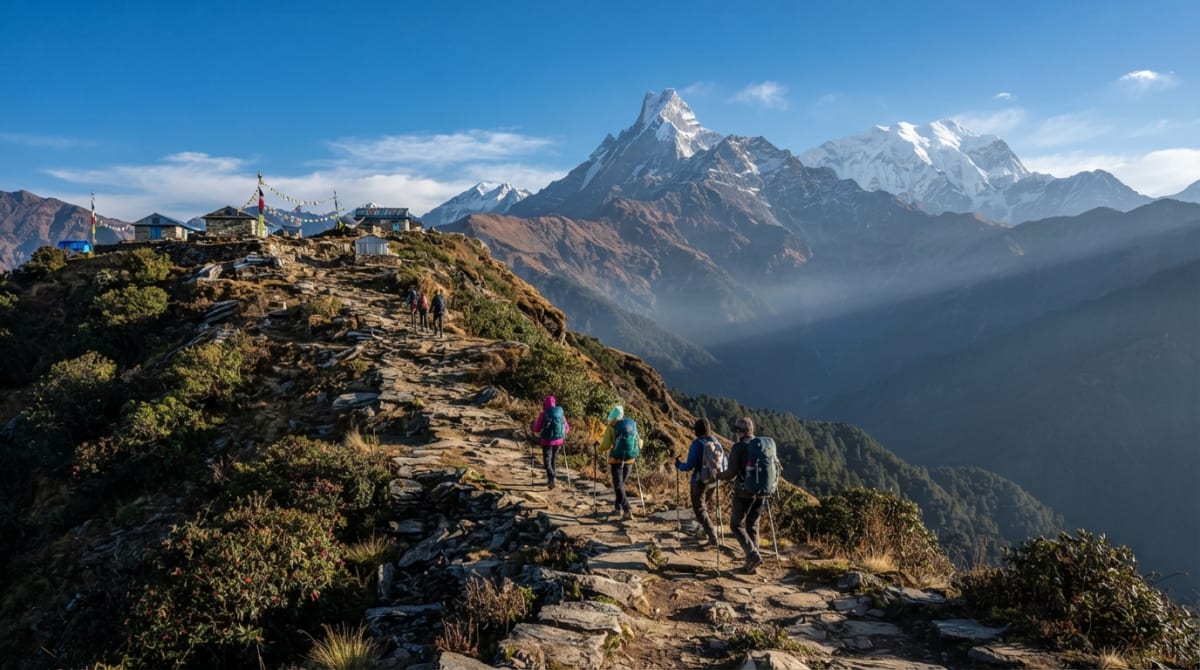
The Mardi Himal Trek spends most of its time in forest and on the ridge, but it begins and ends among farming villages. On the first day, the trail from Kande climbs through small settlements and terraces. On the descent, villages such as Siding and Lwang show traditional village life: stone houses with slate or tin roofs, courtyards where grain dries in the sun, livestock sheds, water taps where people gather, and terraced fields stepping down the hillsides. Nearby, across the Modi Khola valley, the large Gurung village of Ghandruk is famous for its preserved architecture and is often combined with Annapurna treks.
Read our guides to villages around the Mardi Himal trail, Siding village and traditional Gurung village architecture.
Farming and Daily Life
Gurung villages have traditionally lived from mixed farming. Terraces grow rice at lower altitudes and maize, millet, wheat, potatoes and mustard higher up, depending on the season. Buffalo, cows, goats and chickens are kept for milk, meat, manure and ploughing. In the past, many families took sheep to high pastures in summer, and some still do. The farming calendar shapes village life: planting rice in the monsoon, harvesting in autumn, and festivals marking the turning of the seasons.
Today, village life is changing. Many young people work abroad, in cities or in tourism, and remittances from family members overseas are an important source of income. Some terraces lie fallow as villages age. Tourism, including the tea houses of the Mardi Himal Trek, offers a way for families to earn a living while staying in their home region. See farming seasons and village life.
Beliefs and Religion
Gurung religious life is a blend of traditions. Many Gurung practise a form of Tibetan Buddhism, and you will see chortens, prayer flags and mani walls in some areas. Alongside Buddhism, traditional Gurung priests, known as pachyu and klehbri, have long performed rituals for important life events, especially funerals, drawing on older shamanic beliefs about the spirit world and ancestors. Hindu festivals and practices are also widely observed, as they are across Nepal.
This blend means you may see Buddhist prayer flags on a house that also has a Hindu shrine, and a family celebrating both Buddhist and Hindu festivals. Read about Hindu and Buddhist traditions you'll notice and prayer flags, chortens and shrines on the trail.
Machapuchare: The Sacred Mountain
Machapuchare, the Fishtail mountain that dominates the Mardi Himal Trek, is regarded as sacred and is closed to climbing. Local people consider it the home of a deity, and the Nepali government has not issued permits to climb it since the 1950s. Its summit has never been officially reached. Knowing this adds meaning to the view as you walk toward it for several days. Read why Machapuchare has never been climbed.
The Gurkha Connection
The Gurung are well known worldwide for their service as Gurkha soldiers. Since the early nineteenth century, men from the hills of Nepal, including many Gurung, have served in the British Army and the Indian Army, and later in other forces such as the Singapore Police. Gurkha soldiers earned a reputation for bravery and loyalty in conflicts around the world.
Gurkha service has had a huge influence on Gurung communities. Pensions and salaries brought money into villages, and returning soldiers brought new ideas, skills and connections. In Pokhara, the Gurkha Memorial Museum tells this story. Many of the houses you see in villages and in Pokhara were built with Gurkha earnings. Read the Gurkha connection around Pokhara.
Traditional Dress
At festivals and special occasions, Gurung women wear traditional dress including a velvet blouse, a wrapped skirt, a patterned shawl and heavy gold and silver jewellery, including large earrings and necklaces. Men traditionally wear a short wrapped garment called a bhangra, a kilt-like cloth, and a Nepali topi hat. Everyday wear is now usually modern, but during festivals such as Tamu Lhosar, streets and villages fill with people in traditional costume.
Food
Traditional Gurung food reflects hill farming. Dhido, a thick porridge of millet or buckwheat flour, is a staple, eaten with lentils, greens and pickles. Gundruk, fermented and dried leafy greens, is made into soups and side dishes. Rice, lentils, maize, potatoes and seasonal vegetables are common, and meat is eaten on special occasions. Local alcohol, such as millet beer and distilled raksi, plays a role in celebrations. On the trek, tea house menus are mostly standard trekker fare, but you may be able to ask for dhido or local dishes in villages. See Nepali dishes to try on the trek.
Festivals
The most important Gurung festival is Tamu Lhosar, the Gurung New Year, celebrated around the end of December. Communities gather in traditional dress for music, dancing, food and cultural programmes, and Pokhara hosts large celebrations. Gurung people also celebrate national festivals such as Dashain and Tihar in autumn, when families gather, homes are decorated and swings are built in villages. If your trek coincides with a festival, you may be invited to join in. Read Tamu Lhosar and Gurung festivals and trekking during Dashain and Tihar.
Music, Dance and Social Traditions
Gurung culture has rich musical traditions, including dances performed at festivals and ceremonies. A traditional social institution called the rodhi, a gathering place where young people met to sing, dance, work and socialise, was once central to village life. Although rodhi are less common today, cultural groups keep these traditions alive, and you may see performances in Pokhara or during festivals. Evening singing in tea houses sometimes includes the famous Nepali folk song Resham Firiri; read about Resham Firiri and trail songs.
Mothers' Groups and Community Life
In many Gurung villages, women's groups known as aama samuha, or mothers' groups, play a central role in community life. They organise cultural programmes, raise funds for village projects, keep paths and public spaces clean, and often perform traditional songs and dances for visitors and festivals. In villages that receive trekkers, mothers' groups have sometimes helped manage waste, run homestay programmes or support local schools. If you are welcomed by a cultural programme on a village visit, it is likely a mothers' group behind it, and any donation you give usually goes to community projects.
Handicrafts and Weaving
Gurung communities have long traditions of weaving. Woollen rugs known as radi and thick woollen blankets called pakhi were traditionally woven from the wool of sheep grazed on high pastures, and bamboo is woven into baskets such as the doko, the conical basket you will see porters and farmers carrying on their backs. Some villages still produce these crafts, and they are sometimes sold in Pokhara. Buying locally made handicrafts directly from producers is a good way to support traditional skills. See our guide to souvenir shopping in Pokhara.
Being a Guest in a Gurung Home
If you are invited into a village home or stay in a homestay, you will likely be offered tea, perhaps with snacks, as a sign of welcome. It is polite to accept at least a little. Remove your shoes at the door, avoid stepping over the hearth or pointing your feet at people or at the fire, and wait to be shown where to sit. Guests are often given the best seat and served first. Compliment the food, ask about the family, and show interest in photos of relatives, many of whom may be working abroad. These small courtesies are noticed and appreciated. See homestays near the Mardi Himal trail.
Gurung Culture and Tourism
Tourism has brought income, jobs and new opportunities to the Mardi Himal region. Many tea houses are family-run, often by Gurung families from nearby villages, and many guides and porters come from these communities. At the same time, tourism brings challenges, such as rubbish, pressure on resources and changes to traditional life. Choosing locally owned lodges, hiring local guides and porters, buying local products and respecting customs all help ensure tourism benefits the people who live here. Read how your trek supports local communities.
How to Visit Respectfully
- Greet people with "namaste", palms pressed together.
- Dress modestly in villages, covering shoulders and knees.
- Always ask before photographing people, especially elders and during ceremonies.
- Walk clockwise around chortens and mani walls, and do not touch religious objects without permission.
- Remove shoes when entering homes and some shrines.
- Accept and offer things with your right hand or both hands.
- Do not give sweets or money to children; support schools or community projects instead.
- Show interest and ask questions; most people are happy to talk about their culture.
Our guide to cultural dos and don'ts covers etiquette in more detail.
Questions to Ask Your Guide
Your guide is often the best window into local culture. Good conversation starters include: which village their family comes from, what festivals they celebrate at home, what their grandparents did for a living, whether anyone in the family served as a Gurkha, and what has changed in the villages since the trekking route opened. Most guides enjoy these conversations, and the answers bring the landscape to life in a way no guidebook can.
Learning More in Pokhara
Pokhara is an excellent place to learn more about the region's cultures. The Gurkha Memorial Museum explains Gurkha history. The International Mountain Museum covers the peoples and cultures of the Himalaya as well as mountaineering. Tibetan settlements around the city show another community that shaped the region. See the International Mountain Museum and Tibetan settlements in Pokhara.
Experience Gurung Culture with Us
Many of our guides come from the hill communities around Pokhara and are happy to share stories of village life, festivals and family history. On the trek, they can arrange a village visit or help you try local food. If culture is a priority, the 9-day Mardi Himal Trek gives you time in Kathmandu and Pokhara as well as the villages on the trail, while the 5-day trek from Pokhara descends through the Gurung village of Siding. Ask us about timing your trek with a festival.