

The Mardi Himal Trek takes you high into the Himalaya, beneath peaks regarded as sacred by local people. Far to the south, on the flat plains near the Indian border, lies another sacred place: Lumbini, the birthplace of Siddhartha Gautama, who became the Buddha. Combining the two creates a journey from mountain to plain and from adventure to reflection, and it gives you a much broader picture of Nepal's landscapes and spiritual heritage.
This guide explains how to combine the Mardi Himal Trek with a visit to Lumbini, what to see there, how to travel between the two and when to go. For the trek, see our 9-day Mardi Himal Trek, which can be extended with a Lumbini visit.
Why Visit Lumbini?
Lumbini is one of the most important pilgrimage sites in the Buddhist world and a UNESCO World Heritage Site. According to tradition, Queen Maya Devi gave birth to Siddhartha Gautama here in a garden, and the site has been venerated for well over two thousand years. Today, pilgrims from across Asia and beyond come to pray, meditate and walk among the ancient ruins and modern monasteries. Even for visitors who are not Buddhist, Lumbini offers a peaceful, reflective atmosphere and a fascinating glimpse into the history of one of the world's great religions.
After the physical effort of the trek, Lumbini's calm gardens and quiet temples provide a restful contrast. Many travellers find it a meaningful way to end their trip.
What to See
The heart of Lumbini is the Sacred Garden, which contains the Maya Devi Temple, built over the traditional birthplace of the Buddha. Inside, protected ruins and a marker stone indicate the exact spot revered by pilgrims. Nearby stands the Ashoka Pillar, erected by the Indian emperor Ashoka in the third century BCE, with an inscription recording his visit to the Buddha's birthplace. Beside the temple is the sacred pond, where Maya Devi is said to have bathed, surrounded by trees hung with prayer flags.
North of the Sacred Garden lies the Monastic Zone, a large area where Buddhist communities from many countries have built monasteries and temples in their own architectural styles. You can see Thai, Chinese, Japanese, German, Vietnamese, Burmese and other temples, each reflecting different traditions. A long canal and walkways connect the zones, and the World Peace Pagoda stands at the northern end. Renting a bicycle or rickshaw is a pleasant way to explore the spread-out site.
The Story Behind Lumbini
According to Buddhist tradition, Queen Maya Devi was travelling to her parents' home when she stopped to rest in the garden at Lumbini and gave birth to a son, Siddhartha Gautama, beneath a tree. He grew up as a prince in the kingdom of the Shakya clan, but as a young man he left his comfortable life to seek an end to human suffering. After years of searching and meditation, he attained enlightenment and became known as the Buddha, the "awakened one", spending the rest of his life teaching across northern India.
Lumbini was forgotten for centuries and rediscovered in the late nineteenth century, when archaeologists identified the Ashoka Pillar and its inscription. Since then, excavations, conservation work and a master plan for the site have restored its place as a centre of pilgrimage. Standing in the Sacred Garden, it is remarkable to think of the long line of pilgrims, from ancient emperors to modern travellers, who have come to this spot.
Visiting Etiquette
Lumbini is a sacred site, and visitors are expected to behave respectfully. Dress modestly, covering shoulders and knees. Remove shoes before entering the Maya Devi Temple and many monasteries. Walk clockwise around stupas and sacred objects. Keep your voice low, especially in meditation areas and near pilgrims praying. Photography may be restricted inside the Maya Devi Temple and some monasteries, so check the signs or ask. Do not climb on ruins or sacred structures. Many visitors find that simply sitting quietly in the Sacred Garden, watching pilgrims and listening to chanting, is the most memorable part of the visit.
Exploring the Monastic Zone
The Monastic Zone is one of Lumbini's most interesting features. It is divided into areas for different Buddhist traditions, and countries and communities from around the world have built monasteries in their own styles. Some are grand and colourful, others simple and serene. Walking or cycling between them, you can see the diversity of Buddhist art and architecture in a single afternoon: golden stupas, carved wooden halls, painted murals and peaceful gardens. Many monasteries welcome respectful visitors, and some offer meditation sessions or talks. Allow at least half a day to explore at a relaxed pace.
Nearby Historic Sites
The region around Lumbini contains several other sites associated with the Buddha's early life and the ancient Shakya kingdom. Tilaurakot, west of Lumbini, is associated by many archaeologists with ancient Kapilavastu, the city where Siddhartha is said to have grown up, and has excavated ruins of walls and gates. Ramagrama, to the east, is home to a stupa said to contain relics of the Buddha. Devdaha, associated with Maya Devi's family, is another site of pilgrimage. Visiting these requires extra time and transport, but they add depth for those interested in history and archaeology.
Where to Stay
Accommodation is available near the Lumbini site and in the nearby town of Bhairahawa, also known as Siddharthanagar. Options range from simple guesthouses to comfortable hotels. Some monasteries offer basic lodging for pilgrims and meditators, usually with simple rules and a donation. Staying close to the site lets you visit early in the morning or late in the afternoon, when it is cooler and quieter.
Weather and Health in the Plains
After the cold of the Mardi Himal ridge, the plains around Lumbini can feel very warm, especially from April to June, when temperatures can be extremely high. Drink plenty of water, wear a sun hat and light, modest clothing, and plan outdoor visits for the early morning and late afternoon. Mosquitoes are common in the lowlands, so use repellent. Winter mornings can be foggy and cool, so bring a warm layer.
Combining Lumbini with Chitwan
Lumbini and Chitwan both lie in the southern plains, and many travellers visit them together. A popular route after the Mardi Himal Trek is Pokhara to Lumbini, Lumbini to Chitwan, and Chitwan to Kathmandu, giving you mountains, pilgrimage and jungle in about two weeks. See Mardi Himal and Chitwan and our three-week Nepal itinerary.
Who This Combination Suits
A trek and Lumbini visit suits travellers interested in Buddhism, history and spirituality, as well as those looking for a peaceful, reflective ending to an active trip. It suits pilgrims from Buddhist countries who want to combine a trek with a visit to the Buddha's birthplace, and anyone curious about the religious traditions they encounter on the trail. See Hindu and Buddhist traditions near Mardi Himal.
Getting from Pokhara to Lumbini
Lumbini lies in the Terai plains, south of Pokhara. By road, the journey usually takes six to eight hours, passing through hill towns and descending to the plains, often via the Siddhartha Highway. Tourist buses and private vehicles make the trip; a private vehicle is more comfortable and allows stops. Flights to Bhairahawa, near Lumbini, are an alternative, including from Kathmandu. From Lumbini, you can return to Kathmandu by road or flight, or continue to Chitwan. See bus travel in Nepal.
A Sample Itinerary
| Day | Plan |
|---|---|
| 1–2 | Arrive in Kathmandu, travel to Pokhara |
| 3–7 | Mardi Himal Trek, return to Pokhara |
| 8 | Travel Pokhara to Lumbini |
| 9 | Full day exploring Lumbini |
| 10 | Fly or drive to Kathmandu |
| 11 | Departure |
This can be combined with Chitwan for a longer trip covering mountains, jungle and pilgrimage sites.
Meditation and Retreats
Lumbini's peaceful atmosphere makes it a natural place for meditation. Some monasteries and meditation centres in and around the site offer sessions, courses or retreats, ranging from a short introduction to several days of silent practice. Rules and schedules vary, and some require advance registration or a donation. Even without a formal course, many visitors find a quiet corner of the Sacred Garden or a monastery garden to sit in silence. After the physical focus of trekking, a period of stillness can be a surprisingly powerful way to reflect on the journey.
Exploring by Bicycle
The Lumbini site is spread over a large area, with the Sacred Garden, Monastic Zone, canal and Peace Pagoda separated by long paths. Renting a bicycle is a pleasant and practical way to explore, allowing you to move between monasteries at your own pace and stop wherever you like. Rickshaws and electric vehicles are also available for those who prefer not to cycle. Start early to avoid the midday heat, carry water, and take breaks in the shade of the monastery gardens.
From Mountains to Plains: A Journey of Contrasts
Travelling from the Mardi Himal ridge to Lumbini is a journey across Nepal's dramatic geography. In a few days you move from alpine grassland and snow-covered peaks at around 4,500 meters, through the green, terraced hills around Pokhara, to the flat, fertile plains of the Terai at under 200 meters. The climate, vegetation, architecture and people change along the way, from Gurung villages in the hills to the communities of the plains. Seeing this range in a single trip helps you understand how varied Nepal really is, and why the country's cultures and traditions are so diverse.
Many travellers find the contrast between the physical challenge of the trek and the calm of Lumbini especially meaningful. The mountains reward effort and endurance; Lumbini invites stillness and reflection. Together, they make a balanced and memorable journey.
Practical Tips
- Start early. Visit the Sacred Garden in the morning, when it is cooler and quieter.
- Dress modestly. Cover shoulders and knees, and wear shoes that are easy to remove.
- Carry water and a hat. The plains can be hot, and distances between sites are long.
- Hire a local guide. A guide explains the history and symbolism of the sites.
- Allow enough time. A rushed visit misses the peaceful atmosphere that makes Lumbini special.
Buddhist Heritage on the Trek Itself
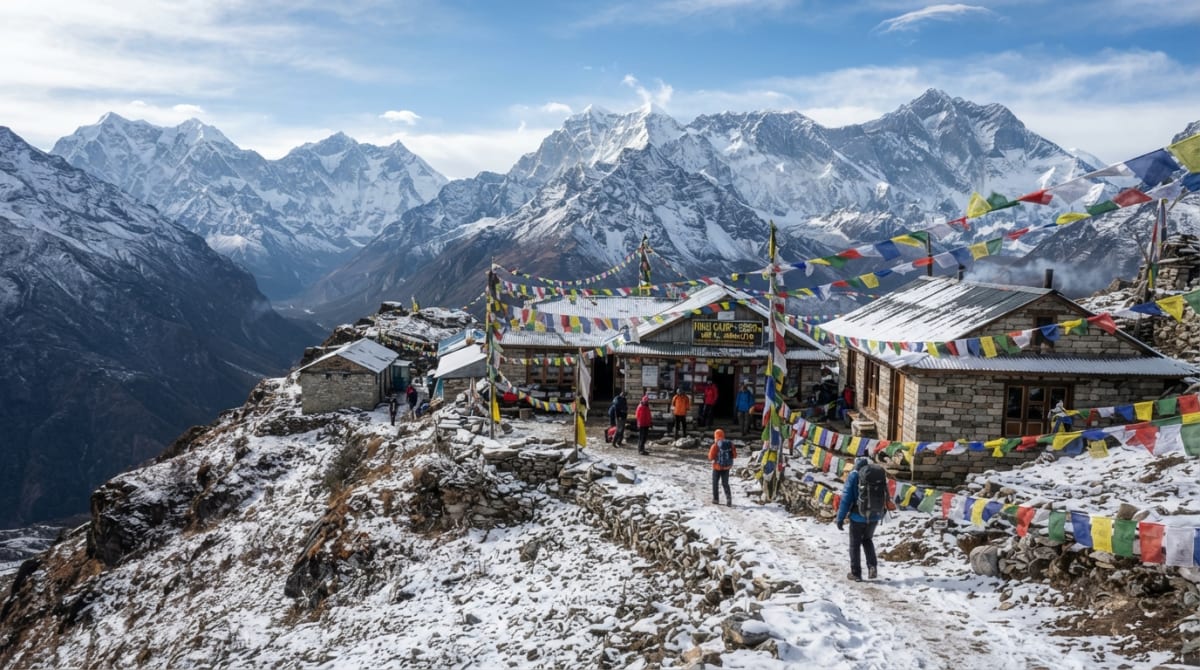
A visit to Lumbini adds meaning to the Buddhist symbols you encounter on the Mardi Himal Trek. Prayer flags strung across the ridge near High Camp, small chortens beside the trail and prayer wheels in villages all belong to traditions that trace their roots to the teachings of the Buddha. In the hills around Pokhara, many Gurung communities practise a form of Buddhism alongside older and Hindu traditions, and Tibetan settlements near Pokhara keep their own Buddhist customs alive. Travelling from the prayer flags of the ridge to the birthplace of the Buddha connects these threads into a single story. See prayer flags and shrines on the trail and Tibetan settlements in Pokhara.
Budget for a Lumbini Extension
Adding Lumbini to your trip means extra transport, one or two nights of accommodation, meals, entrance fees to the Sacred Garden and bicycle or rickshaw hire. Travelling by tourist bus keeps costs low, while a private vehicle or flights add comfort and save time. Accommodation ranges from simple guesthouses to comfortable hotels. Overall, a Lumbini extension is an affordable way to add a very different experience to your Nepal journey.
Festivals at Lumbini
Lumbini is especially lively during Buddha Jayanti, the celebration of the Buddha's birth, usually held in spring on the full moon of the Nepali month of Baisakh. Pilgrims gather from Nepal and abroad for prayers, processions and ceremonies, and the site is decorated with flags and lamps. Visiting during the festival is a powerful experience, though it is also busier and hotter than winter months. Check the date in the Nepali calendar when planning. See the Nepali calendar for trekkers.
Best Time to Visit
The most comfortable time to visit Lumbini is from October to March, when temperatures in the plains are mild. These months overlap well with the autumn and winter trekking seasons on Mardi Himal. Spring and early summer can be very hot in the Terai, and the monsoon brings heavy rain. Winter mornings can be foggy but atmospheric. See the best time for the trek.
Book a Trek and Lumbini Visit
We can extend the 9-day Mardi Himal Trek with a Lumbini visit, including transport and accommodation. Contact us to plan it, or see our two-week Nepal itinerary for more combinations.