

The 3-day Mardi Himal Trek is the fastest sensible way to stand beneath Machapuchare at Mardi Himal Base Camp and be back in Pokhara for dinner. It follows exactly the same ridge as the longer versions, through rhododendron forest, along the open grassy spine above Low Camp and up the steep slope to the Base Camp viewpoint, but it compresses five days of walking into three. That makes it popular with travellers who have only a long weekend in Pokhara, fit hikers who enjoy a challenge, and Nepal residents squeezing a mountain trip between work commitments.
It is also the most demanding way to do the trek. The days are long, the climbs are steep and the altitude comes quickly. This guide sets out the 3-day itinerary day by day, explains the walking times and altitude profile, and helps you decide honestly whether it suits you. For the full package details, see the Short Mardi Himal Trek.
The 3-Day Itinerary at a Glance
| Day | Route | Altitude | Walking time |
|---|---|---|---|
| 1 | Drive Pokhara to Kande, trek to Low Camp | 822 m → 1,770 m → 2,970 m | 6–8 hours |
| 2 | Low Camp to High Camp | 2,970 m → 3,580 m | 3–4 hours |
| 3 | High Camp to Base Camp, descend to Siding, drive to Pokhara | 3,580 m → about 4,500 m → 1,750 m → 822 m | 9–11 hours plus drive |
Walking times are for fit trekkers with short breaks and will vary with conditions. Your guide will adjust the pace on the day.
Day 1: Pokhara to Kande and Up to Low Camp
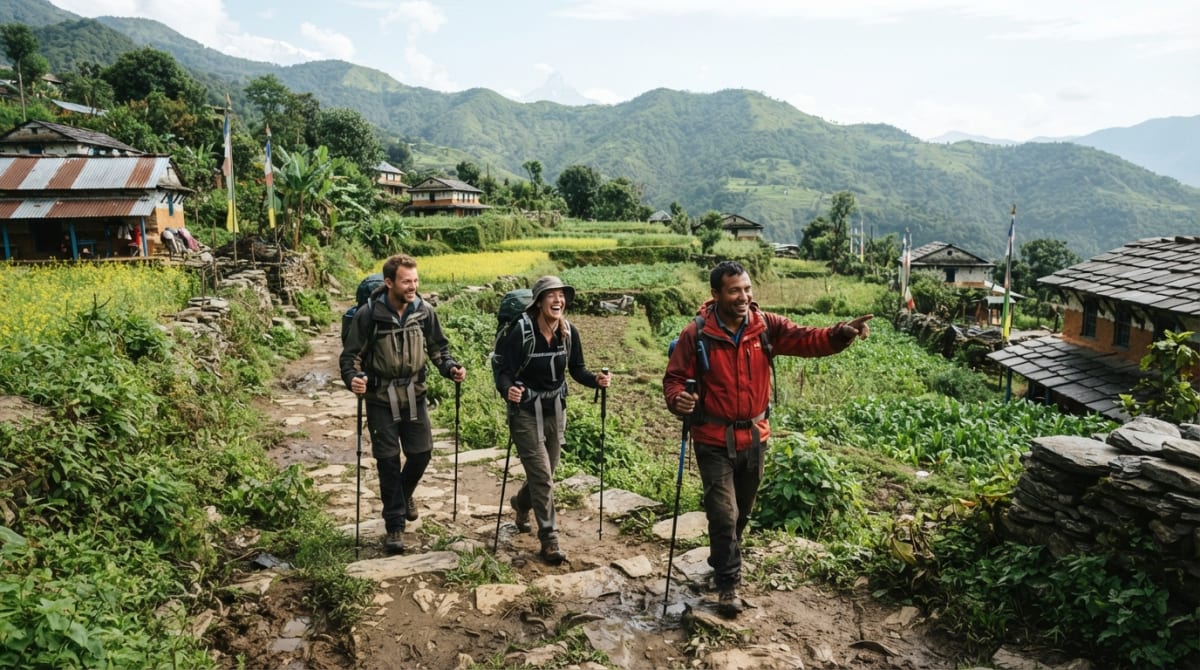
The day begins early with a pickup from your hotel in Pokhara and an hour's drive west along the Baglung highway to Kande. From the road, a stone staircase climbs steeply through farmland to Australian Camp, where you get your first wide view of the Annapurna range. The trail then drops briefly to Pothana, where your permits are checked, and continues through forest to Pitam Deurali, the usual first-night stop on longer itineraries. On the 3-day trek you keep going.
Above Pitam Deurali, the trail climbs steadily through dense rhododendron and oak forest, passing Forest Camp and Rest Camp before the trees thin out at Low Camp, around 2,970 meters. In total you gain more than 1,200 meters from Kande, which makes this one of the biggest climbing days on any Mardi Himal itinerary. Pace yourself from the first step, eat and drink regularly, and aim to arrive by late afternoon. Low Camp's reward is a sunset view of Machapuchare directly ahead. Read Kande to Pitam Deurali and Forest Camp to Low Camp for the details of each section.
Day 2: Low Camp to High Camp
Day two is shorter but higher. From Low Camp, the trail leaves the forest and climbs the open ridge, passing Badal Danda after about an hour and continuing along the narrowing crest to High Camp at 3,580 meters. The views are spectacular all the way, with Machapuchare, Mardi Himal and Annapurna South ahead and the deep Modi Khola valley falling away to the west. Most fit trekkers reach High Camp by late morning or early afternoon.
Use the rest of the day to recover and acclimatize. A short, slow walk up the ridge above the lodges in the afternoon helps your body adjust, then rest, eat well and drink plenty of water. You have gained around 2,700 meters in two days, so a mild headache is common. Tell your guide about any symptoms. Go to bed early, because day three starts before dawn. See our High Camp guide and Low Camp to High Camp.
Day 3: Base Camp, Siding and Back to Pokhara
The final day is the longest and hardest. You leave High Camp around 4 a.m. by headlamp and climb steeply to the Upper View Point, around 4,200 meters, in time for sunrise over the peaks. If conditions and your energy allow, you continue to Mardi Himal Base Camp at roughly 4,500 meters, then return to High Camp for a quick breakfast. From there, you descend the ridge to Badal Danda and drop steeply through forest and farmland to Siding, around 1,750 meters.
In total you descend around 2,700 meters in a single day, after climbing around 900 meters in the dark. Your legs will feel it. A jeep waits at Siding to drive you back to Pokhara, usually arriving in the evening. Many trekkers describe this as one of the hardest but most satisfying days of walking they have ever done. Read the High Camp to Base Camp guide and Badal Danda to Siding.
Who the 3-Day Itinerary Suits
The 3-day trek is best for fit, experienced walkers who are comfortable with long days, steep climbs and the effects of altitude. It works well for trekkers who have already been above 3,500 meters and know how their body responds, for trail runners and fast hikers, and for Nepal residents who know the region. It is also a good option if you are already acclimatized from another trek in the Annapurna region and want to add Mardi Himal on the way back to Pokhara.
It is less suitable for complete beginners, people who have had altitude sickness before, families with young children, and anyone who wants time to enjoy the forest and viewpoints at a relaxed pace. If you are unsure, the 5-day Mardi Himal Trek from Pokhara is a much gentler choice for only two extra days. Read how hard the 3-day trek is for more detail.
Altitude on a 3-Day Trek
The biggest concern with the 3-day itinerary is how fast it gains altitude. Standard mountain medicine advice suggests increasing your sleeping altitude by no more than 300 to 500 meters per night once above 3,000 meters. On this itinerary you sleep at around 2,970 meters on night one, having started the day at 822 meters in Pokhara, and at 3,580 meters on night two. That is quicker than ideal, although the maximum sleeping altitude is modest and you only visit 4,500 meters briefly before descending a long way.
In practice, most fit, healthy trekkers manage it with mild symptoms such as a headache or poor sleep at High Camp. The key is to be honest with your guide, walk slowly on the climbs, drink three to four liters a day and be willing to turn around at the Upper View Point if you feel unwell. Descending is the best treatment, and on this itinerary you descend a very long way on day three anyway. Read our altitude sickness guide.
How to Prepare for the Pace
Because the days are long and steep, preparation matters more on the 3-day trek than on any other version. Build up to hikes of seven or eight hours with over 1,000 meters of ascent, and practise long descents too, since day three is dominated by downhill walking. Stair training with a loaded daypack is excellent specific preparation, and back-to-back long hiking days will show you how your legs recover. Our training plan for the 3-day trek sets out a programme.
Pack light. On a three-day trek you need very little: one change of base layer, warm evening layers, a down jacket, a shell, a sleeping bag, a headlamp and basic toiletries. If you hire a porter, you can walk with only a daypack, which makes the long days far more comfortable. See our packing list for the 3-day trek.
Tea Houses and Food on a 3-Day Trek
On the 3-day itinerary you spend your two nights at Low Camp and High Camp, both of which have several simple lodges with twin rooms, shared toilets and a warm dining room. Because you arrive at Low Camp later in the day than on other itineraries, your guide will usually reserve rooms in advance during busy months, so you do not arrive to a full lodge after a long climb. Low Camp often offers hot showers for a fee; at High Camp showers are rarely practical in cold weather.
Eating well is essential on such demanding days. Start each day with a filling breakfast of porridge, eggs and bread, eat a proper lunch in the forest on day one, and choose carbohydrate-rich dinners such as dal bhat, which comes with free refills. Carry snacks from Pokhara, including nuts, chocolate and energy bars, to eat on the move. On day three, you will have a hot drink and a biscuit before leaving High Camp, snacks on the climb, and a proper breakfast after the Base Camp hike. See our tea house menu guide.
Should You Hire a Porter?
On the 3-day trek, a porter makes a bigger difference than on any other itinerary. Carrying a full pack up 1,200 meters on day one and down 2,700 meters on day three is exhausting, and it raises the strain on your knees and back. With a porter carrying your main bag, you walk with only a light daypack holding water, snacks, a warm layer and your camera, which lets you focus on pacing and enjoying the views. One porter normally carries for two trekkers, so the cost is modest when shared. Porters on our treks are fairly paid, insured and properly equipped. See carry your own pack or hire a porter?
Best Season for the 3-Day Trek
The 3-day itinerary works best when the days are long, the trail is dry and the weather is stable. Autumn, from late September to November, is ideal, with clear mornings for the Base Camp hike and firm paths for the long descent. Spring, from March to May, is also good, though afternoon cloud and storms in May make an early start on day three even more important. In winter, the short days and ice above High Camp make the final day risky; a longer itinerary is safer. In the monsoon, wet and slippery trails make the long descent hazardous and views are unreliable. See the best time for the trek.
Common Mistakes on the 3-Day Trek
The most common mistake is starting too fast on day one. The climb from Kande to Low Camp is long, and trekkers who race up the staircase often struggle in the forest later. Another mistake is not eating and drinking enough, which leaves you depleted before the hardest day. On day three, some trekkers push to Base Camp despite worsening altitude symptoms or fatigue, then find the long descent to Siding very difficult. Turning around at the Upper View Point is a perfectly good choice on this itinerary.
Finally, some trekkers underestimate the descent. Dropping 2,700 meters in a day is punishing on the knees and thighs, and fatigue raises the risk of slips on the steep forest trail. Use trekking poles, take regular short breaks and do not rush the final hours before Siding. Read coming down from Base Camp.
3 Days vs 5 Days: Is It Worth the Extra Time?
If you can spare two more days, the 5-day itinerary is a noticeably better experience for most people. It adds a night at Pitam Deurali before Low Camp and returns to Low Camp after the Base Camp hike, which means shorter days, better acclimatization and a more relaxed descent. You have more time to enjoy sunsets and sunrises, and more margin for bad weather. The 3-day trek gives you the essentials: the forest, the ridge, High Camp and Base Camp. The 5-day trek gives you time to savour them. Compare the 5-day itinerary and our guide on how many days you need.
Book the 3-Day Short Mardi Himal Trek
Our Short Mardi Himal Trek includes private transport between Pokhara, Kande and Siding, ACAP and TIMS permits, a licensed English-speaking guide, tea house accommodation and three meals a day on the trail. Porters are available as an add-on. Our guides know this fast itinerary well and will set a pace that gets you to Base Camp safely and back to Pokhara in time for a well-earned dinner. Contact us to check dates or talk through whether the 3-day version is right for you.