

For many trekkers, the most memorable view of the Annapurnas is not from Base Camp or the Upper View Point, but from the sky above Pokhara. Tandem paragliding from the hill of Sarangkot is one of Nepal's most popular adventure activities, and on a clear day it gives you a bird's-eye panorama of Phewa Lake, the city, the green foothills and, rising above it all, Machapuchare and the peaks you have just walked beneath. Combining the Mardi Himal Trek with a paragliding flight is an easy, exhilarating way to round off your trip.
This guide explains what tandem paragliding in Pokhara involves, when to fly, how to choose an operator, and how to fit a flight into your Mardi Himal itinerary. For the trek itself, see the 5-day Mardi Himal Trek from Pokhara.
Why Pokhara Is Famous for Paragliding
Pokhara has a combination of features that make it one of the world's best places for paragliding. Sarangkot, a hill rising above the northern shore of Phewa Lake, provides an excellent launch site. The valley's thermals, rising currents of warm air, allow gliders to stay aloft and soar for extended periods. The lake offers a spectacular landing area and backdrop. And the Annapurna range, including Machapuchare, forms an unforgettable horizon on clear days. Birds of prey often share the thermals with paragliders, and some pilots describe flying alongside them as one of the most magical experiences in the sport.
What a Tandem Flight Is Like
A tandem flight begins with a drive up to the launch site at Sarangkot, where your pilot briefs you, fits your harness and helmet, and explains what to do during take-off and landing. When conditions are right, you run a few steps down the slope with your pilot behind you, the wing fills with air, and suddenly your feet leave the ground. Within moments you are floating high above the terraced hillsides, with the lake shimmering below and the mountains filling the horizon.
The flight itself is surprisingly calm. You sit in a comfortable harness while your pilot steers, riding thermals to gain height and circling over the valley. Some pilots offer gentle aerobatics on request, but you can ask for a smooth, scenic flight if you prefer. After around 20 to 30 minutes, you descend toward a landing field near the lake, landing with a few gentle steps or sliding onto your seat. Many operators offer photos and videos of your flight.
When to Fly
The paragliding season in Pokhara runs from roughly October to May. Autumn, especially October and November, offers the clearest mountain views and stable conditions. Winter flights are often clear in the mornings, though some days are hazy. Spring brings good thermals but more haze, with mountain views clearest early in the day. During the monsoon, from June to September, rain and cloud limit flying, and many operators pause or reduce flights. Mornings usually offer the clearest views, while midday can bring stronger thermals and longer flights.
These seasons align closely with the best trekking seasons, making it easy to combine a flight with Mardi Himal. See the best time for the trek.
Fitting a Flight into Your Itinerary
The easiest way to include paragliding is to book a flight on the day after you return from the trek. After descending to Siding and driving back to Pokhara, spend the night recovering, then fly the next morning. Your legs will appreciate a day off walking, and the flight lets you see the ridge you walked from a completely different perspective. Alternatively, you can fly the day before the trek, if you arrive in Pokhara with a spare day, though flying after the trek means you are not worried about getting injured before you start.
Our 10-day itinerary includes a free day in Pokhara that is perfect for paragliding, and any itinerary can be extended by a day for a flight.
A Different View of the Mardi Himal Ridge
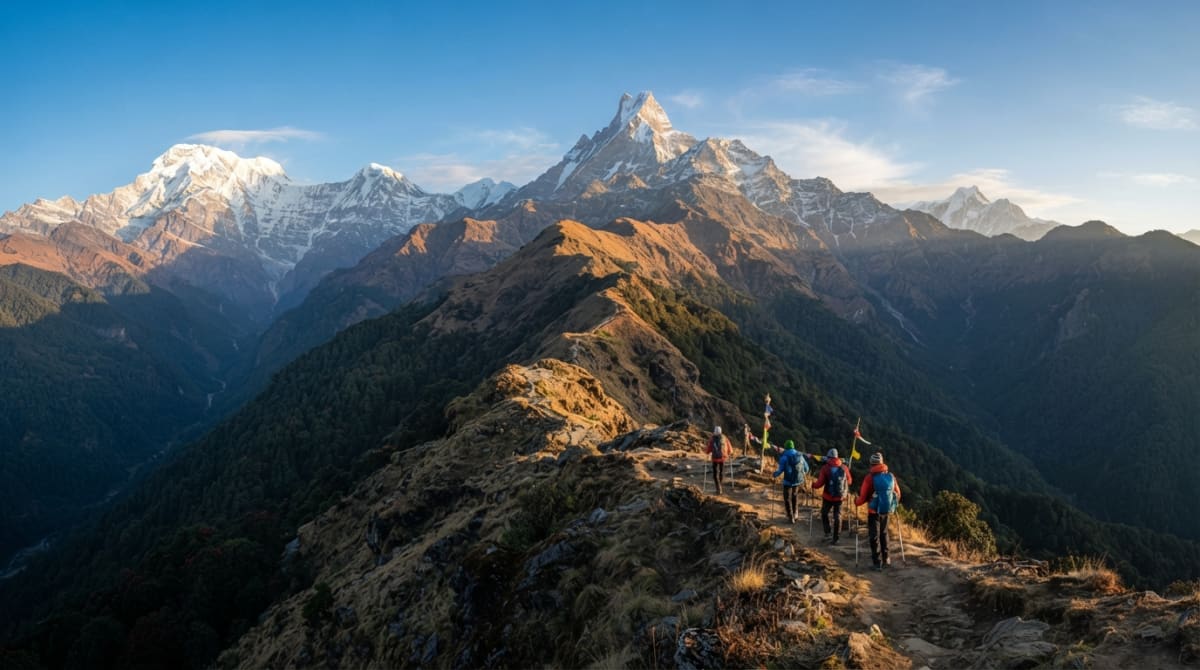
One of the most satisfying parts of flying after the trek is recognising the landscape you walked through. From the air above Sarangkot on a clear morning, you can look north across the green foothills toward the ridge that climbs to Mardi Himal, with Machapuchare towering at its head. The forests you walked through appear as dark green bands on the hillsides, and the snow-covered peaks look astonishingly close. It is a new perspective on a journey you have just completed, and many trekkers say it helped them understand the geography of the region in a way that walking alone did not.
Even if you cannot pick out the exact trail, the sense of scale is overwhelming. Seeing how the foothills rise toward the high peaks, and how Pokhara sits at their feet, puts the whole trek into context.
Sarangkot: More Than a Launch Site
Sarangkot, the hill from which most flights launch, is worth visiting in its own right. It is one of Pokhara's most popular sunrise viewpoints, with a panorama that on clear mornings includes Dhaulagiri, the Annapurna range and Machapuchare above the valley. Many visitors drive up before dawn to watch the sunrise and then stay on for a paragliding flight later in the morning. The village of Sarangkot has small guesthouses and cafés, and walking trails lead down through the hillside to the lakeshore. If your flight is in the morning, arriving early for sunrise makes a memorable double experience.
Fitness and Health Requirements
Tandem paragliding does not require special fitness, but you need to be able to run a few steps on the launch slope and follow your pilot's instructions. Operators usually have weight limits for safety, so check these when booking. People with certain medical conditions, such as serious heart problems, recent injuries or back problems, and pregnant women should not fly. If you are prone to motion sickness, ask your pilot for a gentle flight without spirals and avoid a heavy meal beforehand. After the trek, tired legs are not usually a problem, since the flight itself is seated.
What to Wear and Bring
Wear comfortable clothes suitable for the weather, with a light jacket or fleece, as it can be cooler at altitude and in the wind. Closed shoes with good grip are important for take-off and landing; trekking shoes or trainers are ideal. Sunglasses and sunscreen are useful. Secure anything in your pockets, and leave large bags at your hotel. Most operators provide a helmet and harness. If you want to film your own flight, ask your operator about secure mounts for cameras or phones.
Weather and Cancellations
Paragliding depends on the weather. Pilots need suitable wind, stable conditions and good visibility, so flights may be delayed or cancelled when it is too windy, rainy or cloudy. Responsible operators will not fly in unsafe conditions, even if that means disappointing customers. To give yourself the best chance, book your flight early in your stay in Pokhara, ideally with a spare day available in case of cancellation. Mornings are usually the best time for clear views.
Other Air Adventures in Pokhara
Paragliding is not the only way to see the Himalaya from the air in Pokhara. Ultralight aircraft flights take off from near the airport and fly close to the foothills, with views of the Annapurnas and Machapuchare. Scenic mountain flights and helicopter tours are also offered from Pokhara and Kathmandu at higher cost. Each gives a different perspective; paragliding offers the most immersive, open-air experience at a reasonable price.
Paragliding for Families and Older Travellers
Many operators fly with teenagers and older adults, subject to weight limits, health and consent. Families often enjoy flying one after another, meeting at the landing site by the lake. Older travellers who are fit enough to trek Mardi Himal are usually fine for a tandem flight, though anyone with health concerns should check with their doctor and discuss it with the operator.
Choosing an Operator
There are many paragliding companies in Pokhara, and quality varies. Choose an established operator with licensed, experienced pilots, well-maintained equipment and a good safety record. Check reviews, ask about pilot qualifications and experience, and confirm what the price includes, such as transport to the launch site, photos and videos, and insurance. Avoid operators who pressure you to fly in poor conditions. Your agency can recommend reputable companies.
Photos and Videos
Most operators offer photos and videos of your flight, usually shot with a camera mounted on a pole held by the pilot. These typically cost extra but capture the take-off, the views and your reactions, making a great souvenir alongside your trekking photos. If you prefer to use your own phone or camera, ask your pilot whether it is allowed and how to secure it. Hold on tight: dropping a phone from hundreds of meters above Phewa Lake is not a good way to end a trip.
Cost and What Is Included
Prices for tandem paragliding in Pokhara vary by operator, flight length and season. A standard flight usually includes pickup from your hotel in Lakeside, transport to the launch site at Sarangkot, the flight with a licensed pilot, equipment and a transfer back from the landing site. Photos, videos and longer cross-country flights generally cost extra. Compare what is included rather than choosing solely on price, as safety and pilot experience matter more than saving a small amount.
Combining with Other Pokhara Activities
A paragliding flight usually takes a few hours including transport, leaving the rest of the day free. You might combine it with a boat ride on Phewa Lake, a walk to the World Peace Pagoda, a visit to the International Mountain Museum, or a relaxing massage to ease your trekking legs. Some travellers pair a morning flight with an afternoon of zip-lining or other adventure activities, while others prefer a lazy lakeside lunch. See things to do in Pokhara and the International Mountain Museum.
What Trekkers Say About Flying
Trekkers who fly after Mardi Himal often describe it as a perfect contrast to the trek. On the trail, every meter of height is earned with effort; in the air, you gain height effortlessly, carried by rising warm air. On the ridge, the mountains feel close and personal; from the sky above Sarangkot, you see the whole range at once. Many say the flight gave them a new appreciation for how far they walked and how high they climbed. For some, the quiet moments soaring with birds of prey were as memorable as sunrise at Base Camp.
Before or After the Trek?
Most trekkers choose to fly after Mardi Himal, and there are good reasons for this. You avoid any risk of a minor injury, such as a twisted ankle on landing, affecting your trek. You also get to see the ridge you walked from above, which makes the flight more meaningful. And after days of walking, a seated activity with spectacular views is a welcome change. On the other hand, flying before the trek can be a good use of a spare day if you arrive early in Pokhara, and it builds excitement for the mountains ahead. If the weather cancels your pre-trek flight, you may be able to reschedule after the trek. Whichever you choose, keep a little flexibility in your plans.
Safety and Insurance
Tandem paragliding with a reputable operator in suitable weather has a good safety record, but like any adventure sport it carries some risk. Listen carefully to your pilot's briefing and follow instructions during take-off and landing. Flights may be delayed or cancelled if the weather is unsuitable; this is a sign of a responsible operator. Check whether your travel insurance covers paragliding, as many policies treat it as an adventure activity requiring extra cover. See our travel insurance guide.
Book Your Trek and Flight
We can arrange a tandem paragliding flight with a reputable Pokhara operator as part of your Mardi Himal trip. Start with the 5-day Mardi Himal Trek from Pokhara or the 9-day trek from Kathmandu, and contact us to add a flight. For more ideas, see things to do in Pokhara after the trek.