

On the longer Mardi Himal itineraries, summit day ends not with a race down the mountain but with a quiet evening at Badal Danda, a small cluster of lodges on the ridge between High Camp and Low Camp. The next morning, you wake rested, often to one last clear view of Machapuchare and the Annapurnas, and begin the final descent. By the afternoon, you have walked from the high ridge through deep forest into the terraced fields of Siding village, and a jeep is waiting to take you back to Pokhara.
This guide covers the last trekking day of the 9-day Mardi Himal Trek from Kathmandu and the 7-day trek for trekkers who fly directly into Pokhara: the route, timings, terrain, where to stop, and how to make the most of your final hours on the trail. For the lodge at the start of the day, see Badal Danda.
The Day at a Glance
| Section | Typical time | Altitude |
|---|---|---|
| Badal Danda to Low Camp | About 1 hour | About 3,210 m → about 2,970 m |
| Low Camp to the forest's lower edge | 2.5–3 hours | About 2,970 m → about 2,200 m |
| Forest edge to Siding | 1.5–2 hours | About 2,200 m → around 1,750 m |
| Siding to Pokhara by jeep | 2–3 hours | Road journey to 822 m |
In total, expect five to six hours on foot with breaks and lunch, followed by the drive. It is a long day, but after the summit hike it feels manageable, especially since your body is recovering fast at lower altitude.
Morning at Badal Danda
One of the pleasures of sleeping at Badal Danda is the morning view. With no pre-dawn alarm, you can step out of the lodge as the sun rises and watch the light spread over Machapuchare, Mardi Himal and Annapurna South, the peaks you stood beneath the previous morning. On many days, the valleys below are filled with a sea of cloud, and the ridge feels like an island. Take your time over breakfast, pack your bag, settle up any lodge extras, and set off around 7:30 or 8 a.m. See the sea of clouds on Mardi Himal.
Badal Danda to Low Camp
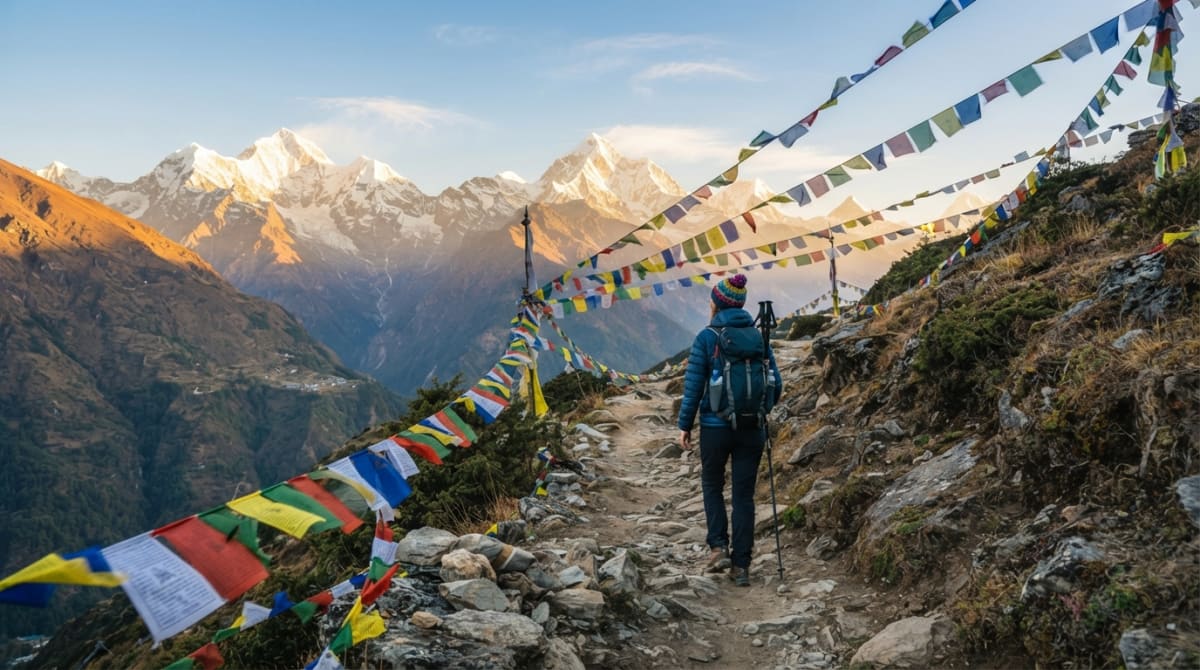
The first hour follows the crest of the ridge south to Low Camp. It is a gentle, pleasant walk, mostly downhill, through grass and dwarf rhododendron, with the peaks behind you and the green hills around Pokhara ahead. This is the last stretch of open ridge on the trek, so turn around often for a final look at the mountains. At Low Camp, around 2,970 meters, most groups pause for tea and a snack before the long descent begins. See Low Camp.
Into the Forest
From Low Camp, the trail to Siding leaves the main ridge and drops east into the forest. The change is immediate. The open views give way to a world of gnarled rhododendron and oak trees, their branches thick with moss and ferns, and the air becomes cool, damp and quiet. In spring, from March to April, the rhododendrons bloom in red, pink and white, and the forest floor is scattered with fallen petals. In autumn, the light filters through golden leaves. Listen for the calls of laughing thrushes and the rustle of langur monkeys moving through the canopy.
The trail here is steep. It descends on rough stone steps, roots and earth, sometimes zigzagging and sometimes plunging straight down. After rain, it can be muddy and slippery, and in the monsoon, leeches appear in the lower forest. Take your time, use your poles, and let your guide set the pace. See the rhododendron forest section and oak, bamboo and moss forests.
Bamboo, Streams and Clearings
Lower down, the forest opens and changes character. Patches of bamboo appear, small streams cross the trail, and occasional clearings give views across the valley of the Mardi Khola to the terraced hillsides opposite. You may pass herders' shelters or small seasonal tea stalls. This middle section is a good place for a short break and a drink before the final descent. As you lose height, the temperature rises noticeably, and you will probably want to shed a layer or two. See the Modi and Mardi Khola valleys.
Farmland and the Approach to Siding
The last part of the descent leaves the forest behind and enters farmland. The trail winds between terraced fields of millet, maize and rice, depending on the season, and past scattered farmhouses with stone walls, slate or tin roofs, and vegetable gardens. Buffaloes graze by the path, chickens scatter at your feet, and children often call out a cheerful "namaste." After days in the mountains, this return to village life feels warm and welcoming. It is a good reminder that the trek passes through a lived-in landscape. See farming and village life below Mardi Himal.
Siding Village
Siding is a traditional farming village at around 1,750 meters, where the trail meets the road. It has a few simple tea houses and lodges, and most groups stop here for lunch, usually dal bhat, noodles or fried rice, before the jeep ride. Take a moment to look back up at the ridge you walked down; from the village, it is hard to believe you were near Base Camp only a day earlier. If you are lucky with the weather, the tip of Machapuchare may still be visible above the forest. See the Siding village guide.
The Jeep Back to Pokhara
After lunch, you board a jeep for the drive back to Pokhara. The road from Siding is a rough, unpaved rural road that winds down through villages and terraced hillsides toward Lumre, where it meets a better road into the city. The drive usually takes two to three hours, depending on the season and the state of the road. It is bumpy and dusty in the dry months, and it can be muddy or slow after heavy rain. Your guide arranges the vehicle in advance, so it is ready when you arrive. You normally reach Pokhara in the late afternoon, in time for a hot shower and a celebratory dinner by Phewa Lake. See the Siding to Pokhara jeep.
How Hard Is the Day?
Badal Danda to Siding is not technical, and it does not involve altitude challenges, since you descend steadily into thicker air. Its difficulty lies in the length and steepness of the descent. Losing around 1,450 meters, most of it in the forest below Low Camp, is hard work for the thighs and knees, particularly the day after the summit hike. Most trekkers feel it in their legs by the time they reach Siding, and many are stiff the next day. The good news is that energy levels are usually high, as appetite and sleep have returned and the air feels rich after the high ridge. See Mardi Himal difficulty by section.
Tips for the Final Day
- Use two trekking poles and lengthen them slightly for the descent.
- Lace your boots firmly so your toes do not jam into the front of your boots.
- Dress in layers; you start cool on the ridge and finish warm in the valley.
- Carry water and snacks; there are few reliable stops in the forest.
- Keep rain gear handy, as afternoon showers are common in some seasons.
- Check for leeches in the monsoon, especially in the lower forest.
- Keep your camera out for the forest, the farmland and the village scenes.
- Keep small change for drinks or snacks in Siding.
See trekking with knee problems and leeches on Mardi Himal.
If the Weather Turns
Afternoon cloud and showers are common on the lower slopes, particularly in spring and the monsoon, and the forest below Low Camp can become very slippery once rain has soaked the steps and roots. If rain is forecast, set off a little earlier so you reach the farmland before the worst of it, and keep your rain jacket and pack cover at the top of your bag. Waterproof trousers or gaiters keep mud off your legs. Heavy rain can also affect the jeep road from Siding, and occasionally a landslide or deep mud means the vehicle has to meet you further down the valley, adding a short walk on the road. Your guide stays in touch with the driver and will adjust the plan if needed. In rare cases, when the Siding trail is unsafe, the group may descend via Forest Camp instead. See weather safety on the Mardi Himal ridge and landslides and trail hazards.
Porters and Luggage on the Last Day
If you trek with a porter, your main bag travels with them, and they usually walk at their own pace, often reaching Siding before you. Keep everything you need for the day in your daypack: water, snacks, rain gear, a warm layer, sunscreen, your camera, cash, and any medication. When you reach the village, check that all your bags are loaded into the jeep before you leave. If you left extra luggage at your hotel in Pokhara before the trek, you can collect it on arrival that evening. See porter duffel bags and weight limits and choosing a daypack.
Seasonal Differences
Autumn (September–November) brings clear mornings, dry trails and harvest scenes in the fields, with golden rice terraces in September and October. Spring (March–May) is rhododendron season, when the forest below Low Camp is at its most colorful, though afternoons can be hazy. Winter (December–February) is dry and clear, with cold mornings on the ridge and pleasant temperatures lower down. Monsoon (June–August) brings lush green scenery and planted paddy fields, but also mud, leeches and a slower, messier descent, and the jeep road can be affected by landslides. See the best time for the Mardi Himal Trek.
Why Descend via Siding?
Many trekkers ask why the route does not simply return the way it came. The answer is variety. Descending via Siding turns the trek into a loop, taking you through different forest and into a traditional village that you would otherwise never see, rather than retracing your steps through Forest Camp and Pitam Deurali. It is also a more direct route down from the upper ridge to the road. On occasion, when the Siding trail is very muddy or the road is blocked, your guide may choose to descend via Forest Camp instead. See the map and route guide and trekking Mardi Himal in reverse.
Supporting the Communities You Pass
The last day is a good opportunity to put a little money into the local economy. Buying lunch or drinks in Siding, rather than eating only snacks from Pokhara, supports the families who run the tea houses. Ask before photographing people, especially inside homes or at close range, and keep to the path through the fields to avoid damaging crops. Carry your rubbish out with you; the villages have limited waste facilities. See how your trek supports local communities.
Tipping and Saying Goodbye
The last trekking day is also when many groups say goodbye to their porters and sometimes their guide, as the team may return home from Pokhara the next day. It is customary to tip your guide and porters at the end of the trek, often over dinner in Pokhara or at the jeep in Siding. There is no fixed rule, but tips are an important part of trekking crew income, and a small ceremony of thanks is always appreciated. See tipping on the Mardi Himal Trek.
After the Trek
Back in Pokhara, take time to rest and enjoy the city. A boat on Phewa Lake, a massage, a paragliding flight or a visit to the International Mountain Museum all make good recovery activities. On the 9-day itinerary, you return to Kathmandu the following day, while on the 7-day itinerary, you have time in Pokhara before your international flight. See things to do in Pokhara after the trek and recovery after Mardi Himal.
Walk the Full Mardi Himal Loop with Us
The Badal Danda to Siding descent is the final chapter of our longer Mardi Himal itineraries. To walk the full loop, from Kande and Forest Camp up to Base Camp and down through Siding, see the 9-day Mardi Himal Trek or, if you are flying directly into Pokhara, the 7-day trek. Contact us to plan your dates.