

Mardi Himal Base Camp is the goal of every Mardi Himal trek. At roughly 4,500 meters, it sits at the head of the long ridge you have been following for days, beneath the steep flanks of Mardi Himal and in the shadow of Machapuchare. Reaching it means an early start, a steep climb in thin air and a cold wait for the sun. It also means some of the finest mountain views in the Annapurna region, with glaciers and summits so close they seem to lean over you.
This guide explains everything you need to know about visiting Mardi Himal Base Camp: where it is, how the hike works, when to go, what you will see, how to stay safe, and what to bring. For the whole trek in context, see our day-by-day itinerary.
Where Is Mardi Himal Base Camp?
Base Camp lies at the northern end of the Mardi Himal ridge, above High Camp and beyond the Upper View Point. It is not a village or a lodge but an open area of grass, rock and, in winter, snow, marked by prayer flags and sometimes a signboard. From here, the ground rises steeply toward Mardi Himal's summit, and climbers heading for the peak continue beyond it. For trekkers, Base Camp is the end of the route.
Base Camp Altitude
You will see different figures quoted for Base Camp's altitude, usually around 4,500 meters. The difference comes from which exact spot is measured and the source of the data. Whichever figure you use, it is high enough to feel the effects of altitude, with noticeably thin air and breathlessness on any climb. You do not sleep at this altitude, which keeps the risk of altitude sickness manageable. Read how high Mardi Himal Base Camp is.
The Hike from High Camp
The Base Camp hike starts at High Camp (3,580 m) and gains around 900 meters. Most groups leave between 4 and 5 a.m. to reach the viewpoints before cloud builds. The route has three main sections:
- High Camp to the Upper View Point: a steep climb up a grassy ridge, often frosty in the early morning, taking around two to two and a half hours. This is the hardest section.
- Upper View Point to Base Camp: a more gradual traverse across open slopes, with some ups and downs, taking about an hour to an hour and a half.
- The return: retracing your steps to High Camp in two to three hours, often faster once the sun softens the ground.
Our detailed guide to the High Camp to Base Camp hike covers pacing and route details.
The Upper View Point vs Base Camp
Many trekkers stop at the Upper View Point, around 4,200 meters, to watch sunrise, then decide whether to continue to Base Camp. The viewpoint offers a superb panorama and is a worthy destination in itself, especially if time, weather or energy are limited. Base Camp adds closer views of Mardi Himal and the glacier-hung faces above, and a stronger sense of arrival. See Upper View Point vs Base Camp.
What You Will See
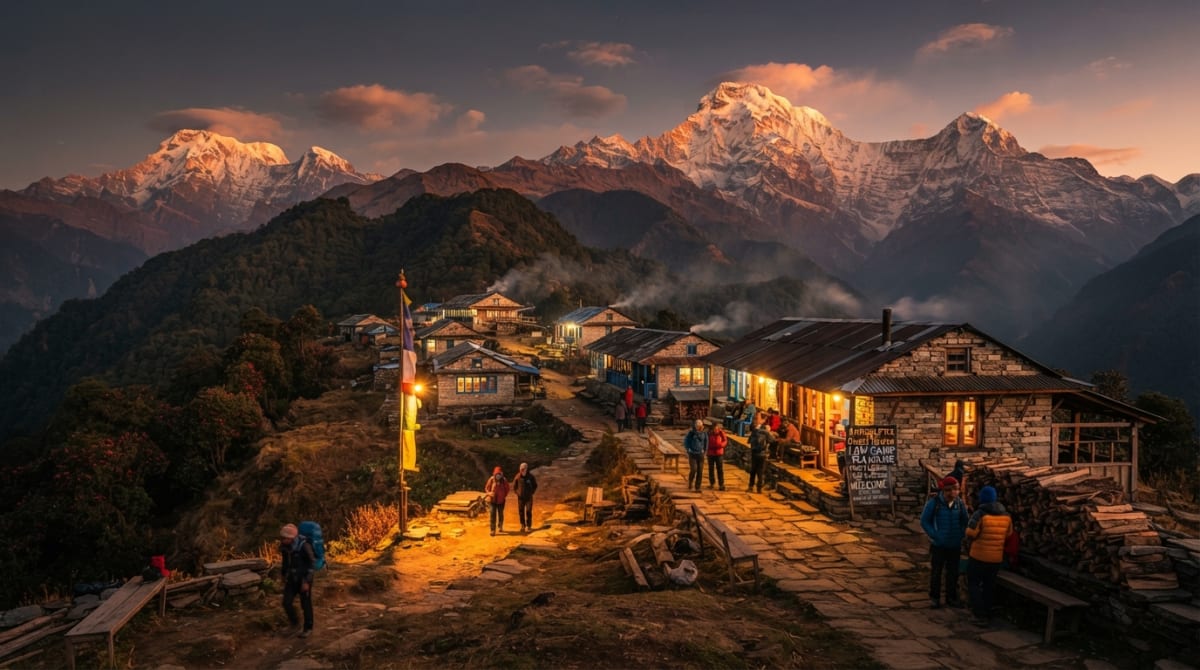
On a clear morning, the view from Base Camp is overwhelming. Machapuchare, 6,993 meters, towers to the right, its sharp summit ridge now clearly revealing its twin "fishtail" shape. Mardi Himal rises steeply ahead. To the west, Annapurna South and Hiunchuli form a wall of snow and ice. Below and around you, glaciers, moraines and deep valleys drop away. Behind you, the ridge you have climbed stretches south toward Pokhara, often above a sea of cloud. Read the mountains you see from Mardi Himal.
When to Go
The best time to reach Base Camp is early morning. In most seasons, clouds build from late morning, often hiding the peaks by midday. Leaving High Camp before dawn lets you watch sunrise from the Upper View Point or on the way, then continue to Base Camp in clear morning light. Seasonally, autumn and winter bring the clearest mornings, spring offers good early views with more haze, and the monsoon is unreliable. See the best time for the trek.
Weather and Conditions
Conditions at Base Camp can be harsh. Temperatures at dawn are usually below freezing for most of the year, and wind on the exposed ridge makes it feel much colder. In winter and after late storms, snow and ice can cover the route, especially the steep slope above High Camp. Visibility can change quickly as clouds move up from the valleys. Always carry warm layers and be ready to turn back if conditions deteriorate. See wind chill and cold at Base Camp.
Safety at Base Camp
The Base Camp hike is non-technical in normal conditions, but its combination of altitude, steep ground, darkness and cold means it deserves respect. Follow your guide's pace, use trekking poles, and carry microspikes in winter. Watch for signs of altitude sickness: a worsening headache, nausea, dizziness or confusion mean you should descend. Do not wander off the main route near Base Camp, where steep slopes and loose ground lie close by. Read hiking to Base Camp in the dark and when to turn back.
Why Base Camp Is Worth the Effort
After several days of climbing, some trekkers wonder whether the pre-dawn hike is really necessary when the views from High Camp are already so good. The answer is almost always yes. From High Camp, the peaks are impressive but still at a distance; from Base Camp, you stand among them. You see the structure of the mountains: hanging glaciers, rock buttresses, the knife-edge ridges linking summit to summit. You feel the scale of Machapuchare in a way that is impossible from lower down. And the experience of climbing through the dawn, watching the light change, adds a sense of achievement that stays with you long after the trek.
That said, reaching Base Camp is not the only measure of success. The Upper View Point offers a magnificent panorama, and turning around there because of weather, altitude or tiredness is a sensible decision, not a failure.
A Sunrise Timeline
A typical autumn summit morning unfolds something like this. Around 4:30 a.m., you leave High Camp by headlamp, the stars bright overhead and the air well below freezing. By 5:30, the sky behind you begins to pale, and the outlines of the peaks appear as dark shapes against a slowly lightening sky. Around sunrise, the first light touches the highest summits, turning them pink and then gold, while the valleys below remain in deep shadow. This is when most trekkers pause at or near the Upper View Point to watch.
Within half an hour, the light spreads down the mountain faces and across the ridge, and you feel the first warmth of the sun. You continue toward Base Camp in bright, clear morning light, arriving mid-morning with the peaks in full view. By late morning, the first clouds may begin to rise from the valleys, which is the signal to start the descent.
Altitude and Your Body at 4,500 Meters
At Base Camp, each breath contains a little over half the oxygen available at sea level. Everyone feels this: breathing is heavy, walking uphill is slow, and even small efforts leave you panting. Many trekkers feel a mild headache at the top, and some feel light-headed or unusually tired. These sensations usually ease quickly once you start descending.
The key is to move slowly and steadily, drink water, eat a snack, and pay attention to how you feel. A severe headache, nausea, confusion or loss of coordination are signs to descend immediately. Because you spend only a short time at this altitude and sleep much lower, the risk of serious altitude illness is low for most trekkers who have followed a sensible itinerary. Read our altitude sickness guide.
How Fit Do You Need to Be?
The Base Camp hike is the most demanding part of the trek. It combines around 900 meters of climbing at high altitude with an early start, cold temperatures and a descent of the same height. For many trekkers, the total day, including the return to High Camp and then a further descent to Low Camp or Badal Danda, lasts seven to nine hours.
If you have trained well and walked the previous days without difficulty, you should manage it. Walking slowly, resting briefly but often, and eating and drinking along the way make a big difference. If you are struggling badly on the climb to the Upper View Point, it may be wise to stop there. See our fitness guide.
Base Camp Through the Seasons
Autumn: the most reliable season for clear views, with cold but usually calm mornings and dry ground. Busy at the viewpoints in October.
Winter: often crystal clear, with heavy snow on the peaks. The route can be icy and the cold intense, so microspikes and warm gear are essential, and turnaround decisions are more common.
Spring: clear early mornings, with haze and cloud building sooner. Late snow is possible in March. Milder temperatures make the wait for sunrise more comfortable.
Monsoon: views are unreliable, the trail is wet and the grass slippery. Occasional clear dawns can be spectacular.
Photography at Base Camp
Base Camp offers dramatic compositions: Machapuchare's summit ridge, the steep face of Mardi Himal, and trekkers or prayer flags in the foreground for scale. A wide-angle lens captures the sweep of the peaks, while a telephoto isolates details such as ice cliffs and the fishtail summit. Shoot early, when light is warm and air clear. Keep batteries warm in an inside pocket, as the cold drains them quickly. Read our photography guide.
The Descent After Base Camp
The descent from Base Camp to High Camp is faster than the climb but hard on the knees, and the steep grassy slope below the Upper View Point can be slippery when frozen early in the morning or muddy once the sun has softened it. Use trekking poles and take your time. After a late breakfast at High Camp, most itineraries continue down to Badal Danda or Low Camp for the night, making it a long day. Read coming down from Base Camp.
Respecting Base Camp
Base Camp is a fragile alpine environment and, for many local people, a place close to sacred mountains. Carry out all rubbish, including food wrappers and tissues. Do not add to the litter of old prayer flags or leave stones and markers. If you need a toilet, go well away from the trail and carry out paper. Keep noise down so that everyone can enjoy the silence of the mountains. See Leave No Trace on the Mardi Himal Trail.
What to Bring
- Headlamp with fresh batteries
- Down jacket, fleece, base layers and windproof shell
- Warm hat, buff and insulated gloves
- Water, ideally hot, in an insulated bottle
- Snacks such as nuts, chocolate or energy bars
- Sunglasses and sunscreen for the descent
- Camera and spare batteries kept warm
- Trekking poles, plus microspikes in winter
See what to wear on summit day.
Common Mistakes on the Base Camp Day
- Starting too fast. The steep first section punishes a rushed pace; go slowly from the start.
- Not enough warm layers. The wait for sunrise is the coldest part of the whole trek.
- Forgetting water and snacks. There are no lodges above High Camp.
- A weak headlamp. Bring a bright one and spare batteries.
- Staying too long at the top. Clouds often roll in by late morning, and a long descent still lies ahead.
- Ignoring your guide's turnaround call. Guides watch the weather, the ground and your condition; if they suggest turning back at the Upper View Point, there is a good reason.
- Rushing the descent. Many slips happen on the way down, when legs are tired and the frozen grass has turned to mud.
Plan Your Visit
Every one of our Mardi Himal itineraries includes the Base Camp hike, with a night at High Camp beforehand. The 5-day trek from Pokhara and the 9-day trek from Kathmandu both give you the best chance of a clear morning at Base Camp. Contact us to plan your trek.