

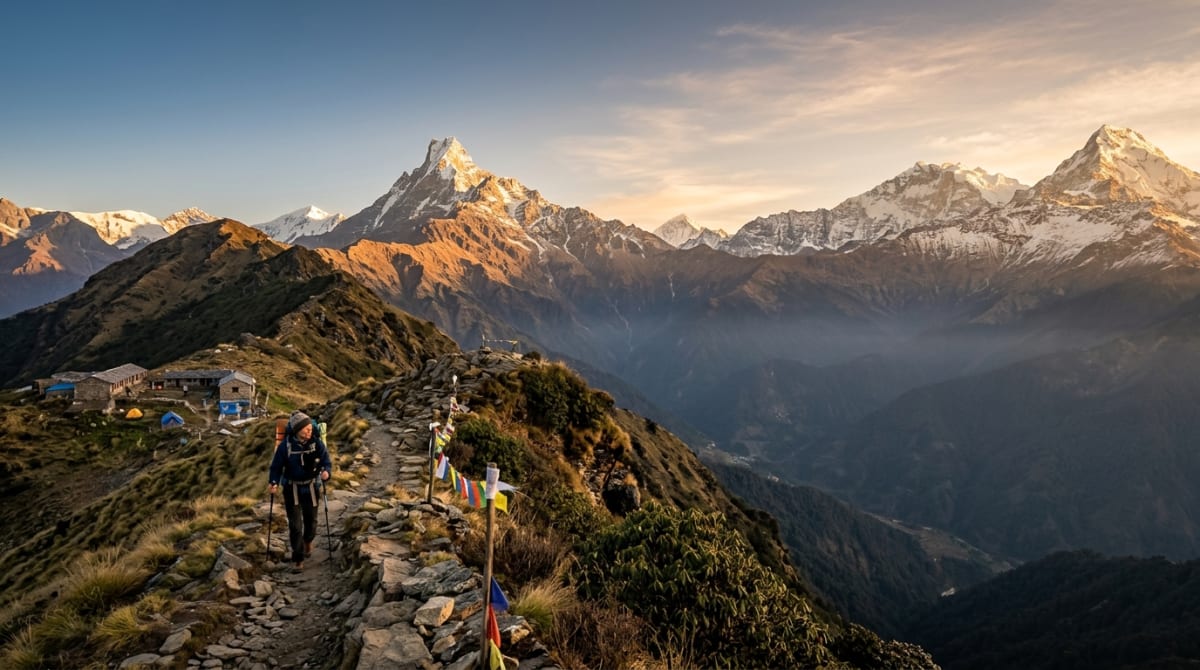
For most trekkers, the Mardi Himal adventure begins at an unassuming roadside settlement called Kande. There is no grand gateway, just a handful of shops and houses beside the Pokhara–Baglung highway, a sign pointing uphill, and a stone staircase disappearing into the terraces. Within an hour of leaving your jeep, you will be standing on a grassy ridge with the Annapurna range spread across the horizon. Kande is where the city falls away and the trek truly starts.
This guide explains everything about Kande as a trailhead: how to get there, what it is like, what to expect on the first climb, and practical tips for day one. For the complete route, see the Mardi Himal map and route guide, and for a full package including transport, see the 5-day Mardi Himal Trek from Pokhara.
Where Kande Is
Kande sits at around 1,770 meters on the highway that runs west from Pokhara toward Baglung and Beni. The road climbs out of the Pokhara valley past Hemja and Phedi, winding up through green hills and villages, and Kande appears on a shoulder of the ridge where the trail begins. Because it is directly on the road, it is the easiest and most accessible starting point for the Mardi Himal Trek, and it puts you onto the ridge quickly.
Getting to Kande
The drive from Pokhara's Lakeside to Kande usually takes about an hour, depending on traffic leaving the city. Most organised treks, including ours, include a private jeep that picks you up from your hotel and drops you at the start of the trail. Taxis from Lakeside also make the trip for a negotiated fare. Local buses toward Baglung leave from the Baglung bus park in Pokhara and pass Kande; they are cheap but slower and often crowded, and there is limited space for large bags. Tell the conductor you want to get off at Kande. See Pokhara to Kande: bus, taxi and private jeep.
What You Find at Kande
Kande is small. Along the road you will find a few shops selling water, snacks and basic supplies, tea stalls, and a couple of simple lodges. It is a good place to buy a last bottle of water or a packet of biscuits, but do not rely on it for anything important; buy your snacks and supplies in Pokhara, where the choice is better and prices lower. There are no ATMs, so withdraw cash in Pokhara before you leave.
The First Climb: Kande to Australian Camp
From the road, the trail climbs steeply up a stone staircase through terraced fields, small farmhouses and patches of forest. You gain around 300 meters in about an hour to an hour and a half, reaching Australian Camp at around 2,060 meters. The steps are uneven, and on a warm morning you will quickly break a sweat. Start slowly, find a steady rhythm and take short breaks. Many trekkers make the mistake of racing up the stairs in their excitement and tiring themselves for the rest of the day. See Australian Camp on the Mardi Himal Trek.
Preparing the Night Before
A smooth start at Kande begins the evening before in Pokhara. Attend your pre-trek briefing, confirm your pickup time with your guide, and make sure your permits are ready. Pack your duffel for the porter and your daypack for the trail, and leave any spare luggage at your hotel. Withdraw enough Nepali rupees for the trek, since there are no ATMs beyond Pokhara, and buy snacks in Lakeside. Charge your phone, headlamp and power bank. Get a good night's sleep; the first climb comes soon after you step out of the jeep. See your arrival day in Pokhara.
What to Carry in Your Daypack
On day one, your daypack should contain water, snacks, sunscreen, sunglasses, a sun hat, a rain shell, a warm layer for breaks at Australian Camp, your phone and camera, a small first aid kit with blister care, toilet paper and hand sanitiser. If you are carrying your own permits, keep them somewhere easy to reach for the checkpoint at Pothana. Everything else goes in the duffel with your porter, who may walk at a different pace. See packing your daypack when a porter carries your bag.
Arriving at Kande
When your jeep pulls up at Kande, there is usually a short pause while porters organise their loads and your guide checks that everyone has what they need. It is a good moment to use a toilet at one of the tea shops, apply sunscreen and adjust your layers. Mornings can start cool, but you will warm up quickly on the stairs, so consider starting in a base layer rather than a fleece. Your guide may give a quick briefing on the day ahead before you set off up the steps.
Tips for Walking the Stone Steps
The staircase above Kande is typical of Nepali trails, with uneven stone steps of varying heights. Take short steps and keep a steady rhythm rather than bounding up two at a time. Use trekking poles to spread the effort between your arms and legs. Let faster walkers and porters pass on wider sections, stepping to the uphill side. Breathe through the effort and stop briefly when you need to, rather than pushing until exhausted. On the way down, if you ever return this way, take particular care, as steps can be slippery when wet or covered in leaves.
Village Life Around Kande
The lower slopes above Kande are farmland, and the climb passes small homes, terraced fields and grazing animals. Depending on the season, you might see rice or millet growing, mustard in bloom, or farmers ploughing with oxen. Children may call out greetings, and villagers carry loads of fodder or firewood along the path. Take a moment to observe daily life, greet people with "namaste", and ask before taking photos. See farming and village life below Mardi Himal.
Kande Through the Seasons
In autumn, mornings at Kande are often clear and fresh, and the view from Australian Camp can be superb. In winter, mornings are cool and sometimes foggy in the valleys, but the sky above is often clear. In spring, the climb can be hot and hazy, with rhododendrons beginning to bloom higher up. In the monsoon, the steps are slippery, leeches appear in damp patches, and the terraces are brilliant green with young rice. Adjust your clothing and pace to the season. See the best time for the trek.
Alternatives to Kande
Kande is the most direct start, but not the only one. Phedi, a little closer to Pokhara on the same highway, has a steep stone staircase up to the village of Dhampus, from where a trail continues to Australian Camp and joins the Kande route. Starting from Phedi adds a little more climbing and a larger village experience. Some trekkers also start at Siding and walk the route in reverse. See Phedi vs Kande and starting Mardi Himal from Dhampus.
Common Mistakes at the Start
The most common mistake at Kande is starting too fast. The staircase comes immediately, and excitement makes people rush. Another is wearing too many layers and overheating within minutes. Some trekkers forget to fill water bottles before leaving Pokhara, or leave sunscreen in their duffel. Others keep permits buried deep in their bags, causing delays at the checkpoint. A calm, prepared start sets the tone for the whole trek.
Why Kande Became the Main Trailhead
Before the Mardi Himal route was developed for tea house trekking, the Kande area was best known as the start of short hikes to Australian Camp and Dhampus and as a gateway to the Annapurna Base Camp trail via Landruk. As lodges were built along the Mardi Himal ridge in the last decade or so, Kande's position directly on the highway made it the natural starting point: it is the closest road access to the ridge, it avoids the longer climb from Phedi, and it puts trekkers on the ridge within an hour. Today, most organised treks begin here.
Starting on a Fast Itinerary
If you are on the 3-day Short Mardi Himal Trek, Kande is the beginning of a very long first day. Rather than stopping at Pitam Deurali, you continue through the forest all the way to Low Camp, gaining more than 1,200 meters. On this itinerary, an early start from Pokhara matters, so you reach Low Camp in daylight. Pace yourself especially carefully on the staircase above Kande, since you have many hours of climbing ahead. See the 3-day itinerary.
Porters at the Trailhead
If you have hired a porter, Kande is where you hand over your duffel. Porters usually carry the bags of two trekkers, strapped together and supported by a tumpline across the forehead or shoulder straps. They often walk at a different pace from trekkers, sometimes ahead and sometimes behind, meeting you at lunch and at the evening's lodge. Make sure your duffel is within the agreed weight and that anything you need during the day is in your daypack. Greet your porter, learn their name, and treat them as part of the team. See porter welfare.
Walking Out Through Kande
Most itineraries finish at Siding rather than returning via Kande, but some trekkers come back this way, for example if the Siding road is blocked or if they want to return along the ascent route. Descending the staircase to Kande at the end of a trek is steep and hard on the knees, so use trekking poles and take your time. Transport back to Pokhara is easy to find on the highway. See our transportation guide.
Kande for Day Hikers
Not everyone who starts at Kande is heading for Mardi Himal Base Camp. Kande is also the starting point for popular short hikes from Pokhara. A day hike from Kande to Australian Camp and on to Dhampus, descending to Phedi, is a classic half-day or full-day outing with mountain views and village scenery. An overnight trip to Australian Camp for sunset and sunrise is another favourite. These hikes are ideal for travellers without time for the full trek, or as a warm-up before a longer trek. See Mardi Himal vs the Australian Camp and Dhampus hike.
Your Guide's Role at the Start
At Kande, your guide takes charge of the practical details: making sure porters have their loads, checking everyone has water and sun protection, explaining the day's route and timings, and setting a sensible pace up the stairs. Use the moment to ask any last questions about the trail, your gear or the weather. Guides often stop at viewpoints on the way up to point out landmarks and explain the route ahead. See a day in the life of a Mardi Himal guide.
A Moment to Look Back
Halfway up the staircase, stop and turn around. Behind you, the Pokhara valley and the hills to the south stretch into the haze, and you can often see the road winding back toward the city. It is a good reminder of how quickly the trek leaves the lowlands behind.
Weather at the Trailhead
Kande's altitude of around 1,770 meters means it is usually a few degrees cooler than Pokhara. Mornings can be misty, particularly in winter, with fog sitting in the valleys and clearing by mid-morning. In spring, haze from the lowlands often builds by late morning. In the monsoon, rain and low cloud are common. Check the forecast the night before, and pack a light rain shell whatever the season, since showers can develop quickly in the hills.
Road Safety on the Way
The road from Pokhara to Kande is paved and generally in good condition, but traffic can be heavy and drivers sometimes overtake on bends. Choose reputable transport, wear a seatbelt where available, and avoid travelling after dark. In the monsoon, small landslides occasionally affect the road. See jeep and road safety.
Book a Trek Starting at Kande
All our standard Mardi Himal treks start at Kande, with private transport from Pokhara included. See the 5-day trek from Pokhara or the 9-day trek from Kathmandu, and contact us with any questions.