

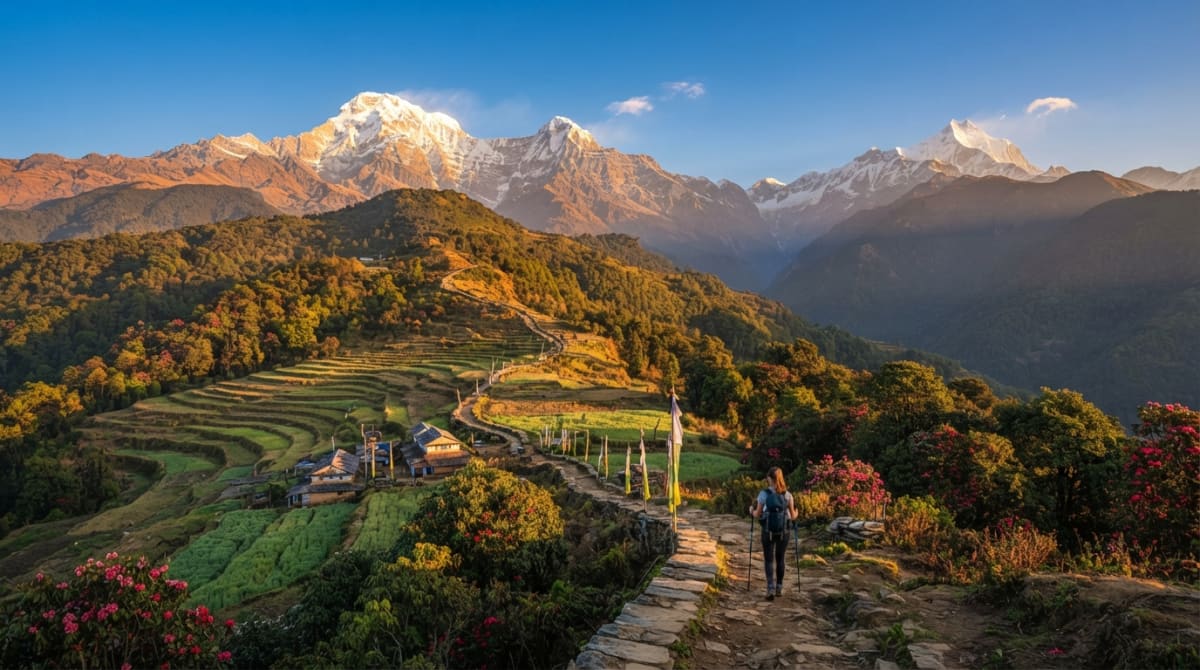
About an hour after leaving the road at Kande, the stone steps give way to a broad, grassy clearing on the ridge. Lodges line its edges, prayer flags flutter in the breeze, and on a clear morning the whole northern horizon is filled with snow peaks. This is Australian Camp, the first great viewpoint of the Mardi Himal Trek and one of the most accessible mountain panoramas anywhere near Pokhara. Some visitors come here only for the view; for Mardi Himal trekkers, it is a thrilling preview of what lies ahead.
This guide explains everything about Australian Camp: where it is, what you can see, the lodges and facilities, whether to stay overnight, and how it fits into the Mardi Himal Trek. For the whole route, see the Mardi Himal map and route guide.
Where Australian Camp Is
Australian Camp sits at around 2,060 meters on the ridge above Kande, the usual trailhead for the Mardi Himal Trek. From Kande, a steep staircase through farmland climbs about 300 meters to reach it in around an hour to an hour and a half. It can also be reached from Phedi via the village of Dhampus, a slightly longer walk. Because it is so close to the road and to Pokhara, it is one of the most visited viewpoints in the region, busy with day hikers as well as trekkers heading onward to Mardi Himal and the Annapurna Base Camp trail via Landruk. See our Kande trailhead guide.
The Name
The name Australian Camp is often said to date from earlier decades, when Australian trekking groups camped on the clearing, and the name stuck as the area became popular with visitors. Today, it is simply the name everyone uses for the meadow and the small settlement of lodges around it.
The View
The reason people come to Australian Camp is the view. On a clear day, the Annapurna range stretches across the northern skyline. Machapuchare, the sacred Fishtail mountain, stands out with its sharp pyramid shape, and Annapurna South and Hiunchuli rise to its west. The foothills and forested ridges in front of the peaks create layers of depth, and in the early morning the snow catches the first light in shades of pink and gold. It is a wide, sweeping panorama rather than the close-up view you will get later from High Camp and Base Camp, but it gives a wonderful sense of the scale of the range.
The best views are usually in the early morning, before haze and clouds build from the valleys. In autumn and winter, the skies are often clear all morning; in spring, haze may hide the peaks by late morning; in the monsoon, views are unpredictable. See the mountains you see from the Mardi Himal Trek.
Lodges and Facilities
Several lodges surround the meadow, offering simple rooms, dining rooms and terraces with mountain views. Menus include dal bhat, noodles, fried rice, momos, pancakes and hot drinks. Many lodges have hot showers and charging for a fee, and mobile signal is usually available thanks to the proximity to Pokhara. Because Australian Camp is popular with day visitors and Nepali tourists, it can be lively on weekends and holidays. Facilities are generally better than at the higher camps of the Mardi Himal Trek. See our tea house guide.
Passing Through on the Mardi Himal Trek
On most Mardi Himal itineraries, you pass through Australian Camp on day one, stopping for a tea break or early lunch before continuing to Pothana and Pitam Deurali. It is a natural resting point after the steep climb from Kande, and a good place to adjust your layers, apply sunscreen and take your first mountain photographs. Arriving early gives you the best chance of clear views. See Kande to Pitam Deurali: day one.
Staying Overnight
Spending a night at Australian Camp is a lovely option, especially on a relaxed itinerary. Sunset and sunrise over the Annapurnas are the highlights, and the evening atmosphere on the meadow, with the lights of villages twinkling in the valleys below, is peaceful once the day hikers have gone. For families, older trekkers or anyone who prefers a gentle start, an overnight here makes the first day very short and gives the body a gradual introduction to walking and altitude. See the slow Mardi Himal itinerary and the family trek itinerary.
Sunrise at Australian Camp
If you stay overnight, set an alarm for sunrise. As the sky lightens behind you, the peaks appear as pale shapes, then catch the first direct light, glowing pink and orange before turning bright white. Clouds often fill the valleys below the ridge, creating a sea of cloud with the mountains floating above. Bring a warm layer and a hot drink, and find a spot on the edge of the meadow. It is one of the most accessible Himalayan sunrises in Nepal.
A Day Hike from Pokhara
Australian Camp is a popular day hike from Pokhara for travellers without time for a longer trek. A classic route drives to Kande, climbs to Australian Camp for the view and lunch, then continues through Dhampus and descends to Phedi to catch transport back to Pokhara. It makes a rewarding day with mountain views, village scenery and forest walking. It is also a good warm-up hike before starting a longer trek. See Mardi Himal vs the Australian Camp and Dhampus hike.
Australian Camp Through the Seasons
In autumn, Australian Camp offers some of its clearest views, with crisp mornings and blue skies. In winter, the air is often very clear and the peaks heavily snow-covered, though mornings and evenings are cold. In spring, rhododendrons bloom in the surrounding forest, and the meadow is green, though haze can hide the peaks later in the day. In the monsoon, cloud and rain often obscure the view, but the landscape is lush and quiet. See the best time for the trek.
Photography Tips
Australian Camp is excellent for wide landscape photographs. Use the meadow, lodges, prayer flags or fellow trekkers as foreground interest against the long line of peaks. Shoot early, when the light is soft and the air clear. A telephoto lens isolates Machapuchare's distinctive summit. At sunset and sunrise, the changing light on the snow creates dramatic colours. See the photography guide.
Nature Around Australian Camp
The forest around Australian Camp includes oak and rhododendron, with birds such as laughingthrushes, bulbuls and tits active in the mornings. In spring, rhododendrons bloom in red and pink along the trail toward Pothana. Butterflies are common in warmer months. Look out for langur monkeys in the trees. See flora and fauna along the trail.
Australian Camp vs Other Early Viewpoints
Around Pokhara, several viewpoints offer panoramas of the Annapurna range, including Sarangkot above the city, the World Peace Pagoda across Phewa Lake, and Dhampus on the approach to Australian Camp. Sarangkot is easily reached by road and famous for sunrise, but it is busy and closer to the city. The World Peace Pagoda offers views over the lake with the mountains behind. Dhampus is a larger village with good views and traditional houses. Australian Camp stands out for its open meadow setting, its slightly higher position on the ridge, and its peaceful atmosphere in the evenings once day visitors leave. For Mardi Himal trekkers, it is also conveniently on the route, so there is no need for a separate trip.
A Night at Australian Camp: What It Is Like
If you choose to stay overnight, the afternoon at Australian Camp is relaxed. After arriving from Kande, you have time to sit on the meadow, read, and watch the clouds move across the peaks. As the day visitors head back down, the atmosphere becomes quieter. Toward sunset, lodge guests gather on the terraces to watch the light fade on the Annapurnas, sometimes with a sea of cloud forming below. Dinner is served in cosy dining rooms, and the night sky can be spectacular on clear, moonless nights, away from the lights of Pokhara. Early the next morning, you step out into the chilly air for sunrise before breakfast and the walk onward. Many visitors say a night here is one of the most peaceful experiences of their trip.
Walking Times from Australian Camp
From Australian Camp, it takes around 30 to 45 minutes to reach Pothana, and a further hour to an hour and a half to reach Pitam Deurali. If you started at Kande, you will usually arrive at Pitam Deurali by early afternoon. For those continuing on fast itineraries, Forest Camp is around four to five hours beyond Pitam Deurali, and Low Camp two to three hours further. Going back down, Kande is about 45 minutes to an hour from Australian Camp, and Dhampus is a similar distance in the other direction. See Mardi Himal distance and duration explained.
Who Should Stay Overnight
An overnight at Australian Camp suits several kinds of travellers: families with children who benefit from a short first day, older trekkers who prefer a gentle introduction, photographers who want sunrise and sunset over the Annapurnas, and anyone arriving in Pokhara late who would rather not start a long first day. It is also a good choice for travellers who only want a short taste of the hills, without the altitude of the full Mardi Himal Trek. Fit trekkers on standard itineraries usually pass through on day one without staying.
Respecting the Meadow
Because Australian Camp is so popular, it faces pressure from litter and trampling. Carry out your rubbish, use lodge toilets, avoid damaging the grass and flowers, and keep noise down in the evenings for guests staying overnight. Buying tea and meals from the lodges supports the families who maintain the area. See responsible trekking on Mardi Himal.
Tips for Visiting Australian Camp
- Arrive early. Morning views are usually the clearest, before haze and cloud build.
- Bring a warm layer. The breeze on the open ridge can be cool, even on sunny days.
- Book ahead on holidays. Lodges fill with Nepali tourists on weekends and festivals.
- Carry cash. Card payments are rarely accepted.
- Watch the time on day hikes. Allow enough time to descend to Kande or Phedi before dark.
- Stay for sunset if you can. The evening light on the Annapurnas is magical.
Australian Camp for Families
Australian Camp is one of the best places near Pokhara to introduce children to the Himalaya. The climb from Kande is short enough for most children, the meadow offers space to run and play, and the views are spectacular. An overnight stay adds the excitement of a mountain lodge, sunset and sunrise, without significant altitude. For families planning the full Mardi Himal Trek, starting with a night at Australian Camp builds confidence for the days ahead. See Mardi Himal with kids.
Getting Back to Pokhara
If you are visiting Australian Camp as a day hike or overnight trip, you can return to Pokhara the way you came, descending the stairs to Kande and taking a jeep, taxi or local bus. Alternatively, continue through Dhampus and descend to Phedi, where transport is also available on the highway. Both options take around an hour of walking down, followed by about an hour's drive. Descending the steep stone steps can be hard on the knees, so use trekking poles and take your time. See Pokhara to Kande transport.
A Place People Return To
Many visitors who first see the Annapurnas from Australian Camp come back years later, sometimes on the way to Mardi Himal or Annapurna Base Camp, sometimes simply for another night on the meadow. Its combination of easy access, open space and a truly Himalayan view makes it one of the most loved spots in the Pokhara hills.
After Australian Camp
From Australian Camp, the Mardi Himal trail drops gently through forest to Pothana, where your permits are checked, then continues to Pitam Deurali. The walking becomes easier and more shaded after the steep climb from Kande. See Pothana village and Pitam Deurali.
Visit Australian Camp on Your Trek
Every standard Mardi Himal itinerary passes through Australian Camp on the first morning. See the 5-day Mardi Himal Trek from Pokhara or the 9-day trek from Kathmandu, and contact us if you would like to include an overnight stay at Australian Camp in your plan.