

Summit morning on the Mardi Himal Trek comes with a decision that almost every trekker faces somewhere between High Camp and the top of the ridge. After two hours of climbing in the dark and the cold, you reach the Upper View Point just as the sun lights up Annapurna South, Hiunchuli, Mardi Himal and Machapuchare. It is a spectacular place, and many people feel that they have arrived. Yet the trail keeps going, across open slopes toward Mardi Himal Base Camp, roughly an hour or more further on and about 300 meters higher. Should you stop here, or keep walking?
There is no single right answer. It depends on how you feel, the weather, the season, the time and the rest of your itinerary. This guide explains what each option gives you, what it costs, and how our guides help trekkers make the call on the day. For the full walk from High Camp, see the summit-day hike from High Camp to Base Camp.
The Two Options at a Glance
| Upper View Point | Mardi Himal Base Camp | |
|---|---|---|
| Approximate altitude | About 4,200 m | About 4,500 m |
| Time from High Camp (up) | 2–2.5 hours | 3–4 hours |
| Time back to High Camp | About 1.5 hours | 2–3 hours |
| Extra effort | — | About 300 m more climbing plus the return |
| Best for | Sunrise, wide panorama, shorter day | Close-up mountain views, glaciers, the full experience |
| Crowds | Busier in peak season | Quieter, as many trekkers stop at the viewpoint |
Altitudes on the ridge are quoted differently from source to source, and the trail itself moves slightly from season to season, so treat these figures as approximate. The important difference is the extra climb of around 300 meters and the two to three hours that going on to Base Camp adds to what is already the longest day of the trek.
What You See from the Upper View Point
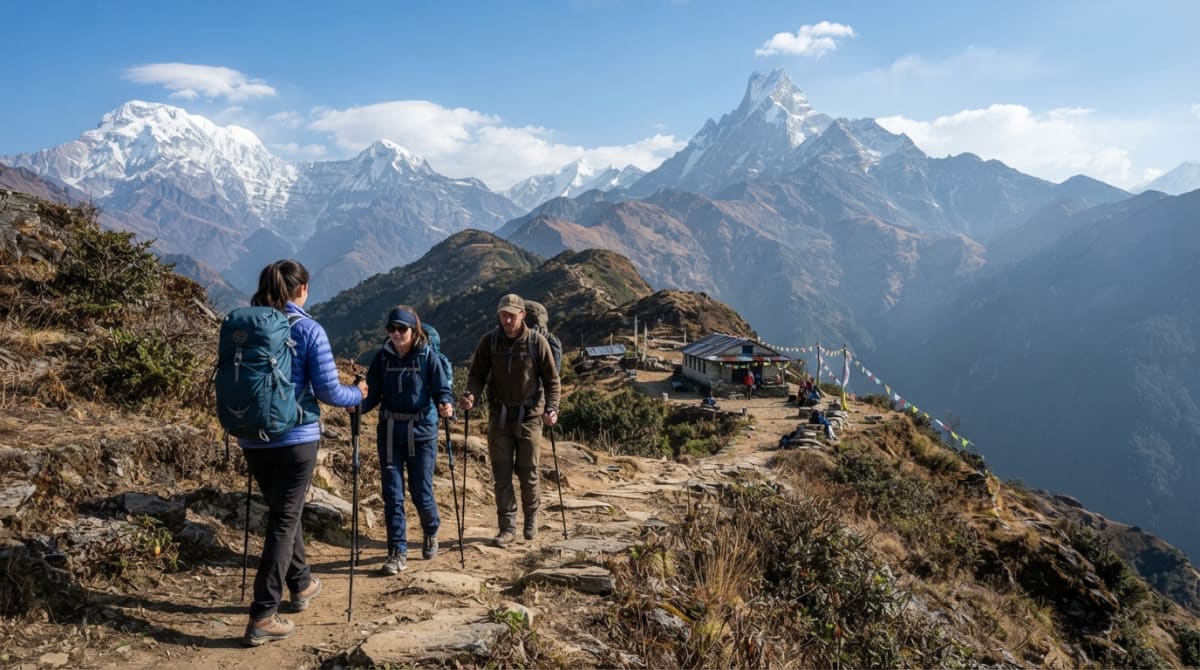
The Upper View Point is a broad shoulder on the Mardi Himal ridge, marked by prayer flags and cairns, where the trail levels out after the steepest climb of the trek. It faces east and north, which is why it works so well for sunrise. From here you look straight at Machapuchare, the Fishtail, with its twin-summited ridge rising close and sharp. Mardi Himal stands directly ahead, and to the west, Annapurna South and Hiunchuli form a long wall of snow. Far below to the west lies the deep Modi Khola valley, the route to Annapurna Base Camp, and behind you the ridge falls away toward Low Camp, Forest Camp and the hills around Pokhara, often buried under a sea of cloud.
Because the viewpoint is higher than High Camp but not yet tucked in beneath the peaks, the panorama is wide. Many photographers actually prefer it for the sunrise itself, because you can frame the whole range in one shot and watch the light move across several summits at once. On a clear morning, the viewpoint alone justifies the trek. See the sunrise guide and the mountains you see from Mardi Himal.
What Base Camp Adds
From the viewpoint, the trail continues north along the ridge, with gentler gradients but some ups and downs over grass, rock and, in some seasons, snow. As you walk, the mountains stop being a skyline and start to feel like walls. By the time you reach Base Camp, an open area of grass and rock with prayer flags at roughly 4,500 meters, Mardi Himal's steep slopes rise directly ahead, and the glaciers and moraines beneath Machapuchare's west face are close enough to hear the occasional rumble of ice. The scale changes completely.
Base Camp is also quieter. In busy months, the viewpoint can hold dozens of people at dawn, while the walk beyond thins out quickly. Standing at the top of the ridge with the peaks around you and hardly anyone else in sight is, for many trekkers, the most memorable moment of the whole trip. It is also the official end point of the trek, so for those who like to complete a route, reaching Base Camp matters. See the Base Camp visitor's guide and how high Base Camp is.
What Going Further Costs
The extra views come at a price, and it is worth being honest about it. Continuing to Base Camp means:
- More time. Around two to three extra hours, on a day that already starts before dawn and usually ends with a long descent to Badal Danda, Low Camp or even Siding.
- More altitude. Another 300 meters of height, taking you to the highest point of the trek, where there is noticeably less oxygen.
- More cold and exposure. The upper ridge is open to the wind, and conditions can change quickly as clouds build in the late morning.
- More strain on the descent. Tired legs make the steep section below the viewpoint harder and slower on the way down.
For a fit trekker who has acclimatized well, these costs are modest. For someone who reached the viewpoint already exhausted, with a headache or cold hands, they can turn a good day into a difficult one. See the hardest day on Mardi Himal.
How to Decide on the Day
We encourage trekkers to go up with Base Camp in mind but without being attached to it. The decision is best made at the viewpoint itself, once you know how you feel and what the weather is doing. Ask yourself a few simple questions:
- Do I feel reasonably strong, or did the climb to the viewpoint take everything I had?
- Do I have any altitude symptoms beyond breathlessness, such as a worsening headache, nausea or dizziness?
- Are my hands and feet warm, or am I struggling to get feeling back into them?
- Is the sky clear, or are clouds already moving up the valleys?
- Is the trail beyond clear of deep snow and ice, or does it need microspikes we do not have?
- How long is the rest of my day? Am I descending to Low Camp, Badal Danda or all the way to Siding?
If the answers are mostly positive, continue. If several are negative, the viewpoint is a very satisfying place to finish. Your guide will add their own judgment, based on experience of hundreds of summit mornings and what they have seen of you over the previous days. See turnaround decisions on Mardi Himal.
The Role of Your Guide
A guide has been mandatory on the Mardi Himal Trek for foreign trekkers since 2023, and summit morning is where that rule earns its place. Our guides watch pace, breathing and behavior on the climb, check in with each trekker at the viewpoint, and look at the sky, the wind and the trail ahead. If someone is unwell, the group may split, with an assistant guide staying with the slower trekker while the others continue. If conditions are unsafe, such as hard ice without spikes, very strong wind or thick cloud with poor visibility, the guide may decide the viewpoint is the limit for everyone that day. That decision is final, and it is the right one. See why a guide is mandatory.
Weather and Timing
The weather often decides for you. Clear skies are most reliable in the early morning, and in most seasons clouds build from the valleys by late morning. On a perfect autumn day, you may enjoy clear views at Base Camp until nine or ten o'clock. In spring, haze and cloud often arrive earlier, and in the monsoon a brief clear window at dawn may close before you reach the viewpoint. If the cloud is already swallowing the peaks, walking on to Base Camp may bring you nothing but grey, and the viewpoint becomes the sensible end point.
Time matters too. Groups that reach the viewpoint late, perhaps because of a slow climb, may not have enough margin to continue, enjoy Base Camp and still complete the descent in daylight, especially on the 3-day short trek, where the same day ends in Siding. See what happens when the weather turns on summit day and fog and clouds on Mardi Himal.
Season by Season
- Autumn (September–November): The best chance of clear, stable mornings. Most fit groups continue to Base Camp.
- Winter (December–February): Very clear but cold, and snow or ice can make the upper ridge hazardous. The viewpoint is often the limit after heavy snowfall.
- Spring (March–May): Mild mornings and good views, but cloud and haze build earlier. Continuing is common but time-sensitive.
- Monsoon (June–August): Often cloudy and wet. Going beyond the viewpoint is only worthwhile if the sky is clear.
See snow on the Mardi Himal Trek and mountain visibility by month.
Which Itineraries Allow Base Camp?
Every one of our Mardi Himal itineraries includes the hike to Base Camp as the goal of summit day. What varies is how much time and energy you have left. On the 9-day trek from Kathmandu and the 7-day trek for those flying directly into Pokhara, you descend only as far as Badal Danda after the summit, which leaves comfortable margin for Base Camp. The 5-day trek from Pokhara descends to Low Camp, a slightly longer but still manageable afternoon. The 3-day Short Mardi Himal Trek packs the summit hike and the entire descent to Siding into one very long day, so reaching Base Camp depends on a strong pace and good weather. If Base Camp is important to you, choose a longer itinerary.
Acclimatization Makes the Difference
The single biggest factor in whether you feel strong enough to continue is how well you have acclimatized. Trekkers who have gained height gradually, slept well at High Camp and kept drinking and eating arrive at the viewpoint with energy to spare. Those who rushed up, perhaps on a compressed itinerary, often reach it feeling heavy-headed and drained. An itinerary with a night at Low Camp or Badal Danda before High Camp helps a great deal. See acclimatization on Mardi Himal and our altitude sickness guide.
If You Stop at the Viewpoint
If you decide to stop, make the most of it. Stay for the full sunrise, as the colors change for twenty to thirty minutes after first light. Take your photographs, drink something hot, and simply sit and look. If others in your group continue, your guide or an assistant will stay with you or arrange for you to walk back down to High Camp safely, where breakfast and a warm dining room await. You will have saved energy for the descent, and you will have seen one of the great views of the Annapurna region.
If You Continue to Base Camp
If you continue, eat something and drink at the viewpoint first, and adjust your layers for walking. Keep an even pace across the ridge, stay close to your guide, and keep an eye on the weather. At Base Camp, take twenty to forty minutes, not much more, then start down before cloud and fatigue build. Remember that the descent is where most slips happen, so use your poles and take your time on the steep section below the viewpoint. See coming down from Base Camp.
Common Questions from Trekkers
Can I go to Base Camp and skip the viewpoint? No. The viewpoint lies on the only trail to Base Camp, so everyone passes it.
Can I go up again the next day? On a flexible private itinerary with an extra night at High Camp, yes. This is a good option if the first morning is cloudy, and it gives you a second chance at clear views. Ask us when planning.
Is there anything at Base Camp? There are no lodges or shops, only open ground and prayer flags, so carry everything you need for the morning.
Is the walk from the viewpoint to Base Camp dangerous? In normal conditions, it is a non-technical walk over open ground. Snow and ice change that, which is why your guide assesses it on the day.
Plan Your Summit Day with Us
Whichever point you reach, the sunrise from the Mardi Himal ridge is the reward for the whole trek. To give yourself the best chance of Base Camp, choose an itinerary with time to acclimatize, such as the 5-day Mardi Himal Trek from Pokhara or the 9-day trek, and contact us to plan your dates.