

Most trekkers spend weeks thinking about the climb to Mardi Himal Base Camp and almost no time thinking about coming down. Yet the descent is a big part of the trek. From Base Camp at roughly 4,500 meters to Siding village at around 1,750 meters, you lose more than 2,700 meters of height in a day or two, much of it on steep ground. It passes through some of the loveliest scenery of the trek, from the open ridge to rhododendron forest and terraced farmland, but it also asks a lot of tired legs and knees.
This guide explains how the descent works, the routes you can take, how long each section lasts, where each of our itineraries spends the night, and how to look after your body on the way down. For the climb itself, see High Camp to Mardi Himal Base Camp.
The Descent at a Glance
| Section | Typical time | Height lost |
|---|---|---|
| Base Camp to High Camp | 2–3 hours | About 920 m |
| High Camp to Badal Danda | 1–1.5 hours | About 370 m |
| Badal Danda to Low Camp | About 1 hour | About 240 m |
| Low Camp to Siding | 4–5 hours | About 1,200 m |
| Siding to Pokhara by jeep | 2–3 hours | Road journey |
These times are for an average trekking pace with short breaks. Groups that are tired after the summit hike, or that meet ice, mud or rain, take longer. Your guide will set a pace that keeps everyone safe and comfortable rather than one that simply covers the distance.
Base Camp to High Camp
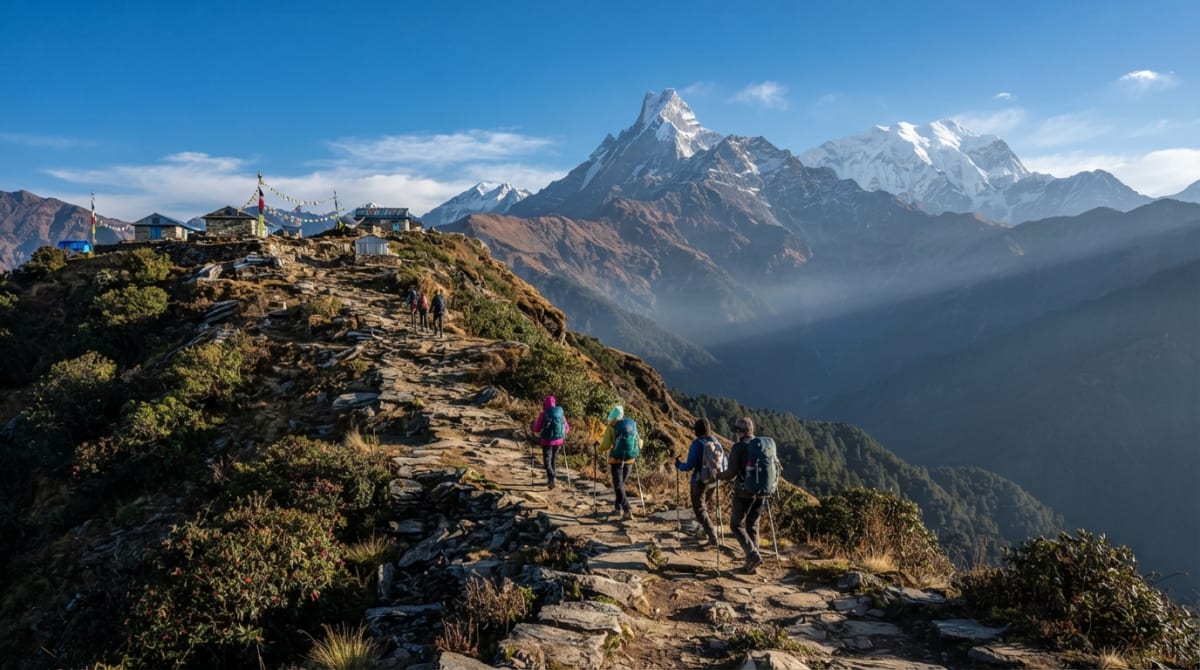
The first leg retraces the summit route. From Base Camp, the trail crosses the open ridge back to the Upper View Point, with some short climbs along the way, then drops steeply down the grassy slopes to High Camp at 3,580 meters. The section below the viewpoint is the most demanding part of the whole descent. Early in the morning it can be frozen hard, and later, once the sun has warmed it, it becomes slippery with mud or melting frost. In winter or after snow, microspikes are often essential here.
Take small, controlled steps, keep your weight over your feet, and plant your poles ahead of you. Resist the temptation to hurry to get out of the wind; a slip on this slope is the most common cause of minor injuries on the trek. The reward is the view: with the peaks behind you and the ridge dropping away toward Pokhara, the walk down to High Camp is one of the most beautiful stretches of the trek. A late breakfast is waiting at the lodge. See steep sections on Mardi Himal.
High Camp to Badal Danda and Low Camp
After breakfast, you pack up and continue down the ridge. This is a gentler, very scenic section, with the trail winding along the crest through grass, dwarf rhododendron and, lower down, stands of taller trees. Badal Danda, the "cloud hill", sits about an hour to an hour and a half below High Camp, and Low Camp at around 2,970 meters is about an hour beyond that. Looking back, you see the peaks you stood beneath a few hours earlier, often glowing in the afternoon light before the clouds close in. See Badal Danda and Low Camp.
Where Each Itinerary Sleeps After Summit Day
How far you descend after the summit hike depends on your itinerary, and it shapes how the day feels:
- 9-day trek from Kathmandu: down to Badal Danda, a short and relaxed afternoon after the summit.
- 7-day trek for direct flights to Pokhara: down to Badal Danda, with the same relaxed pace.
- 5-day trek from Pokhara: down to Low Camp, a longer but still comfortable afternoon.
- 3-day Short Mardi Himal Trek: all the way to Siding and on to Pokhara by jeep, a very long day of eight to ten hours on foot plus the drive.
Sleeping lower after the summit is good for recovery. Most trekkers sleep far better at Badal Danda or Low Camp than they did at High Camp, and they wake refreshed for the final descent. See where to sleep on the upper ridge.
Low Camp to Siding
The final day of most itineraries follows the trail east from Low Camp down to Siding village. This is a steep descent of about 1,200 meters, first through thick rhododendron and oak forest, draped in moss and often full of birdsong, then through bamboo and scrub, and finally through terraced millet and rice fields around the village. The forest section can be muddy and slippery, particularly after rain and in the monsoon, and there are long stretches of stone steps and rough trail that test tired legs. Allow four to five hours with breaks.
Siding itself is a traditional farming village where the trail meets the road. Lunch is usually taken here or at a tea house on the way down, and your jeep back to Pokhara leaves from the village. See Low Camp to Siding and the Siding village guide. On the 9-day and 7-day treks, which spend the night at Badal Danda, the final day starts an hour higher; see Badal Danda to Siding.
Other Ways Down
The Siding route is the most common descent because it makes a loop, taking you through new scenery rather than back over the trail you climbed. It is not the only option:
- Return via Forest Camp. Some groups retrace the ascent route from Low Camp through Forest Camp and Pitam Deurali to Kande, Phedi or Dhampus. It is longer but gentler underfoot in places, and it can be a sensible choice if the Siding trail is very muddy.
- Via Lwang village. A variation of the eastern descent passes through the tea gardens around Lwang, adding a cultural element to the last day. See Mardi Himal via Lwang.
- Linking to Landruk. From the Forest Camp area, a trail drops west toward Landruk, making it possible to continue toward Ghandruk or the Annapurna Base Camp trail on a longer trip. See linking Mardi Himal with Landruk.
Your guide will recommend the best descent for your group based on the season, trail conditions and your onward plans.
Looking After Your Knees
Descending puts far more stress on the knees and the fronts of the thighs than climbing, because your muscles work eccentrically, braking your body with every step. After a large drop, sore quads are normal for a day or two. Trekkers with existing knee problems feel it most. A few simple techniques help a great deal:
- Use two trekking poles, adjusted slightly longer for descents, and plant them ahead of you to take weight off your knees.
- Take short steps and keep your knees slightly bent, rather than dropping heavily onto a straight leg.
- Zigzag on wide, steep slopes where the trail allows, instead of going straight down.
- Step down sideways on very high steps, or turn and face the slope if needed.
- Keep your pace steady; rushing downhill is how knees and ankles get hurt.
- Consider a knee support if you have a history of knee pain, and use it from the start of the descent.
See trekking Mardi Himal with knee problems and trekking poles for Mardi Himal.
Protecting Your Feet
Long descents are hard on feet too. Toes slam into the front of boots, heels slide, and wet socks rub. Lace your boots firmly across the instep before you start down so your foot does not slide forward, and trim your toenails before the trek to avoid bruised nails. Change into dry socks at lunch if your feet are damp, and deal with any hot spot immediately with tape or a blister plaster rather than waiting for it to become a blister. See preventing blisters on Mardi Himal and the best boots for the trek.
Weather and Trail Conditions
Conditions on the descent change with the seasons. In autumn and spring, the trail is usually dry and firm, though the forest below Low Camp holds moisture and can be slick in places. In the monsoon, mud, running water on the steps and leeches in the lower forest make the Low Camp to Siding section slow and messy, and waterproof layers and gaiters are useful. In winter, ice on the upper ridge is the main concern, while the lower trail is usually dry but cold in the shade. Afternoon cloud is common in every season, so you may walk down through mist even after a clear summit morning. See slippery trails after rain and trail conditions on Mardi Himal.
Food, Water and Energy
By the time you start the long descent, you have had a short night and a very early start, and your energy is likely to be low. Eat a proper breakfast at High Camp, even if your appetite is dull, and carry snacks for the walk down. Keep drinking, because you are still losing a lot of water to the dry air and exertion, even though the altitude is falling. On the final day, lunch in Siding or at a tea house on the way down gives you a chance to refuel before the jeep ride. See staying hydrated on Mardi Himal and eating enough at altitude.
Altitude on the Way Down
The good news is that descent is the best treatment for almost every altitude symptom. Most trekkers notice their headache fading and their appetite returning within an hour or two of leaving High Camp, and by Low Camp they feel close to normal. If anyone in the group has altitude symptoms on the summit hike, the plan is simply to keep descending. In the rare case of serious illness, your guide will organize a faster descent or evacuation. See our altitude sickness guide.
The Jeep Ride from Siding
From Siding, a rough rural road winds down the valley toward Lumre and Pokhara. The drive usually takes two to three hours, depending on the state of the road, which is bumpy and dusty in the dry season and can be muddy or partially blocked after heavy rain. Your guide will arrange the jeep in advance, and on busy days it pays to leave in good time. If you suffer from motion sickness, take a front seat and any medication you normally use before setting off. You arrive back in Pokhara by late afternoon or early evening, ready for a hot shower and a celebratory dinner by the lake. See the Siding to Pokhara jeep and jeep road safety.
Descending with Children, Older Trekkers or Mixed Groups
Groups with children, older trekkers or people of very different fitness levels need a little more planning for the descent. Children often run downhill happily and then tire suddenly, while older trekkers may find the long steep sections hard on their joints. The simplest solution is time: choose an itinerary that sleeps at Badal Danda or Low Camp after the summit, so no one faces the entire descent in one day, and allow extra time for the Low Camp to Siding section. Our guides walk at the pace of the slowest member, with an assistant guide or porter guide at the back on larger groups, so nobody feels rushed. Regular short stops for water and snacks keep spirits up, and the changing scenery, from open ridge to forest to villages, gives everyone something to look at. See Mardi Himal with kids and Mardi Himal for seniors.
Common Mistakes on the Descent
- Rushing. Tiredness plus speed is the most common cause of slips and twisted ankles.
- Loose laces. Your feet slide forward and your toes pay for it.
- Putting poles away. They are more useful going down than going up.
- Skipping food and water. Energy crashes happen on long downhill days.
- Underestimating the last day. Low Camp to Siding looks short on a map but feels long on the legs.
After the Descent
Expect stiff legs for a day or two after you get back to Pokhara. Gentle walking along the lakeside, stretching, and a massage in one of Pokhara's spas all help. If you have time, a relaxed day in Pokhara before any onward travel is a good idea, both for recovery and as a buffer against road delays. See recovery after Mardi Himal and things to do in Pokhara after the trek.
Plan Your Mardi Himal Trek
If you want a comfortable descent with time to enjoy it, choose an itinerary that sleeps lower after the summit, like the 5-day Mardi Himal Trek from Pokhara or the 9-day trek from Kathmandu. Contact us and we will help you choose the right route and pace.