

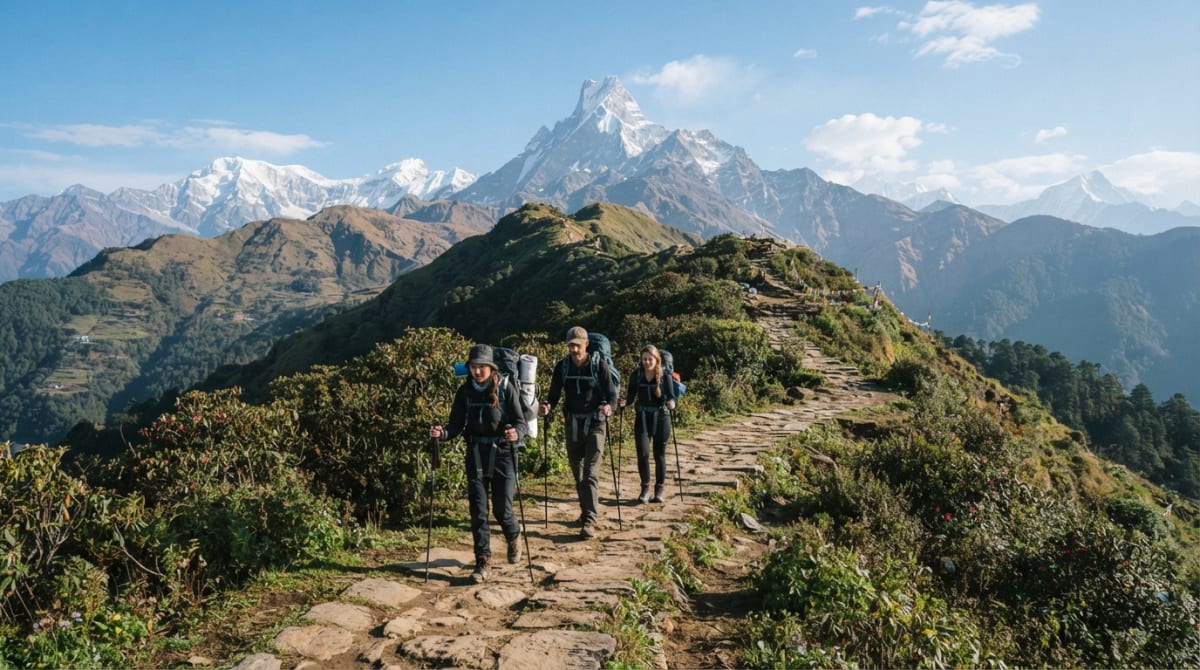
Mardi Himal Base Camp sits at roughly 4,500 meters above sea level. It is the highest point on the Mardi Himal Trek, the end of the long ridge that climbs from the forests above Pokhara toward Machapuchare, and for many trekkers, the highest place they have ever stood. But what does 4,500 meters actually mean? How much thinner is the air? How does it compare with other treks and mountains? And what does it mean for your body, your safety and your preparation?
This guide explains the altitude of Mardi Himal Base Camp in practical terms. For the hike itself, see High Camp to Base Camp, and for everything to expect at the top, the Base Camp visitor's guide.
Altitudes Along the Trek
| Place | Approximate altitude |
|---|---|
| Pokhara | 822 m |
| Kande (trailhead) | 1,770 m |
| Australian Camp | 2,060 m |
| Pitam Deurali | 2,100 m |
| Forest Camp | 2,600 m |
| Low Camp | 2,970 m |
| Badal Danda | 3,210 m |
| High Camp | 3,580 m |
| Upper View Point | 4,200 m |
| Mardi Himal Base Camp | About 4,500 m |
| Mardi Himal summit | 5,587 m |
| Machapuchare summit | 6,993 m |
From Pokhara to Base Camp, you climb nearly 3,700 meters. From High Camp, the last place you sleep, to Base Camp is a climb of about 900 meters, made in a single morning. See distance, duration and elevation explained.
Why Published Figures Vary
You will see Mardi Himal Base Camp listed at different altitudes: 4,500 meters, 4,480 meters, 4,496 meters and others. This is normal in the Himalaya. Base Camp is an area rather than a single point, and figures come from different maps, GPS devices and surveys, each with its own margin of error. GPS altitude readings in particular can be off by tens of meters. For practical purposes, think of Base Camp as around 4,500 meters. The same applies to High Camp and other stops, which also appear with slightly different figures. See key facts about the trek.
What 4,500 Meters Means for Oxygen
The air at 4,500 meters contains the same proportion of oxygen as at sea level, about 21 percent, but the air pressure is much lower, so each breath contains fewer oxygen molecules. At Base Camp, air pressure is a little under 60 percent of sea level, which means each breath holds roughly 40 percent less oxygen than at the coast. At High Camp, at 3,580 meters, it is about 35 percent less. Your body responds by breathing faster and deeper, increasing your heart rate and, over days, producing more red blood cells. These changes are called acclimatization, and they take time.
In practice, you will notice the thin air as breathlessness on the steep climb above High Camp, a pounding heart, and a need to stop more often. Walking slowly and breathing deeply helps. See breathing techniques for altitude and do you need oxygen on Mardi Himal?
Altitude Zones
- High altitude (about 1,500–3,500 m): Most of the trek, from Kande to High Camp. Mild symptoms are possible above 2,500 meters.
- Very high altitude (about 3,500–5,500 m): High Camp and the summit hike to Base Camp. Symptoms are common, and serious altitude illness is possible.
- Extreme altitude (above 5,500 m): The summit of Mardi Himal and the surrounding peaks, reached only by climbers.
The Mardi Himal Trek takes you into the very high altitude zone, but only briefly, which is one reason it is considered a moderate trek in altitude terms.
How Mardi Himal Compares
| Destination | Approximate altitude |
|---|---|
| Poon Hill | 3,210 m |
| Mount Fuji | 3,776 m |
| Annapurna Base Camp | 4,130 m |
| Upper View Point, Mardi Himal | 4,200 m |
| Mount Whitney | 4,421 m |
| Mardi Himal Base Camp | About 4,500 m |
| Mont Blanc | 4,808 m |
| Everest Base Camp | 5,364 m |
| Kilimanjaro | 5,895 m |
Mardi Himal Base Camp is higher than Annapurna Base Camp and Poon Hill, higher than Mount Whitney, the tallest peak in the contiguous United States, and about the same height as the summit of the Matterhorn. It is lower than Mont Blanc, Everest Base Camp and Kilimanjaro. See Mardi Himal vs Everest Base Camp, Mardi Himal vs Kilimanjaro and Mardi Himal vs Annapurna Base Camp.
Altitude Sickness at Mardi Himal
Acute mountain sickness, or AMS, is common above 2,500 to 3,000 meters. Symptoms include headache, nausea, loss of appetite, fatigue, dizziness and poor sleep. On Mardi Himal, mild AMS is most likely at High Camp and during the summit hike. In most cases, it is manageable with rest, hydration and a slow pace, and symptoms ease quickly on descent.
More serious forms of altitude illness, high altitude pulmonary edema (HAPE) and high altitude cerebral edema (HACE), are rare on Mardi Himal, because trekkers sleep no higher than about 3,580 meters and visit Base Camp only briefly. However, they can occur, especially with rapid ascent. Warning signs include breathlessness at rest, a persistent cough, confusion, severe headache, loss of coordination and extreme fatigue. Anyone with these symptoms must descend immediately. See AMS, HAPE and HACE explained and our altitude sickness guide.
Why Mardi Himal Is Relatively Safe at Altitude
Mountaineers have a saying: climb high, sleep low. The Mardi Himal Trek follows this principle naturally. You sleep at High Camp, at 3,580 meters, then make a day trip to around 4,500 meters, spend a short time at the top, and return to sleep at a similar or lower altitude. Your body only experiences the highest altitude for a few hours. This makes serious altitude illness much less likely than on treks where you sleep at 4,500 meters or higher. See acclimatization on Mardi Himal.
Short Itineraries and Altitude
The speed of your ascent matters more than the altitude itself. On the 3-day Short Mardi Himal Trek, you gain height quickly, often reaching High Camp or its surroundings within two days of leaving Pokhara at 822 meters, and making the summit hike the next morning. This suits fit trekkers who have some altitude experience or who are already acclimatized from other trekking. For first-timers or those who have struggled with altitude before, a longer itinerary, such as the 5-day trek from Pokhara or the 9-day trek, gives the body more time to adjust. See how hard the short trek is and Mardi Himal as your first high-altitude trek.
How Each Itinerary Handles the Altitude
| Itinerary | Nights above 2,500 m before the summit | Sleeping altitude the night before | Acclimatization |
|---|---|---|---|
| 3-day Short Mardi Himal Trek | One | High Camp area | Fast; best for fit or already acclimatized trekkers |
| 5-day trek from Pokhara | Two | High Camp, 3,580 m | Moderate; suits most trekkers |
| 7-day and 9-day treks | Two, after a gentler approach | High Camp, 3,580 m | Comfortable; good for first-timers |
| Custom trek with a rest day | Three or more | High Camp, 3,580 m | Best; recommended if you have struggled with altitude |
The more nights you spend between 2,500 and 3,600 meters before the summit hike, the better prepared your body will be for 4,500 meters. An extra night at Low Camp, Badal Danda or High Camp is the single most effective way to make summit day easier. See the itinerary with a rest day.
What It Feels Like at Base Camp
Most trekkers arrive at Base Camp breathing hard, with a racing heart, after the steep climb from High Camp. Once you stop and rest, your breathing settles, though walking even a few steps uphill quickly leaves you breathless again. Many people have a mild headache, feel a little light-headed or find it harder to think clearly than usual. Appetite is often low, and fingers can be clumsy in the cold. These are normal responses to 4,500 meters and usually disappear within an hour or two of descending. What is not normal is severe headache, vomiting, confusion, stumbling or breathlessness that does not ease with rest. These are signs to start down immediately with your guide. See headaches on Mardi Himal and turnaround decisions.
Sleeping at High Camp
Although you do not sleep at Base Camp, the night at High Camp, at 3,580 meters, is where altitude often has the biggest effect. Many trekkers sleep poorly, waking frequently, with vivid dreams or periods of irregular breathing, known as periodic breathing, which is common at altitude and usually harmless. A mild headache on waking is also common. Drink water before bed, keep warm, avoid sleeping pills, and tell your guide if you feel unwell. After the summit, sleeping lower at Badal Danda or Low Camp usually brings a much better night. See sleeping well at altitude and the night before summit day.
Beyond Base Camp: Mardi Himal Peak
Above Base Camp, the summit of Mardi Himal rises to 5,587 meters. Climbing it is a mountaineering expedition rather than a trek, requiring a climbing permit, technical skills, equipment such as crampons, ice axes and ropes, and a longer itinerary with high camps above Base Camp. At that altitude, the risks of altitude illness are much greater, and acclimatization must be planned carefully. See the peak climbing guide and trek vs peak climb.
Temperature at 4,500 Meters
Temperature falls with altitude, by roughly 6 to 7 degrees Celsius per 1,000 meters. That means Base Camp is typically more than 20 degrees colder than Pokhara. Early mornings at Base Camp, when most trekkers arrive, are below freezing for much of the year, and in winter they can be very cold, especially in the wind. Even on sunny days, the wind chill on the exposed ridge can be severe. Warm layers, a down jacket, gloves and a hat are essential. See wind and cold at Base Camp and temperature by month.
Sun and Altitude
Ultraviolet radiation increases with altitude, as there is less atmosphere to filter it. At 4,500 meters, UV levels are much higher than at sea level, and snow reflects even more. Sunburn can happen quickly, even on cold or cloudy days, and snow blindness is a risk without sunglasses. Wear high-factor sunscreen, lip balm with SPF, a hat and sunglasses with good UV protection. See sun protection at altitude.
Preparing for 4,500 Meters
- Choose a sensible itinerary with time to acclimatize.
- Train your fitness, especially uphill walking and stair climbing, so the physical effort is easier.
- Walk slowly and breathe deeply on steep climbs.
- Drink plenty of water, around three to four liters a day.
- Eat well, even if your appetite is low; carbohydrates help at altitude.
- Avoid alcohol above Low Camp, as it affects breathing and hydration.
- Tell your guide about symptoms early, and never ignore warning signs.
- Consider medication such as acetazolamide after consulting a doctor.
See the fitness guide, hydration on Mardi Himal and Diamox and Mardi Himal.
Who Should Be Cautious
Most healthy people can reach 4,500 meters safely with a sensible itinerary. However, people with heart or lung conditions, high blood pressure, asthma, diabetes or other medical conditions should consult a doctor before the trek. Pregnant women should seek medical advice before traveling to high altitude. Past altitude sickness is the best predictor of future problems, so if you have struggled before, choose a slower itinerary. See the pre-trek medical checklist, trekking with high blood pressure and trekking with asthma.
Children and Older Trekkers at Altitude
Children and older adults can reach Mardi Himal Base Camp, but both groups need extra care. Young children may not be able to describe symptoms clearly, so parents and guides must watch for changes in behavior, such as unusual irritability, tiredness, loss of appetite or poor sleep. Older trekkers are not necessarily more prone to altitude sickness, but they may have underlying health conditions and recover more slowly from exertion. For both, a slower itinerary with extra nights on the ridge is the best approach, and turning around at the Upper View Point is always a sensible option. See Mardi Himal with kids and Mardi Himal for seniors.
Insurance
Make sure your travel insurance covers trekking to at least 4,500 meters, and ideally 5,000 meters to be safe, including emergency helicopter evacuation. Many standard policies have lower altitude limits, so check the fine print. See the travel insurance guide.
Reach Base Camp with Us
Every Mardi Himal itinerary we run includes the hike to Base Camp, at a pace matched to your fitness and experience. Fit trekkers with limited time can choose the 3-day Short Mardi Himal Trek, while first-timers will enjoy the extra acclimatization on the 5-day trek from Pokhara. Contact us to choose the right itinerary.