
Every trek comes with its own vocabulary, and the Mardi Himal Trek is no exception. On the trail and in the lodges, you will hear Nepali words for mountains, hills, meals and greetings, along with trekking jargon about permits, altitude and gear. Knowing what these words mean helps you understand your guide, read signposts and menus, follow conversations, and appreciate the landscape and culture more deeply. This glossary explains the terms you are most likely to encounter, grouped by topic. For useful phrases to speak, see Nepali phrases for Mardi Himal.
Landscape and Geography
Himal — A snow-covered mountain or mountain range. It appears in many peak names, including Mardi Himal, and in the name of the Himalaya itself, which comes from Sanskrit words meaning "abode of snow."
Danda — A hill or ridge. Badal Danda, between Low Camp and High Camp, means "cloud hill." Many villages and viewpoints in Nepal include danda in their names, such as Khopra Danda and Jhinu Danda.
Khola — A river or stream. The Modi Khola flows through the valley west of the Mardi Himal ridge, and the Mardi Khola through the valley to the east. See the Modi and Mardi Khola valleys.
Deurali — A pass, saddle or hilltop, often marked by a small shrine. Pitam Deurali, the first overnight stop on most itineraries, sits on a forested saddle where trails divide.
Kharka — A high seasonal pasture where herders graze livestock in summer, often with simple stone shelters. Much of the open Mardi Himal ridge was traditionally kharka.
Phedi — Literally "foot of the hill." Phedi on the Baglung highway is a trailhead at the bottom of the climb to Dhampus.
Bhanjyang — A pass or col between two hills, common in place names across Nepal.
Tal — A lake, as in Phewa Tal, the lake beside Pokhara.
Base Camp — On Mardi Himal, an open area at around 4,500 meters beneath the peak, marking the end of the trek. It has no lodges. See the Base Camp visitor's guide.
Upper View Point — A viewpoint around 4,200 meters above High Camp, popular for sunrise and a common turnaround point.
Mountain and Place Names Explained
Machapuchare — From Nepali "machha" (fish) and "puchhre" (tail), describing the twin-pointed summit seen from some angles. The mountain, at 6,993 meters, is sacred and closed to climbing. See why Machapuchare has never been climbed.
Annapurna — From Sanskrit, usually translated as "full of food" or linked to the goddess of harvest and nourishment. Annapurna South, at 7,219 meters, dominates the western view from the ridge.
Hiunchuli — Roughly "snow peak," from Nepali words for snow and summit. It stands in front of Annapurna South at 6,441 meters.
Mardi Himal — The snow mountain of the Mardi, generally linked to the Mardi Khola river that its snows feed. See the history and name of Mardi Himal.
Australian Camp — A grassy ridge above Kande, said to take its name from an Australian group that camped there in the early days of trekking.
Forest Camp, Rest Camp, Low Camp, High Camp — English names describing the stages of the trek, given as lodges were established along the route from around 2012 onward.
Pokhara — Nepal's lakeside gateway city for the Annapurna region, at around 822 meters, and the capital of Gandaki Province.
Lodges and Accommodation
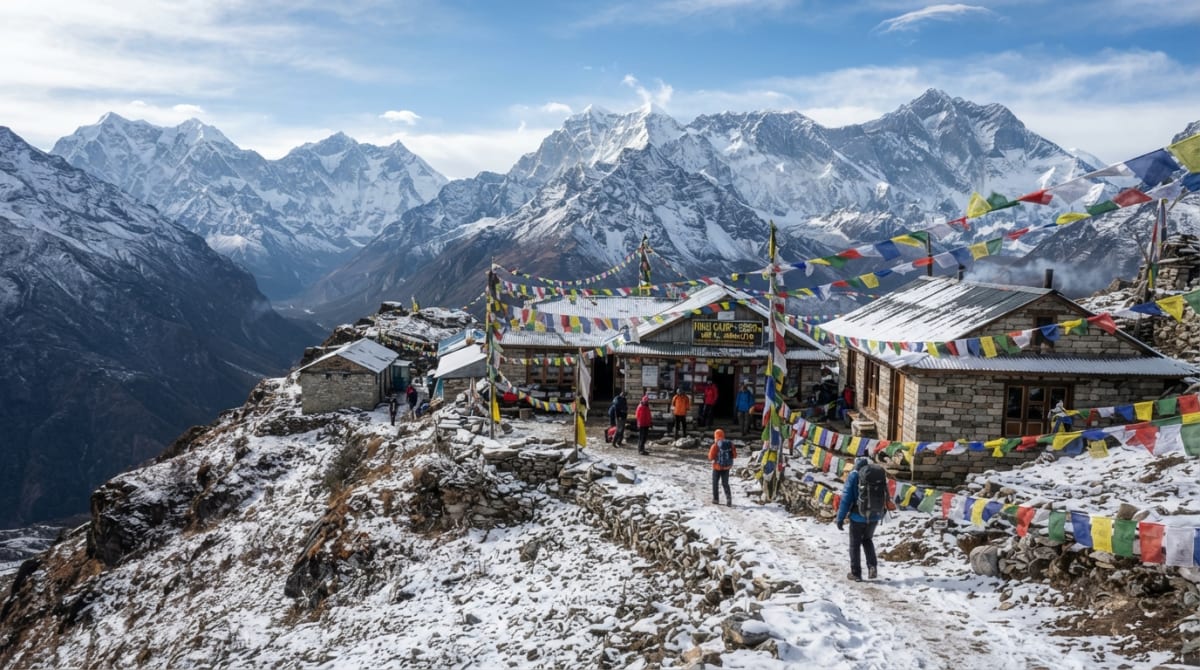
Tea house — A simple, family-run lodge on a trekking route, offering twin rooms, meals and drinks. Tea house trekking means sleeping and eating in these lodges rather than camping. See the tea house guide.
Dining room — The communal room in a tea house, usually the only heated space, warmed by a stove. It is the social heart of the lodge in the evening.
Homestay — Accommodation in a local family's home, common in villages such as Dhampus, Ghalel and Lwang. See homestays near Mardi Himal.
Squat toilet — A toilet set into the floor, common in tea houses, usually flushed with a bucket of water.
Food and Drink
Dal bhat — Nepal's staple meal of rice (bhat) and lentil soup (dal), usually served with vegetable curry (tarkari), pickle (achar) and sometimes greens, with free refills in most lodges. Trekkers often say "dal bhat power, 24 hour." See dal bhat on Mardi Himal.
Tarkari — Vegetable curry, often potato, cauliflower or seasonal greens.
Achar — Pickle or relish, often spicy, made from tomatoes, radish, chili or other vegetables.
Momo — Steamed or fried dumplings filled with vegetables, cheese or meat, originally Tibetan and now a Nepali favorite.
Chiya — Tea, usually sweet milk tea spiced with ginger or cardamom.
Tibetan bread — Deep-fried flatbread, often served with honey or jam at breakfast.
Dhido — A thick porridge made from millet, buckwheat or maize flour, eaten with curry, traditional in hill villages.
Gundruk — Fermented and dried leafy greens, often made into a tangy soup or pickle.
Roti — Flatbread, sometimes made from millet or wheat.
Raksi — Local distilled spirit, often made from millet or rice. Best avoided at altitude.
See Nepali dishes to try and the menu guide.
Greetings and Everyday Words
Namaste — The universal Nepali greeting, said with palms pressed together, meaning roughly "I bow to the divine in you." Used for hello and goodbye.
Dhanyabad — Thank you.
Didi and dai — Older sister and older brother, used respectfully for women and men, including lodge owners and staff.
Bahini and bhai — Younger sister and younger brother.
Ramro — Good or beautiful.
Bistari — Slowly. Guides often say "bistari, bistari," slowly, slowly, a good motto at altitude.
Pani — Water. "Tato pani" means hot water.
Kati? — How much? Useful for prices.
Culture and Religion
Gurung (Tamu) — One of the main ethnic groups of the Annapurna region, with their own language and traditions and a long history of Gurkha service. See Gurung culture.
Prayer flags — Colored cloth flags printed with prayers, strung at passes, viewpoints and shrines, believed to spread blessings on the wind.
Chorten or stupa — A Buddhist monument, which should be passed on the left, walking clockwise.
Mani wall — A wall of stones carved with Buddhist prayers, also passed clockwise.
Tika — A mark on the forehead, often red powder and rice, given as a blessing, especially at festivals.
Dashain and Tihar — Nepal's biggest festivals, usually in October or November. See trekking during Dashain and Tihar.
Lhosar — New year festival for several communities; Tamu Lhosar is the Gurung new year, usually in late December.
Gurkha — Nepali soldiers serving in the British and Indian armies, many from Gurung villages. See Gurkha heritage.
Trekking and Logistics
Trailhead — The starting point of a trek, such as Kande, Phedi or Dhampus.
Porter — A person employed to carry trekkers' bags. See life of a porter.
Porter-guide — A person who combines the roles of guide and porter, common on shorter treks.
Licensed guide — A trained guide holding a government license, required for foreign trekkers since 2023. See how guides are licensed.
Daypack — A small backpack carried by the trekker with essentials for the day, while the porter carries the main bag.
Duffel bag — A soft, durable bag used for porters to carry trekkers' main luggage.
Microspikes — Slip-on chains with small spikes for boots, used on icy trails in winter.
Trail Features
Stone steps — Paved staircases built into steep sections of trail, especially near villages. The climb from Kande to Australian Camp and from Phedi to Dhampus both involve long flights of stone steps.
Suspension bridge — A steel cable bridge across a river gorge, common on routes linking Mardi Himal with Landruk and the Annapurna Base Camp trail.
Cairn — A pile of stones marking the route, especially on open ground above High Camp.
Mule train — A line of pack mules carrying supplies. Always step to the uphill side of the trail to let them pass.
Switchbacks — Zigzagging sections of trail that climb or descend a steep slope gradually.
Weather and Seasons
Monsoon — The rainy season, roughly June to August or early September, when moist air from the Bay of Bengal brings heavy rain to the southern Himalaya.
Pre-monsoon and post-monsoon — Spring (March to May) and autumn (late September to November), the two main trekking seasons.
Sea of clouds — A layer of cloud filling the valleys below the ridge while the peaks and ridge stand in sunshine, common on Mardi Himal. See the sea of clouds.
Wind chill — The cooling effect of wind, which makes temperatures on the exposed ridge feel much colder than the thermometer shows.
Gear Terms
Base layer — The layer worn next to the skin, ideally synthetic or merino wool, which wicks sweat away.
Mid-layer — An insulating layer such as a fleece, worn over the base layer.
Shell — A waterproof and windproof outer jacket and trousers.
Down jacket — A warm, lightweight jacket filled with feathers, essential for evenings at High Camp and summit morning. See choosing a down jacket.
Comfort rating — The temperature at which a sleeping bag should keep an average person comfortable. For Mardi Himal, around minus ten degrees Celsius is a good target.
Gaiters — Coverings worn over boots and lower legs to keep out mud, snow and, in the monsoon, leeches.
Permits and Administration
ACAP — Annapurna Conservation Area Project, which manages the conservation area where the trek lies. The ACAP permit is required for all trekkers. See the ACAP permit.
TIMS — Trekkers' Information Management System card, a registration card that may be required for trekking.
Checkpoint — A post on the trail where permits are checked, such as at Pothana. See checkpoints on the trek.
NPR — Nepali rupees, the local currency.
SAARC — South Asian Association for Regional Cooperation; nationals of member countries pay reduced permit fees.
Altitude and Health
Acclimatization — The process by which the body adjusts to lower oxygen levels at altitude. See acclimatization on Mardi Himal.
AMS — Acute mountain sickness, the most common form of altitude sickness, with headache, nausea, fatigue and poor sleep.
HAPE — High altitude pulmonary edema, a serious condition involving fluid in the lungs.
HACE — High altitude cerebral edema, a serious condition involving swelling of the brain.
Diamox — A brand name for acetazolamide, a medication sometimes used to prevent or treat altitude sickness.
Climb high, sleep low — The principle of climbing to a higher altitude during the day and returning lower to sleep, used on the Mardi Himal summit hike.
See AMS, HAPE and HACE explained.
Nature and Wildlife
Lali gurans — The tree rhododendron, Nepal's national flower, which blooms red, pink and white in the forests of the trek in spring. See the rhododendron forest.
Danphe — The Himalayan monal, Nepal's national bird, a spectacular pheasant sometimes seen near Low Camp. See the Himalayan monal.
Langur — A long-tailed, grey monkey with a black face, sometimes seen in the forest.
Tahr — A wild mountain goat that lives on steep slopes, occasionally seen on the upper ridge.
Lammergeier — The bearded vulture, a huge bird of prey that soars along Himalayan ridges.
Why Learning a Few Words Matters
You do not need to speak Nepali to trek Mardi Himal, as guides speak English and lodge menus are usually in English too. But a few words make a real difference. A warm "namaste" when you arrive at a lodge, a "dhanyabad" after a meal, or calling the lodge owner "didi" shows respect and often brings a smile. Understanding place names helps you picture the landscape, and knowing what dal bhat, tarkari and achar mean makes menus easier. Most of all, showing interest in the language opens conversations with your guide, porter and the people you meet, which is often where the most memorable moments of a trek come from. See cultural dos and don'ts.
Trek with People Who Speak the Language
Our local guides are happy to teach you more Nepali on the trail and explain the stories behind the names. See the 5-day Mardi Himal Trek from Pokhara or the 9-day trek from Kathmandu, and contact us to book.