

Every trek has its defining moments, the scenes you replay in your mind long after you get home. On the Mardi Himal Trek, there are more of them than its short length might suggest. In a few days, you pass from Pokhara's lakeside through ancient forest and onto a high ridge that climbs straight toward one of the most beautiful mountains on Earth. Here are fifteen moments to look forward to, in roughly the order you will experience them. For the full route, see the day-by-day itinerary.
1. The Morning View from Pokhara
Your trek begins before you take a single step on the trail. On clear mornings in Pokhara, the Annapurna range rises above the city, and Machapuchare's distinctive fishtail summit stands out above the green foothills. From the shores of Phewa Lake or the rooftop of your hotel, it looks impossibly high and far away. Knowing that in a few days you will be standing almost beneath it gives the view a special thrill. Get up early on your first morning, find a spot with a clear view to the north, and watch the peaks turn pink in the dawn light. See the Lakeside guide for trekkers.
2. The First Panorama at Australian Camp
After an hour's steep climb from Kande, the trail emerges onto a broad, grassy ridge at Australian Camp, around 2,060 meters. Suddenly the whole range is in front of you: Machapuchare, Annapurna South, Hiunchuli and, on clear days, more distant Annapurna peaks. It is the first big view of the trek, and it comes early, on the very first morning. Many trekkers sit on the grass with a cup of tea and simply stare. If your itinerary allows, spending the first night here gives you both sunset and sunrise over the mountains. See Australian Camp.
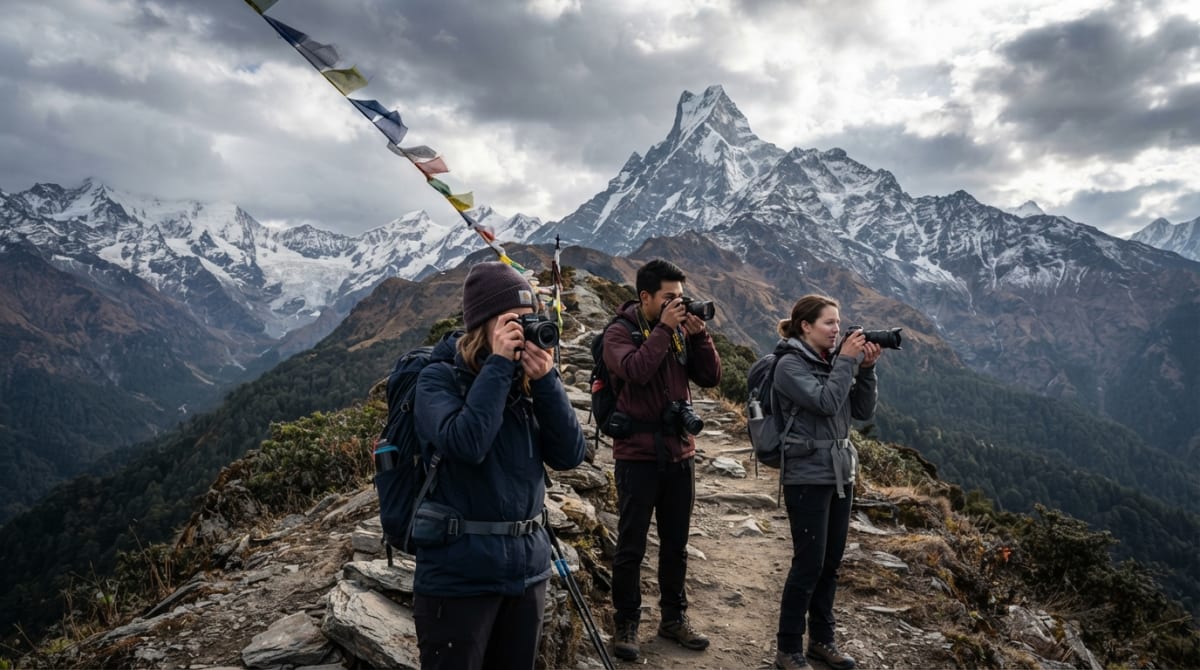
3. The Junction at Pitam Deurali
At Pitam Deurali, the trail divides. One path heads west toward Landruk and the busy route to Annapurna Base Camp; the other turns north into the forest toward Mardi Himal. Taking the quieter fork feels like leaving the main road for a hidden path. Pitam Deurali itself is a small cluster of lodges on a forested saddle, and on clear evenings Machapuchare glows above the trees. It is where the Mardi Himal adventure really begins. See Pitam Deurali.
4. Walking Through the Rhododendron Forest
The day from Pitam Deurali to Forest Camp is spent in one of the finest forests in the Annapurna foothills. Towering rhododendrons and oaks close in overhead, their trunks thick with moss, ferns and hanging lichen, and mist drifts between the trees. In spring, the rhododendrons bloom in deep red, pink and white, and the trail is carpeted with fallen petals. At other times of year, the forest is green, hushed and full of birdsong. It is a completely different world from the high ridge, and many trekkers are surprised by how much they love it. See the rhododendron forest.
5. Spotting a Himalayan Monal
Keep your eyes open near the forest edge, especially in the early morning. The Himalayan monal, known in Nepal as the danphe, is the country's national bird, and the male is one of the most spectacular birds in Asia, with iridescent plumage of green, blue, copper and purple. Monals are sometimes seen in clearings and on open slopes near Low Camp and the lower ridge. Seeing one flash across the trail is a highlight for many trekkers, birders or not. See the Himalayan monal.
6. Stepping Out of the Forest at Low Camp
After hours of climbing through the forest, the trees begin to shrink and thin, and then, at Low Camp, around 2,970 meters, you step out into the open. Machapuchare rises directly ahead, much closer and larger than before, its sheer faces and sharp summit filling the sky. It is one of the most dramatic reveals of any trek in Nepal, and it marks the transition from the forest to the high mountains. See Low Camp.
7. The Sea of Clouds
On many mornings and evenings on the upper trek, the valleys below fill with cloud while the ridge stays in sunshine. From Low Camp, Badal Danda or High Camp, you look down on a white ocean stretching toward the horizon, with forested hills poking through like islands and the peaks rising above. It is a surreal, beautiful sight, and it changes by the minute as the clouds move and the light shifts. See the sea of clouds.
8. The Ridge Walk to High Camp
The walk from Low Camp through Badal Danda to High Camp follows the crest of an open, grassy ridge, with Machapuchare ahead, the deep Modi Khola valley to the west and the Mardi Khola valley to the east. For three or four hours, you walk with views in every direction, the mountains growing larger with every step. It is the heart of the trek and, for many trekkers, the most beautiful walking of the whole trip. See the Mardi Himal ridge and Low Camp to High Camp.
9. Sunset at Badal Danda or High Camp
As the afternoon fades on the ridge, the light turns golden, then pink, and the snow on Machapuchare, Mardi Himal and Annapurna South glows against a darkening sky. Clouds swirl around Badal Danda, the "cloud hill," and the valleys below turn blue. Sunset from High Camp, with the peaks close and the ridge falling away toward Pokhara, is one of the finest of the trek. Put on your down jacket, step outside, and watch the show. See sunset at Low Camp and Badal Danda.
10. A Night Sky Full of Stars
Far from any city lights, the night sky above High Camp is extraordinary. On clear nights, especially around the new moon, the Milky Way arcs over the ridge, and the stars seem close enough to touch. On moonlit nights, Machapuchare glows silver in the darkness. Step outside the lodge for a few minutes before bed, let your eyes adjust, and look up. It is cold, but unforgettable. See stargazing on Mardi Himal.
11. Headlamps on the Ridge Before Dawn
Summit day begins in darkness, around four in the morning. You step out into freezing air, switch on your headlamp, and join a line of lights climbing the steep ridge above High Camp. It is cold, hard work, and your breath comes quickly in the thin air. But there is something magical about it too: the silence, the stars fading overhead, the first hint of light in the east, and the sense of shared purpose with the trekkers around you. See High Camp to Base Camp.
12. Sunrise at the Upper View Point
This is the moment most trekkers come for. At the Upper View Point, around 4,200 meters, you wait in the cold as the sky brightens. Then the first sunlight touches the highest summits, turning them pink, then orange, then gold, while the valleys below remain in shadow. Within minutes, the light spreads across the whole range, and you feel the first warmth on your face. Machapuchare, Mardi Himal, Annapurna South and Hiunchuli glow in front of you. It is one of the great mountain sunrises of the Himalaya. See the sunrise guide.
13. Standing at Mardi Himal Base Camp
From the viewpoint, the trail continues to Mardi Himal Base Camp at around 4,500 meters, the highest point of the trek. Here, the mountains are no longer a distant skyline. Mardi Himal's steep slopes rise directly ahead, glaciers and moraines lie beneath Machapuchare's sheer west face, and prayer flags snap in the wind. For many trekkers, it is the highest place they have ever stood, and the sense of achievement is profound. See the Base Camp visitor's guide.
14. Descending into the Villages
After the summit, the descent from Low Camp to Siding takes you back through the forest and down into terraced farmland, with farmhouses, water buffalo, children calling "namaste," and the smell of wood smoke. After days in the high mountains, the return to village life is warm and welcoming, and lunch in Siding feels like a celebration. If you have time, a night in a village such as Lwang adds a cultural finale. See the Siding village guide and Mardi Himal via Lwang.
15. The First Hot Shower Back in Pokhara
It sounds trivial, but ask any trekker: the first hot shower after a trek is a highlight in its own right. After days of basic facilities and cold mornings, arriving back in Pokhara, peeling off your trekking clothes and standing under hot water is pure bliss. Follow it with a celebratory dinner by Phewa Lake, perhaps with a view of the mountains you just walked beneath, and a well-earned night in a real bed. See things to do in Pokhara after the trek.
Smaller Moments Worth Savoring
Beyond the big scenes, the Mardi Himal Trek is full of smaller pleasures that often end up among trekkers' favorite memories. The first steaming plate of dal bhat after a long day, with the lodge owner coming round to offer a second helping without being asked. A cup of sweet ginger lemon honey tea at Rest Camp as mist drifts through the trees. The sound of porters laughing and singing as they pass on the trail. Warming your hands around the stove in the dining room at High Camp while trekkers from half a dozen countries swap stories. Waking at Low Camp to find the clouds have cleared overnight and Machapuchare is glowing outside your window. The prayer flags at Base Camp snapping in the wind, carrying their blessings toward the peaks. None of these will appear in anyone's itinerary, but together they give the trek its warmth. See evenings in the tea houses and prayer flags and shrines on the trail.
Highlights by Season
Each season shifts which moments shine brightest. In autumn, from late September to November, the mountain views are at their most reliable, sunrises at the Upper View Point are usually crystal clear, and the terraced fields around Siding glow gold at harvest time. In spring, from March to May, the rhododendron forest steals the show, bursting with color, birdsong fills the trees, and the lower ridge is dotted with dwarf rhododendron in flower, though afternoon cloud is more common. In winter, from December to February, the skies are often perfectly clear, snow dusts the upper ridge, and the stars at High Camp are dazzling, at the price of very cold nights. In the monsoon, from June to August, the forest is lush and green, the trail is quiet, and the rare clear morning feels like a gift. See the monthly weather guide.
Making the Most of These Moments
To give yourself the best chance of experiencing all fifteen, choose your season and itinerary with care. Autumn offers the clearest skies for mountain views and sunrises, while spring brings rhododendrons in the forest. Longer itineraries give you more time to enjoy sunsets, stars and forest walks, and an extra night at High Camp gives you a second chance at a clear summit morning. Walk slowly, look around, and put the camera down sometimes. See how to get the most out of Mardi Himal and the best time for the trek.
Why These Moments Stay with You
Part of what makes these moments so memorable is how hard you work for them. The first view at Australian Camp comes after a steep climb from the road. The reveal of Machapuchare at Low Camp comes after a long day in the forest. The sunrise at the Upper View Point comes after a freezing, breathless climb in the dark. Effort sharpens the senses and deepens the reward. The other part is contrast: the dim green forest makes the open ridge feel vast, the cold of summit morning makes the first warm sunlight feel precious, and the simplicity of the lodges makes the hot shower in Pokhara feel luxurious. Trekkers often say they come home changed in small ways, more patient, more grateful and more aware of how little they really need. See is the Mardi Himal Trek worth it?
Experience the Highlights with Us
All of these moments are part of every Mardi Himal itinerary we run. For a relaxed pace with time to enjoy them, choose the 9-day Mardi Himal Trek from Kathmandu or the 5-day trek from Pokhara. Contact us to plan your trip.