

The Low Camp to Siding trail is the quickest way off the Mardi Himal ridge. Instead of retracing the long route south through Forest Camp and Pitam Deurali, it turns east at Low Camp and plunges straight down the flank of the ridge, through dense rhododendron and oak forest, bamboo thickets and finally terraced fields, to the village of Siding and the road back to Pokhara. It is short on the map but steep on the ground, dropping around 1,200 meters in four to five hours. For most trekkers, it is the final chapter of the trek.
This guide walks you through the trail section by section, explains how long it takes, what the terrain is like, how to handle it safely, and what changes if you walk it uphill. It is the final day of the 5-day Mardi Himal Trek from Pokhara, and the same trail closes our other itineraries too. For the village at the start, see Low Camp.
The Trail at a Glance
| Detail | Information |
|---|---|
| Start | Low Camp, about 2,970 m |
| End | Siding, around 1,750 m |
| Height change | About 1,200 m of descent |
| Time downhill | 4–5 hours with breaks |
| Time uphill | 6–7 hours with breaks |
| Terrain | Forest trail, roots, stone steps, then farm paths |
| Facilities | Very limited on the trail; tea houses in Siding |
Leaving Low Camp
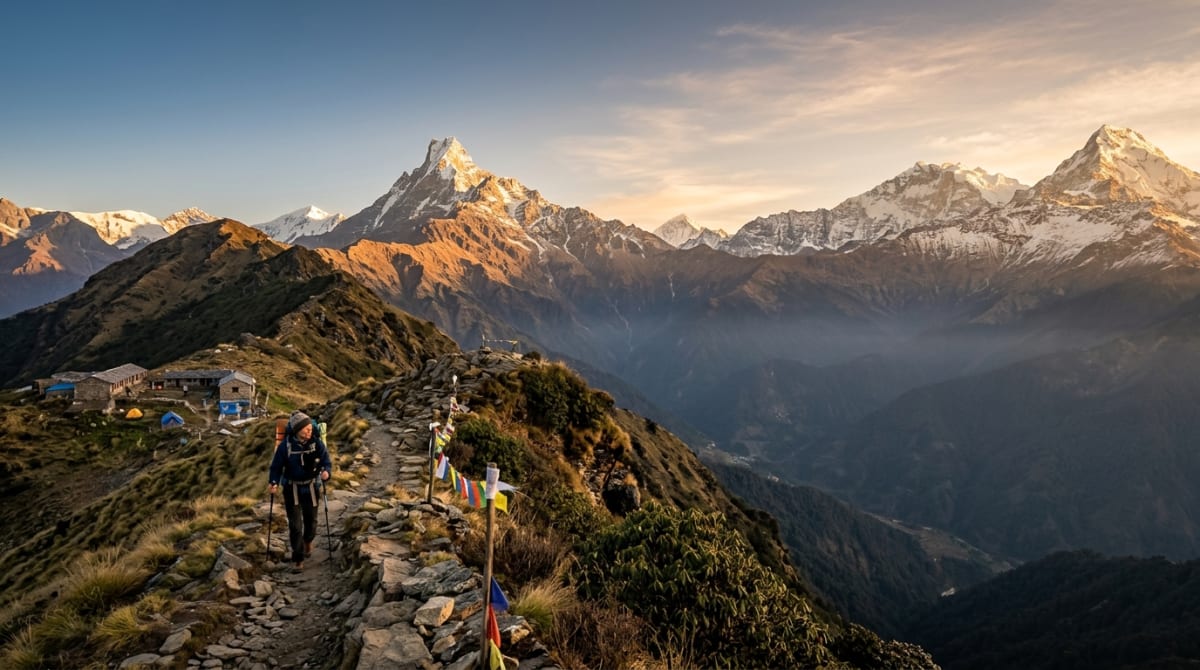
Most groups leave Low Camp after breakfast, between 7 and 8 a.m. If you have spent the night here after the summit, take a last look at Machapuchare from the lodge terrace, as the peak disappears from view once you enter the forest. Fill your water bottles with treated water, pack snacks and rain gear in your daypack, and set your trekking poles slightly longer for the descent. The trail to Siding branches off near the lodges, heading east and downhill, while the main trail continues south along the ridge toward Forest Camp. Your guide will lead the way, but the junction is usually well marked. See trail markings and navigation.
Section One: The Upper Forest
The first part of the descent is the steepest and most atmospheric. The trail drops through an old forest of rhododendron and oak, with twisted trunks covered in thick green moss, ferns and lichens hanging from the branches, and a floor of leaf litter and roots. Mist often drifts through the trees, and sound is muffled, giving the forest a hushed, enchanted feel. In March and April, the rhododendrons bloom in red, pink and white, and the trail is scattered with petals.
The path here descends in steep zigzags and, in places, straight down on roots and rough stone steps. It is rarely dangerous, but it demands concentration. After rain, the roots and stones are slippery, and the earth turns to mud. Take short steps, place your feet deliberately, and use your poles to take weight off your knees. This is not the place to rush. Allow about two hours for this section. See the rhododendron forest section and steep sections on Mardi Himal.
Section Two: Bamboo and Clearings
As you lose height, the forest changes. Bamboo appears in dense thickets along the trail, the trees become more mixed, and small streams cross the path. Clearings open views across the valley of the Mardi Khola to the terraced hillsides opposite, and you may pass seasonal herders' huts or a small tea stall, where you can buy tea, biscuits or noodles if it is open. This is a good place for a longer break. The gradient eases slightly, though there are still steep pitches. The air grows warmer, and you will likely want to remove a layer. Allow about an hour to an hour and a half. See oak, bamboo and moss forests.
Section Three: Terraces and Farmland
The final section leaves the forest and enters farmland. The trail becomes a village path, sometimes paved with stones, winding between terraced fields of millet, maize, rice or vegetables and past scattered farmhouses. Buffaloes, goats and chickens are common companions, and villagers may be working in the fields. The gradient is gentler, but after hours of descent, your legs will feel every step. Siding appears below, a cluster of houses, lodges and a road, and you arrive for lunch. Allow about an hour. See farming and village life and the Siding village guide.
How Hard Is It?
Low Camp to Siding is not technically difficult, and it involves no altitude problems, since every step takes you into thicker air. Its difficulty is the steepness and length of the descent. Losing 1,200 meters on uneven forest trail is tiring for the quadriceps and hard on the knees, and many trekkers feel stiff for a day or two afterward. When you walk it on the day after summit day, it can feel harder than expected, because your legs are already tired. On the 3-day short trek, which descends from Base Camp to Siding in a single day, this section comes at the end of a very long day and is the most tiring part of the trek. See difficulty by section and how hard the short trek is.
Protecting Your Knees and Feet
- Two trekking poles reduce the load on your knees significantly on steep descents.
- Short steps with bent knees absorb impact better than long strides.
- Lace boots firmly across the instep to stop your toes hitting the front.
- Trim toenails before the trek to avoid bruised or lost nails.
- Treat hot spots immediately with tape or blister plasters.
- Wear a knee support if you have a history of knee problems.
- Stretch your quads and calves at breaks and in the evening.
See trekking Mardi Himal with knee problems and preventing blisters.
Pacing the Descent
A steady, unhurried rhythm is the key to a comfortable descent. Many trekkers set off from Low Camp full of energy, relieved to be heading down, and move quickly through the first steep section, only to find their legs shaking and their knees aching by the time they reach the bamboo. A better approach is to walk the upper forest slowly and deliberately, taking a short break every forty-five minutes or so to drink, eat a snack and let your legs recover. Look up often, too; the forest is beautiful, and it is easy to spend the whole descent staring at your feet.
Your guide will set the pace for the group and will walk at the speed of the slowest member. If you are finding the descent hard, say so early. Simple adjustments, such as more frequent stops, lengthening your poles, or letting a porter carry a few items from your daypack, can make a big difference. There is no prize for reaching Siding first, and the jeep will wait. See pacing on the Mardi Himal Trek.
Water, Food and Rest Stops
Facilities between Low Camp and Siding are limited. There may be one or two seasonal tea stalls, but you should not rely on them. Carry at least a liter and a half of treated water per person, plus snacks such as nuts, chocolate, energy bars or biscuits. Streams in the middle section can be used to refill, but always treat the water with tablets, drops, a filter or a UV purifier before drinking. Plan to eat lunch in Siding, where the tea houses cook dal bhat, noodles and fried rice. See water sources on the trail and safe drinking water.
Weather and Seasons
Autumn (September–November): The best conditions, with dry, firm trails and pleasant temperatures. Early autumn can still be muddy after late monsoon rains.
Winter (December–February): Dry and cool; the upper forest can be cold and shaded, and occasional frost or light snow makes the first section slick.
Spring (March–May): Rhododendron season, with the forest at its most beautiful. Afternoon showers become more common in May.
Monsoon (June–August): The most challenging time. Rain turns the trail into mud, roots and stones become slippery, and leeches are common in the lower forest. Allow extra time, wear gaiters, and carry salt or leech repellent. See Mardi Himal in the monsoon and leeches on Mardi Himal.
Walking It in Reverse: Siding to Low Camp
Some itineraries, especially shorter ones, start the trek from Siding and climb directly to Low Camp. This is a demanding first day: around 1,200 meters of steep ascent through forest, taking six to seven hours. It gets you onto the upper ridge quickly, but it gains height faster than the Kande route, which is less friendly to acclimatization, and the relentless climb can be a shock for trekkers who have just arrived in Nepal. If you choose this approach, start early, pace yourself very slowly, drink plenty of water, and consider an extra night at Low Camp before heading higher. See trekking Mardi Himal in reverse and acclimatization on Mardi Himal.
Low Camp to Siding vs Returning via Forest Camp
| Via Siding | Via Forest Camp and Kande | |
|---|---|---|
| Distance and time | Shorter: 4–5 hours to the road | Longer: usually 1.5 days to the road |
| Gradient | Steep and direct | More gradual, with some climbs |
| Scenery | New trail, forest and farmland | Retraces the ascent route |
| Road access | Rough jeep road from Siding | Paved road at Kande or Phedi |
| Best for | Most trekkers; completing a loop | Very muddy conditions, road closures or knee concerns |
Most trekkers prefer the Siding route because it completes a loop and saves time. Your guide may recommend returning via Forest Camp if the Siding trail is dangerously muddy or the jeep road is blocked. See the map and route guide.
Safety on the Descent
The main risks on this trail are slips and falls, twisted ankles and fatigue. Keep a steady pace, stay with your group, and follow your guide's instructions, especially on the steepest pitches and after rain. Watch where you put your feet on roots and wet stones. In the monsoon, check the forecast and avoid descending during heavy rain if possible, as small landslides can occur on the slopes below. In autumn, when the trail is busier, give way to porters and mule trains where they appear, stepping to the uphill side of the path. See slippery trails after rain and trail etiquette.
Wildlife Along the Way
The forest between Low Camp and Siding is one of the richest wildlife habitats on the trek. Listen for laughing thrushes, barbets and cuckoos, and look for flashes of color from sunbirds and minivets in spring. Langur monkeys are sometimes seen swinging through the canopy, and with luck you may spot the Himalayan monal, Nepal's national bird, in clearings near the upper forest. Walk quietly, pause often, and bring binoculars if you are a keen birder. See birdwatching on Mardi Himal and langur monkeys on Mardi Himal.
Arriving in Siding and Driving to Pokhara
In Siding, most groups stop for lunch before boarding a jeep for the two- to three-hour drive back to Pokhara on a rough rural road that joins a better road near Lumre. The ride is bumpy and dusty in the dry season and can be slow after rain. If you suffer from motion sickness, sit in the front and take medication beforehand. You usually reach Pokhara by late afternoon, in time to celebrate by the lake. If you would rather not rush, it is also possible to spend the night in one of Siding's simple lodges and drive back the next morning, a relaxed option that gives you an evening of village life and a chance to rest your legs before the road. See the Siding to Pokhara jeep.
Packing for the Final Day
- Daypack with water (at least 1.5 liters), snacks and water treatment
- Rain jacket and pack cover, plus gaiters in the monsoon
- Light layers; you start cool and finish warm
- Sun hat, sunglasses and sunscreen for the farmland
- Trekking poles
- Blister kit and any personal medication
- Cash for lunch, drinks and tips
- Camera or phone for the forest and village scenes
Walk Low Camp to Siding with Us
The Low Camp to Siding descent is the last trekking day of our 5-day Mardi Himal Trek from Pokhara and the final stretch of the 3-day Short Mardi Himal Trek and the 9-day trek from Kathmandu. Contact us to choose the itinerary that suits your time and pace.