

Above Forest Camp, the Mardi Himal trail climbs into a different kind of forest. The trees grow shorter and more twisted, their branches hung with thick cushions of moss and beards of lichen. Mist often drifts between the trunks, muffling sound and softening the light. This is the cloud forest, a zone where moisture from rising clouds keeps everything damp and green. After two or three hours of steady climbing, the trees begin to thin, and suddenly Machapuchare fills the sky ahead. The walk from Forest Camp to Low Camp is short, but it delivers one of the most dramatic transitions of the whole trek.
This guide explains what to expect on this section, from terrain and timing to nature, views and conditions. On our 9-day Mardi Himal Trek, it forms the first part of the day from Forest Camp to High Camp.
The Section at a Glance
| Detail | Information |
|---|---|
| Start | Forest Camp, about 2,600 m |
| Via | Rest Camp |
| End | Low Camp, about 2,970 m |
| Walking time | 2–3 hours |
| Approximate distance | 3–4 km |
| Terrain | Steady forest climb, roots, stones, some steep pitches |
Leaving Forest Camp
From Forest Camp, the trail climbs steadily through the forest, passing the small lodge stop of Rest Camp after a short while. The path is well defined, winding between trees and over roots and rocks. In the early morning, the forest is often clear and bright, with sunlight filtering through the canopy. By mid-morning, mist frequently rises from the valleys, and the forest takes on a quiet, mysterious atmosphere. See Rest Camp.
Into the Cloud Forest
As you climb above about 2,700 meters, the character of the forest changes. Rhododendrons and oaks become smaller and more gnarled, shaped by wind and snow. Their branches are covered in thick moss, ferns and lichens, including the pale, hair-like lichen sometimes called old man's beard. The ground is soft and damp, and small streams trickle across the trail in places. This cloud forest is one of the most atmospheric environments on the trek, and it is easy to see why guides slow down here to let trekkers take it in. See oak, bamboo and moss forests.
The Final Climb to Low Camp
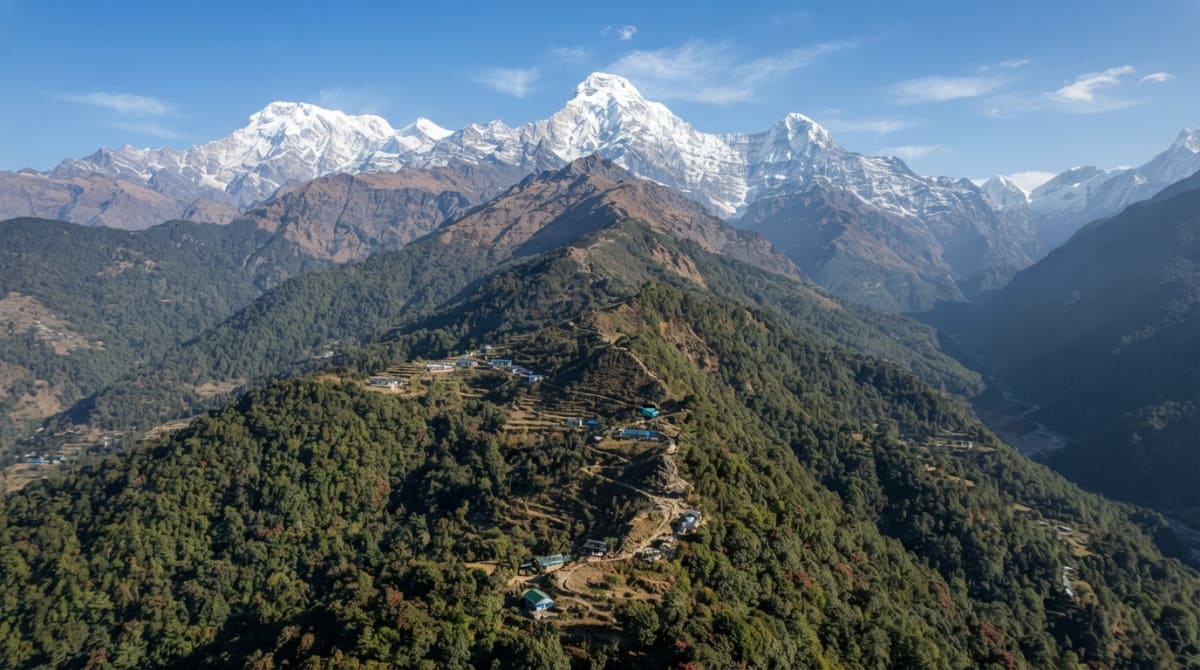
The last part of the climb, below Low Camp, is steeper, with some rocky steps and roots that can be slippery when wet. Take your time and use trekking poles for balance. As you approach Low Camp, the trees thin, patches of sky appear, and glimpses of Machapuchare's summit begin to show through gaps in the canopy, building anticipation. Then the trail emerges onto a small shoulder of the ridge, and Low Camp's lodges appear, with the Fishtail peak rising directly ahead.
Arriving at Low Camp
Low Camp, at around 2,970 meters, is where the Mardi Himal Trek opens up. For the first time, you have a clear, close view of Machapuchare, and on the 5-day trek, you spend the night here. On the 9-day and 7-day treks, you stop for tea or lunch and then continue up the ridge to High Camp. See our Low Camp guide.
Hour by Hour
A typical morning on this section begins with breakfast at Forest Camp around 7 a.m. and a start by 8. The first half hour climbs gently to Rest Camp, a good place for a quick stop if you need one. Beyond Rest Camp, the trail steepens gradually, and the forest becomes denser with moss. Around an hour and a half in, you notice the trees growing shorter and the light brighter as the canopy thins. The final half hour is the steepest, climbing rocky steps with glimpses of Machapuchare through the branches. Most trekkers reach Low Camp by mid-morning, in time for tea and, on longer itineraries, a push on toward High Camp.
The Section Through the Seasons
In spring, the upper forest blooms a little later than the lower forest, so rhododendrons may still be flowering here into late April, often in paler pinks and whites. In autumn, the forest is green and clear after the monsoon, and mornings often reveal Machapuchare through the trees. In winter, frost coats the moss, icy patches can form on steep steps, and after storms there may be snow on the trail near Low Camp. In the monsoon, the cloud forest is at its wettest and most atmospheric, with muddy, slippery sections and leeches on the lower part. See the best time for the trek.
Nature in the Cloud Forest
The cloud forest supports a rich community of plants and animals. Thick mosses and lichens cover almost every surface, and ferns and small orchids grow on branches. Birds are common, though often heard more than seen: laughingthrushes chatter in the undergrowth, tits and warblers move through the canopy, and pheasants sometimes cross the trail. Near the upper edge of the forest, you may spot the Himalayan monal, Nepal's colourful national bird, especially early in the morning. Langur monkeys occasionally move through the trees. See flora and fauna along the trail and spotting the Himalayan monal.
Acclimatization on the Climb
This section takes you from around 2,600 meters to nearly 3,000 meters, the altitude at which many trekkers begin to notice thinner air. You may find your breathing heavier on the steeper sections, and your pace naturally slower. This is normal. Walk at a steady, comfortable pace, breathe deeply, drink water regularly and take short rests. If you develop a headache, nausea or unusual tiredness, tell your guide; on longer itineraries, they may suggest staying at Low Camp rather than continuing to High Camp the same day. See acclimatization on Mardi Himal.
Safety on This Section
The main hazards here are slippery roots and stones, particularly on the steeper final climb and after rain, and reduced visibility in thick mist. Use trekking poles, place your feet carefully and do not hurry. Stay on the main trail and keep your guide in sight when the forest is misty. In winter, watch for ice on shaded steps. See slippery trails after rain.
Food and Water
Rest Camp offers a chance to buy tea or snacks, but otherwise there are no lodges until Low Camp, so carry water and snacks from Forest Camp. The climb is short enough that most trekkers eat at Low Camp, either an early lunch on longer itineraries or a late lunch after arriving on the 5-day trek. Treat any water you refill from taps or streams. See hydration on the trek.
On the 5-Day Trek: Part of a Longer Day
On the 5-day trek from Pokhara, you do not sleep at Forest Camp. Instead, this section is the final part of a long day two from Pitam Deurali to Low Camp, adding up to five or six hours of walking. By the time you reach the cloud forest, your legs will be tired, so pace yourself carefully in the morning and save energy for the steeper climb near the top. The reward is arriving at Low Camp in the afternoon with time to rest before sunset over Machapuchare. See the 5-day itinerary.
On the 9-Day Trek: Continuing to High Camp
On the 9-day and 7-day treks, you start this section fresh from a night at Forest Camp, reach Low Camp by mid-morning, and continue along the open ridge past Badal Danda to High Camp the same day. The total day is five to six hours with nearly 1,000 meters of ascent, one of the biggest days of the trek. Low Camp is a natural place for a tea break or early lunch before the ridge. See Low Camp to High Camp and the 9-day itinerary.
What to Wear
The cloud forest is often cool and damp, but the climb keeps you warm. A long-sleeved base layer and trekking trousers are usually enough while walking, with a fleece for breaks and a rain shell in your daypack for mist and showers. Near Low Camp, the air feels noticeably cooler, and if you are continuing onto the exposed ridge, have your windproof layer and warm hat ready. In winter, start with an extra layer and gloves. See what to wear on the trek.
Photography Tips
The cloud forest is one of the most photogenic environments on the trek. Soft, diffused light in mist brings out the textures of moss and lichen, and layers of trees fading into fog create depth. Look for twisted trunks, fern-covered branches, and shafts of sunlight breaking through the canopy. As you near Low Camp, frame glimpses of Machapuchare between the trees. Keep your camera accessible rather than packed away, as the first views of the peak can be fleeting. See the photography guide.
Pacing and Rest
Although this section is relatively short, it climbs steadily, and on many itineraries it follows or precedes other long walking. Walk slowly enough to breathe comfortably, take short breaks every 30 to 45 minutes on the steeper parts, and snack regularly. Resist the urge to race toward the view; Machapuchare will still be there when you arrive, and arriving tired makes the rest of the day harder.
Walking the Section in Reverse
On the way down, most itineraries do not return through the forest below Low Camp, since the descent to Siding branches off the ridge near Low Camp. However, if you return via the ascent route, for example when the Siding road is blocked or when exiting to Kande or Landruk, you will walk this section downhill. Descending through the cloud forest is quicker, around one and a half to two hours to Forest Camp, but the steep rocky steps and roots below Low Camp require care, especially when wet. Use trekking poles and take your time. See coming down from Base Camp.
The Transition from Forest to Ridge
One of the most memorable aspects of this section is the transition it marks. Below, you have spent a day or two enclosed by trees, with little sense of the surrounding landscape. At Low Camp, the forest ends and the world opens up: the ridge ahead, the deep valleys on either side, and Machapuchare towering above. Many trekkers describe this moment as the point where the trek changes from a forest walk to a genuine mountain journey. Above Low Camp, the trail follows the open, grassy ridge all the way to High Camp and Base Camp, with views almost every step of the way. See the Mardi Himal ridge.
For Families and Older Trekkers
This section is short, but the steep final climb can challenge children and older trekkers, especially at the end of a long day on the 5-day trek. Splitting the forest at Forest Camp, as on longer itineraries, makes it far more manageable. Take frequent breaks, keep snacks handy and turn the climb into a game of spotting birds and moss-covered shapes in the trees. See the family trek itinerary.
Water Sources on the Way
Small streams cross the trail in a few places in the cloud forest, especially after rain, and Rest Camp can refill bottles. Always treat water from streams before drinking, using tablets, a filter or a UV pen. Carrying one and a half liters from Forest Camp is usually enough for this section. See water sources on the trail.
If you are unsure about a water source, ask your guide, who will know which taps and streams are reliable in the current season.
Common Mistakes
The most frequent mistakes here are rushing the steep final climb, slipping on wet roots by not watching your footing, and not having a warm layer ready for the colder air near Low Camp. On longer days, some trekkers forget to eat and drink enough before continuing to High Camp, arriving exhausted. Take the section steadily, enjoy the forest, and use Low Camp as a proper rest stop.
Walk This Section with Us
This climb is part of every Mardi Himal itinerary. See the 9-day Mardi Himal Trek and the 5-day trek from Pokhara, and contact us to book.