

The first day of the Mardi Himal Trek is designed to ease you into life on the trail. It begins with a short, steep climb from the road at Kande, rewards you early with a sweeping mountain view at Australian Camp, and then settles into a gentle walk through forest to Pitam Deurali, where you spend your first night. By the end of the day, you will have left the noise of Pokhara far behind and settled into the rhythm of trekking.
This guide describes each section of day one in detail, with walking times, altitudes, what you will see and practical tips. For the full day-by-day plan, see our itinerary guide. Day one is the same on our 5-day trek from Pokhara and our longer itineraries.
Day One at a Glance
| Section | Time | Altitude |
|---|---|---|
| Pokhara to Kande (drive) | About 1 hour | 822 m → 1,770 m |
| Kande to Australian Camp | 1–1.5 hours | 1,770 m → about 2,060 m |
| Australian Camp to Pothana | 30–45 minutes | About 1,990 m |
| Pothana to Pitam Deurali | 1–1.5 hours | About 2,100–2,150 m |
Morning: The Drive and the Stairs
After breakfast in Pokhara, your jeep drives west out of the city along the Baglung highway, climbing through villages and farmland to Kande. From the road, a stone staircase climbs steeply through terraces and small homes. It is the steepest part of the day, gaining around 300 meters in an hour or so. Start slowly, breathe steadily and take short breaks. See our Kande trailhead guide.
Australian Camp
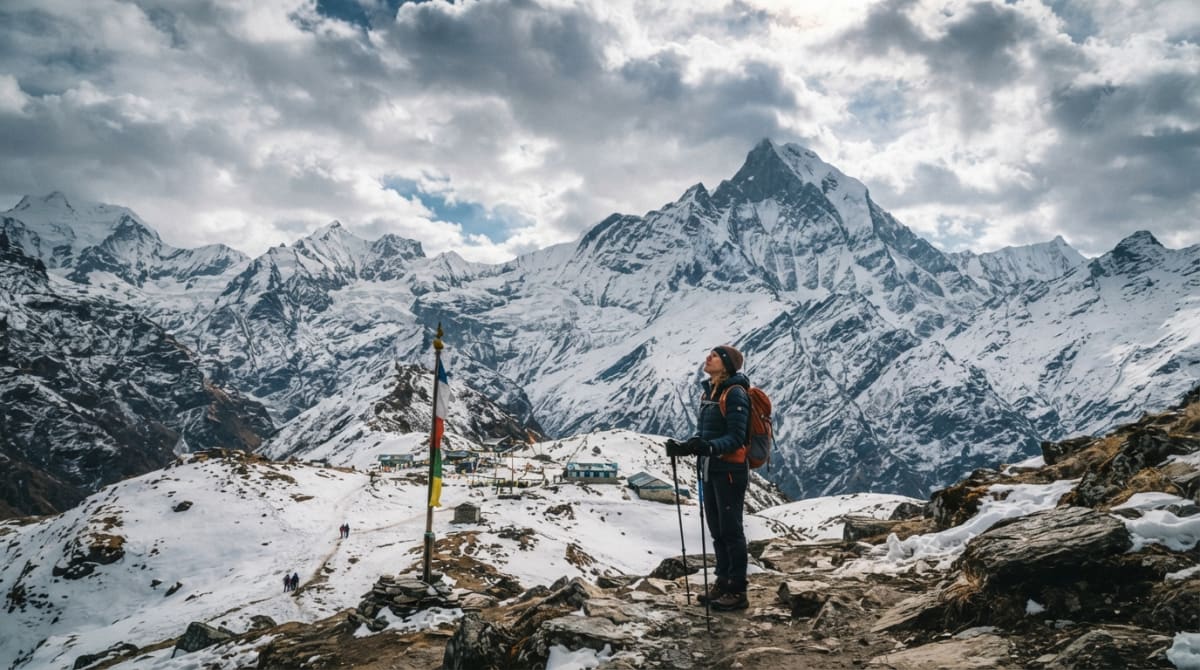
At the top of the stairs, the trail emerges onto a broad, grassy clearing: Australian Camp. On a clear morning, the view is superb, with the Annapurna range lined up across the northern skyline, including Machapuchare, Annapurna South and Hiunchuli. Several lodges surround the meadow, and it is a popular spot for a tea break. Day hikers from Pokhara often come only this far. See Australian Camp.
Pothana and the Checkpoint
From Australian Camp, the trail drops gently through forest to Pothana, a small settlement of lodges. Here, at the Annapurna Conservation Area checkpoint, your permits are checked and recorded. If you are trekking with a guide, they will handle the paperwork while you rest. See Mardi Himal checkpoints and Pothana village.
Pothana to Pitam Deurali: Into the Forest
After Pothana, the trail enters a pleasant forest of oak, rhododendron and other broadleaf trees, climbing gently with a few short ups and downs. The path is well defined, shaded and mostly easy underfoot, a welcome change after the staircase. Birds call from the canopy, and in spring the first rhododendron blooms appear. Occasional gaps in the trees offer glimpses of the peaks. This section is shared with trekkers heading toward Landruk and the Annapurna Base Camp trail, so you may meet other groups. After an hour or so, you reach Pitam Deurali, where the Mardi Himal route branches north from the Landruk trail.
Arriving at Pitam Deurali
Pitam Deurali, at around 2,100 to 2,150 meters, is a small cluster of lodges on the ridge. Most trekkers arrive in the early afternoon, with plenty of time to rest. It is one of the better-equipped stops on the route, with several lodges, some rooms with attached bathrooms, hot showers for a fee, charging and often mobile signal. On clear evenings, the views toward Machapuchare and the Annapurnas can be beautiful. See our Pitam Deurali guide.
The Afternoon and Evening
With the afternoon free, take a shower while the water is warm, change into dry clothes, and relax with a cup of tea. Charge your devices and organise your gear for the next day's long forest climb. Take a short, gentle walk around the lodges to stretch your legs. As the sun sets, the temperature drops quickly, and everyone gathers in the dining room. Dinner is usually around 6:30 p.m., often dal bhat or noodles. Go to bed early; day two is longer. See evenings in a Mardi Himal tea house.
Views on Day One
Day one offers two main viewpoints. The first is Australian Camp, where the Annapurna range appears across the skyline on clear mornings; arriving early gives you the best chance before haze builds. The second is around Pitam Deurali in the evening and early morning, when clouds often settle and the peaks glow in the low light. Between them, the forest limits views, but the trees themselves are beautiful, particularly in spring. See the photography guide.
Day One Through the Seasons
In autumn, day one is usually dry and clear, with comfortable temperatures and good views at Australian Camp. In winter, the air is crisp and often very clear, with frost in shaded forest and cold evenings at Pitam Deurali. In spring, the climb can be warm and hazy, but the forest comes alive with rhododendrons and birdsong. In the monsoon, the steps and forest trail are slippery, leeches are common, and views are often hidden, though the green landscape is lush. See the best time for the trek.
Pacing Your First Day
Day one is short, but how you walk it sets the tone for the rest of the trek. Resist the urge to race the stairs from Kande. Walk at a pace where you can still talk, take short regular breaks, and drink water often. If you arrive at Pitam Deurali feeling fresh, you have paced it well. Your body will also be adjusting to the altitude, which is modest on day one but will increase quickly over the next two days. See pacing yourself on the trek.
Nature on Day One
The forest between Australian Camp and Pitam Deurali is rich in birdlife, including laughingthrushes, tits and warblers, and you may see langur monkeys moving through the trees. In spring, rhododendrons bloom in red and pink, and wildflowers line the trail. Look for moss and ferns on the trunks and the view across the valleys through gaps in the canopy. See flora and fauna along the trail.
Alternative First-Day Plans
If you prefer an even gentler start, you can stop overnight at Australian Camp, enjoying sunset and sunrise over the Annapurnas, and continue to Pitam Deurali or Forest Camp the next day. If you are strong and on a fast itinerary, such as the 3-day short trek, you continue past Pitam Deurali through the forest to Low Camp on the first day. See the slow itinerary and the 3-day itinerary.
What to Pack for Day One
On day one, keep your daypack light but prepared. Carry at least a liter and a half of water, snacks, sunscreen, sunglasses and a sun hat for the open sections, a rain shell in case of showers, and a warm layer for stops at Australian Camp, where the breeze can be cool. Keep your permits accessible for the checkpoint at Pothana if you carry them yourself. A small first aid kit with blister care is useful from the first day, since new boots or socks can rub on the stairs. See our packing list.
Food and Water on Day One
You can stop for tea, snacks or lunch at Australian Camp and Pothana, both of which have lodges with simple menus. Many trekkers have an early lunch at Australian Camp or Pothana and arrive at Pitam Deurali in time for a late snack. Water can be refilled at lodges; treat it with tablets, a filter or a UV pen rather than buying plastic bottles. Drink regularly, even though the first day is short, to help your body adjust to the rising altitude. See safe drinking water on the trek.
Meeting Other Trekkers
Day one is often when you meet the people you will share the trail with for the next few days. Australian Camp and Pothana are busy with day hikers and trekkers heading to Landruk and Annapurna Base Camp, while at Pitam Deurali, the Mardi Himal trekkers begin to gather. Evenings in the dining room are sociable, with trekkers from many countries swapping plans and stories. Many friendships formed on day one continue all the way to Base Camp.
Lodges at Pitam Deurali
Pitam Deurali has several tea houses, making it one of the most comfortable overnight stops on the Mardi Himal route. Rooms are simple twin rooms with beds, mattresses and blankets, and some lodges offer rooms with attached bathrooms. Hot showers, heated by gas or solar, are usually available for a small fee, as is charging. Mobile signal is often available, useful for letting family know you have started the trek. The dining rooms are warm and friendly, with menus offering dal bhat, noodles, fried rice, momos and soups. Because it is relatively low, nights are milder than at the camps above. See our tea house guide.
Acclimatization on Day One
Although day one only reaches around 2,100 to 2,150 meters, it is the first step in your body's adjustment to altitude. You started the day at around 820 meters in Pokhara, and over the next two days you will climb to 3,580 meters at High Camp. Sleeping at a moderate altitude on the first night helps. Drink plenty of water, avoid alcohol, eat a good dinner and notice how you feel. Most people feel no symptoms at Pitam Deurali, but it is a good time to learn to listen to your body. See our altitude sickness guide.
Where the Trails Divide
Pitam Deurali is an important junction. Here the trail continuing west and down toward Landruk, the Modi Khola valley and the Annapurna Base Camp route separates from the Mardi Himal route, which climbs north along the ridge into the forest. From this point on, the number of trekkers usually drops, and the trail feels quieter and wilder. Your guide will make sure you take the right path the next morning. If you are combining Mardi Himal with other treks, this junction also offers options for linking routes later. See linking Mardi Himal with Landruk.
Day One for Families and Older Trekkers
For families with children and older trekkers, day one is an ideal introduction because it is short. Take the staircase slowly, with plenty of breaks, and enjoy the view at Australian Camp. If anyone is struggling, you can even stay overnight at Australian Camp and continue the next day. See the family trek itinerary.
Evening Views from Pitam Deurali
If the sky is clear in the evening, walk a few minutes from your lodge to an open spot and watch the light fade on the peaks to the north, often above a sea of cloud filling the valleys below. It is a lovely first taste of the views to come.
Photography Tips for Day One
For the best photos on day one, aim to reach Australian Camp early, before the haze builds, and shoot the Annapurna range with the meadow or lodges in the foreground. In the forest, soft light and mist make for atmospheric shots of the trail and trees. At Pitam Deurali, watch the peaks at sunset and sunrise, when clouds often settle in the valleys below. Always ask before photographing people in the villages above Kande.
Common Day-One Mistakes
The most common mistake is racing the stairs from Kande and arriving at Australian Camp exhausted. Another is overdressing at the start and overheating on the climb. Some trekkers forget sun protection, as the open terraces and Australian Camp can be very sunny. Others leave their permits deep in their duffel, delaying the checkpoint. And a few skip lunch, arriving at Pitam Deurali tired and hungry. Keep it simple: walk slowly, drink, eat and enjoy the first views.
Looking Ahead to Day Two
Day two climbs from Pitam Deurali through the heart of the rhododendron forest to Forest Camp or Low Camp. It is longer and steeper than day one, so rest well and eat a good breakfast. See Pitam Deurali to Forest Camp.
Book Your Trek
Day one is included in all our Mardi Himal itineraries, with private transport to Kande. See the 5-day trek from Pokhara, and contact us to book.