

If you ask trekkers and guides which version of the Mardi Himal Trek offers the best balance, most will point to the 5-day itinerary from Pokhara. It walks the entire ridge from the Kande trailhead to Mardi Himal Base Camp and back down to Siding, with sensible daily distances, a night in each of the key lodge stops and enough time to acclimatize before the pre-dawn summit hike. It fits neatly into a week or ten days in Nepal, and it starts and ends in Pokhara, so there are no long travel days eating into your trek.
This guide sets out the 5-day itinerary day by day, with walking times, altitudes, what each section is like and practical tips for each day. For prices, inclusions and departure dates, see our 5-day Mardi Himal Trek from Pokhara.
The 5-Day Itinerary at a Glance
| Day | Route | Overnight altitude | Walking time |
|---|---|---|---|
| 1 | Drive Pokhara to Kande, trek to Pitam Deurali | 2,150 m | 3–4 hours |
| 2 | Pitam Deurali to Low Camp | 2,970 m | 5–6 hours |
| 3 | Low Camp to High Camp | 3,580 m | 3–4 hours |
| 4 | High Camp to Base Camp, return to Low Camp | 2,970 m | 7–9 hours |
| 5 | Low Camp to Siding, drive to Pokhara | 822 m | 4–5 hours plus drive |
Day 1: Pokhara to Kande and Pitam Deurali
Your guide collects you from your hotel in Pokhara after breakfast, and you drive about an hour west along the Baglung highway to Kande at 1,770 meters. The trek begins with a steep stone staircase through farmland and small homes, climbing roughly 300 meters to Australian Camp, where the first panorama of the Annapurna range opens up across the northern horizon. It is a short climb, but it gets your heart rate up quickly, so start slowly.
From Australian Camp, the trail drops gently to Pothana, where your ACAP permit is checked, then continues through pleasant forest to Pitam Deurali at around 2,150 meters. This is an easy first day of three to four hours, designed to ease you into the trek. You will likely arrive by early afternoon with time to rest, charge devices and watch the evening light on the mountains. Pitam Deurali is one of the better-equipped stops on the route. Read Kande to Pitam Deurali and our Pitam Deurali guide.
Day 2: Pitam Deurali to Low Camp
Day two is the heart of the forest section and the longest walking day before the summit hike. The trail leaves Pitam Deurali and climbs steadily north along the ridge through dense rhododendron, oak and moss-draped forest. In spring the rhododendrons bloom in red and pink along much of the way; in autumn the forest is green, cool and quiet. There are few big views through the canopy, but the forest itself is beautiful and full of birdsong.
You pass Forest Camp, a good lunch stop, and Rest Camp, before the trees begin to thin toward Low Camp at around 2,970 meters. Expect five to six hours of walking with around 800 meters of ascent. At Low Camp, Machapuchare stands directly in front of the lodges, and sunset here is one of the highlights of the trek. Read Pitam Deurali to Forest Camp and our Low Camp guide.
Day 3: Low Camp to High Camp
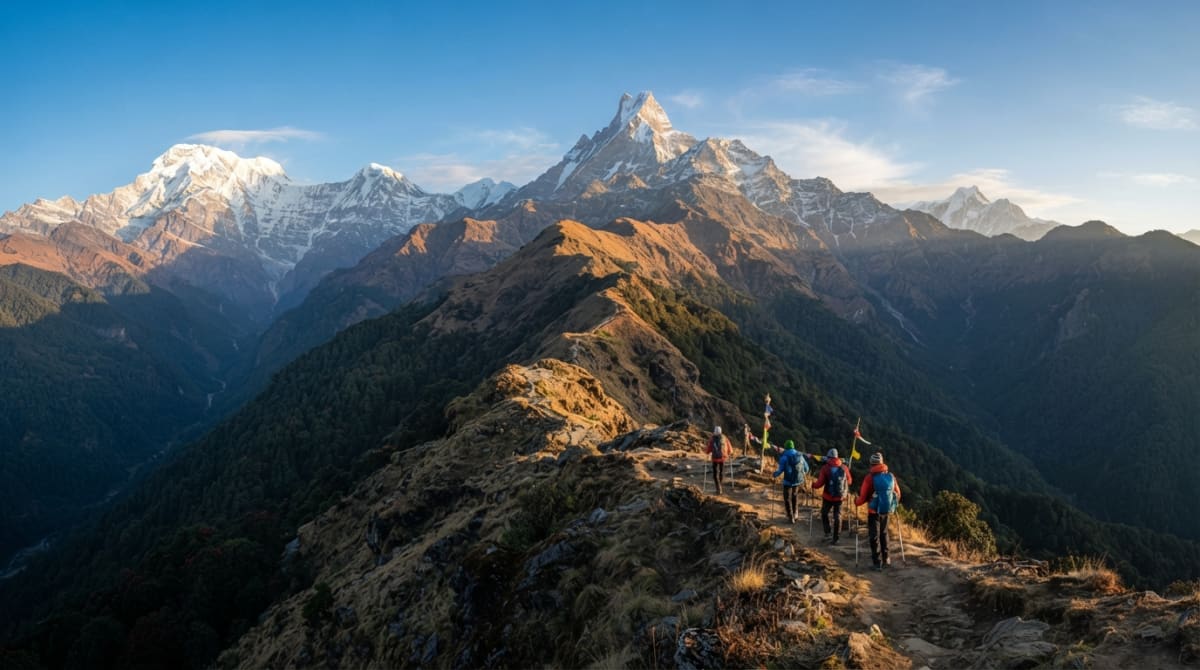
Above Low Camp, the character of the trek changes completely. You step out of the forest onto an open ridge covered in grass and dwarf rhododendron, with the mountains ahead of you and steep drops on either side. After about an hour you pass Badal Danda, a small lodge stop that often sits in the cloud line, and the ridge narrows as it climbs toward High Camp at 3,580 meters. This is the most scenic walking of the whole trek.
The day is relatively short, three to four hours, which gives your body time to adjust to the altitude. After lunch at High Camp, a slow walk a little way up the ridge helps acclimatization, then rest and prepare for the early start. Most trekkers feel the altitude here, with heavier breathing and perhaps a mild headache in the evening. Drink plenty, eat well and go to bed early. See Low Camp to High Camp and our High Camp guide.
Day 4: Mardi Himal Base Camp and Back to Low Camp
Summit day begins in the dark, typically between 4 and 5 a.m. With headlamps on, you climb steeply up the grassy ridge above High Camp to the Upper View Point at around 4,200 meters, arriving in time to watch sunrise light up Annapurna South, Hiunchuli, Mardi Himal and Machapuchare. After the colours fade, you continue on a gentler traverse to Mardi Himal Base Camp at roughly 4,500 meters, where the peaks feel close enough to touch.
After time at the top, you return to High Camp for a late breakfast, then descend along the ridge past Badal Danda to Low Camp for the night. It is a long day of seven to nine hours with around 900 meters of ascent and 1,500 meters of descent, but sleeping back at Low Camp means a much better night than at High Camp. Read the High Camp to Base Camp guide and the Base Camp visitor's guide.
Day 5: Low Camp to Siding and Back to Pokhara
The final day is almost entirely downhill. From Low Camp, a trail drops east off the ridge through forest and then through terraced farmland to Siding, a traditional Gurung village at around 1,750 meters. The descent is steep and long, around 1,200 meters, and it is hard on the knees, so trekking poles and a steady pace help a great deal. You pass small farms and houses, and the change from alpine ridge to warm, green village life is striking.
At Siding, a jeep waits to drive you back to Pokhara along a rough road, usually taking two to three hours. You arrive in the afternoon, in time for a hot shower and a lakeside dinner. Read Low Camp to Siding and our Siding village guide.
Why the 5-Day Itinerary Works So Well
The 5-day plan balances several things that matter on Mardi Himal. The first day is short, which eases you into the trek and avoids exhausting yourself on the steep start. The second night at Low Camp, just under 3,000 meters, gives your body a step in acclimatization before you sleep at High Camp. The Base Camp hike starts from High Camp, so you can reach the viewpoints at sunrise. And returning to Low Camp afterward means you sleep lower after the highest day, which improves recovery and shortens the final descent.
Compared with the 3-day version, the days are more manageable and the altitude gain more comfortable. Compared with the 9-day version, you save the travel days in Kathmandu if you are already in Pokhara or have arranged your own travel there. For many trekkers, it is the sweet spot. See which Mardi Himal trek is right for you.
Who the 5-Day Trek Suits
This itinerary suits most reasonably fit trekkers, including first-timers who have trained, couples, groups of friends and solo travellers joining a guide. It is ideal if you are already in Pokhara, perhaps as part of a longer trip around Nepal, or if you prefer to arrange your own journey from Kathmandu. It also works well for Nepal residents with a few days off.
If you have little experience of hiking, need more rest, or are travelling with children or older family members, consider adding a day, which our guides can arrange, or choosing the longer 9-day trip. Read is Mardi Himal suitable for beginners?
Preparing for the 5-Day Trek
Train for six to eight weeks with regular walking, stair climbing, leg strength work and weekend hikes carrying a daypack, building up to five or six hours with plenty of ascent and descent. Break in your boots, buy insurance covering trekking to 4,500 meters and helicopter evacuation, and pack a layering system with a warm down jacket and a good sleeping bag. Arrive in Pokhara at least a day before the trek for the briefing. Our fitness guide and packing list have the details.
Best Season for the 5-Day Trek
The 5-day itinerary works in every season, but some months suit it better than others. Autumn, from late September to November, gives the clearest mornings for the Base Camp hike, dry trails and comfortable walking temperatures, although High Camp and Low Camp are busy in October. Spring, from March to May, brings rhododendron blooms to the forest on day two and warm days, with more haze and afternoon cloud. In winter, the itinerary still works, but ice above High Camp and cold nights call for microspikes, a warmer sleeping bag and ideally a buffer day. The monsoon brings rain, leeches and unreliable views, so flexibility is essential. See the best time for the trek.
Tea Houses on the 5-Day Route
You spend your four nights in three places: Pitam Deurali on night one, Low Camp on nights two and four, and High Camp on night three. Pitam Deurali is the most comfortable, with several lodges, some rooms with attached bathrooms, hot showers and usually mobile signal. Low Camp has several simple lodges with shared toilets and hot showers for a fee, and its sunset views make it a favourite stop. High Camp is the most basic, with cold rooms, limited water in winter and charging dependent on solar power, but the evening atmosphere in the dining room is special. Your guide reserves rooms ahead in busy months. See our tea house guide.
What the Days Feel Like
On paper the 5-day plan looks simple, but each day has a distinct character. Day one feels like a gentle introduction, with a sharp climb at the start and relaxed forest walking afterward. Day two is a test of patience, a long, steady climb through the trees with the reward of Machapuchare at Low Camp. Day three is short but thrilling, as the forest gives way to the open ridge and the mountains fill the view. Day four is the adventure, with its headlamp start, freezing dawn and the sense of standing among giants at Base Camp. Day five is the long goodbye, dropping from the alpine world back into warm villages and fields. Most trekkers say the variety is what makes the five days feel so full.
Budgeting for Extras
With transport, permits, guide, lodges and meals included in the package, your spending on the trail is limited to extras. Budget in Nepali rupees for hot showers, device charging, Wi-Fi, snacks and drinks beyond your meals, and bottled or filtered water refills. Prices rise with altitude, so things cost more at High Camp than at Pitam Deurali. Set aside money for tips for your guide and porter at the end of the trek, which are customary and an important part of their income. Withdraw cash in Pokhara, as there are no ATMs on the trail. See how much cash to carry and our tipping guide.
Common Mistakes on the 5-Day Trek
The most common mistake is treating day one as a warm-up and then rushing day two. The forest climb to Low Camp is long, and trekkers who start fast often struggle by the afternoon. Another is not drinking enough on day three, when the altitude gain to High Camp can bring on headaches. On day four, some trekkers push to Base Camp while feeling unwell, making the long descent to Low Camp miserable. And many underestimate day five: the descent to Siding is steep and relentless, so do not leave your trekking poles in your bag. Walk slowly, drink often, and trust your guide's pace.
Adding a Buffer Day
In winter, the monsoon or unsettled spring weather, adding a sixth day gives you a spare morning for the Base Camp hike if the first is cloudy or icy. You can also use the extra day to spend a night at Forest Camp, splitting the long forest day in two. See our 6-day itinerary with a buffer day.
Book the 5-Day Mardi Himal Trek
Our 5-day Mardi Himal Trek from Pokhara includes private transport between Pokhara, Kande and Siding, ACAP and TIMS permits, a licensed English-speaking guide, tea house accommodation and three meals a day while trekking. Porters are available as an add-on. If you are arriving in Nepal through Kathmandu and want everything arranged, the 9-day Mardi Himal Trek adds airport transfers, hotels and travel to Pokhara. Contact us to check dates.