

Look at a trekking map of the Annapurna foothills and you will notice that the Mardi Himal Trek and the Annapurna Base Camp trek are neighbors. Both begin in the hills west of Pokhara, and both climb toward the same cluster of peaks: Machapuchare, Annapurna South and Hiunchuli. The Mardi Himal trail follows a ridge east of the Modi Khola, while the ABC trail follows the river valley itself. The two meet at Pitam Deurali, a small cluster of lodges on a forested saddle, and just below it to the west lies Landruk, a large Gurung village looking across the valley to Ghandruk.
That junction opens up a range of possibilities, from a single extra night in a traditional village to a full combination with Annapurna Base Camp. This guide explains how the connection works, how long each section takes, and how to build it into your trek. For the first day that reaches the junction, see Kande to Pitam Deurali and Pitam Deurali.
The Connection at a Glance
| Section | Typical time | Approximate altitude |
|---|---|---|
| Pitam Deurali to Bheri Kharka | About 1 hour | About 2,100 m → about 1,750 m |
| Bheri Kharka to Tolka | About 1 hour | About 1,750 m → about 1,700 m |
| Tolka to Landruk | 1–1.5 hours | About 1,700 m → about 1,565 m |
| Landruk to Jhinu Danda | 3–4 hours | About 1,565 m → about 1,780 m |
| Landruk to Ghandruk | About 3 hours | Down to the Modi Khola, then up to about 1,940 m |
Times are approximate and depend on your pace and trail conditions. The trail between villages is well used and generally easy to follow, with stone steps, forest paths and village lanes.
Where the Trails Divide
From Kande or Dhampus, all trekkers bound for Mardi Himal or the ABC trail via this route walk together through Australian Camp or Dhampus to Pothana and on to Pitam Deurali. At Pitam Deurali, the trails divide. The Mardi Himal trail turns north and climbs into the forest toward Forest Camp and the ridge. The Landruk trail continues west and downhill, descending through forest and fields toward the Modi Khola. The junction is signposted, and your guide will know it well. See the map and route guide.
Pitam Deurali to Landruk
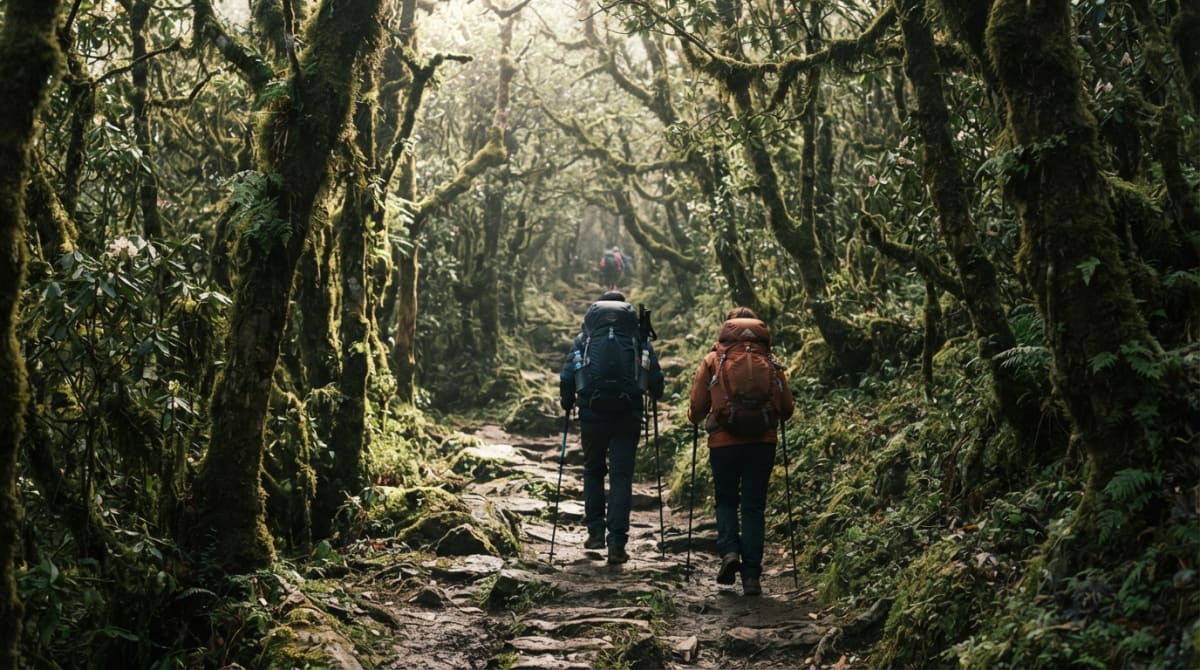
The walk from Pitam Deurali to Landruk is one of the prettiest half-days in the area. The trail first descends through rhododendron and oak forest to Bheri Kharka, a small settlement with a few lodges. It continues through forest and past terraced fields to Tolka, a quiet village strung along the hillside, with views across the valley. From Tolka, the trail contours and descends gently to Landruk, crossing streams and passing farmhouses on the way. Allow three to four hours, mostly downhill. See farming and village life.
Landruk
Landruk is a large Gurung village spread across a steep hillside above the Modi Khola, at around 1,565 meters. Its stone houses with slate roofs, terraced fields of rice and millet, and narrow paved lanes give it a strong traditional character. Across the deep valley, Ghandruk, one of the best-known Gurung villages in Nepal, sits on the opposite slope, and on clear days Annapurna South and Hiunchuli rise at the head of the valley. Landruk has a good selection of lodges and makes a relaxing overnight stop with a very different feel from the lodge settlements on the Mardi Himal ridge. See Gurung culture, Gurung village architecture and villages around Mardi Himal.
Onward from Landruk
From Landruk, several routes lead onward:
- North to Jhinu Danda: The trail follows the east bank of the Modi Khola upstream to New Bridge, crosses the river and climbs to Jhinu Danda, famous for its natural hot springs by the river. It takes three to four hours. From Jhinu Danda, the ABC trail climbs to Chhomrong and on toward the Annapurna Sanctuary. See the Jhinu Danda hot springs.
- Across to Ghandruk: A trail descends steeply to the Modi Khola, crosses on a suspension bridge and climbs the other side to Ghandruk, about three hours in total. Ghandruk has a Gurung museum, many lodges and superb views.
- Back to the road: Road access in the area has expanded, and jeeps now reach several villages in the Modi Khola valley, subject to conditions. Your guide can arrange transport back to Pokhara from a nearby road head.
Adding Landruk to Your Mardi Himal Trek
The simplest way to use the connection is to add a village night at the end of your trek. After the summit, instead of descending to Siding, you retrace the ridge down through Low Camp and Forest Camp to Pitam Deurali, then continue west to Landruk for the night. The next day, you can drive back to Pokhara, or continue to Jhinu Danda for a soak in the hot springs before heading home. This turns the trek into a longer, more varied loop with a strong cultural element.
A sample version of the 9-day trek from Kathmandu with this extension might end like this:
- Summit day: High Camp to Base Camp, then descend to Low Camp or Badal Danda.
- Next day: Low Camp to Forest Camp and Pitam Deurali (5–6 hours).
- Next day: Pitam Deurali to Landruk (3–4 hours); afternoon exploring the village.
- Final day: Landruk to Jhinu Danda and the hot springs, then drive to Pokhara, or drive directly from near Landruk.
It adds one to two days to the standard itinerary. See the custom itinerary guide and the 9-day Mardi Himal Trek.
Combining Mardi Himal and Annapurna Base Camp
For trekkers with more time, the Landruk connection makes it possible to combine Mardi Himal with the classic Annapurna Base Camp trek. There are two ways to do it:
- Mardi Himal first: Complete the Mardi Himal trek up to Base Camp, descend to Pitam Deurali, continue via Landruk and Jhinu Danda to Chhomrong, and follow the ABC trail up the Modi Khola to the Annapurna Sanctuary. You arrive well acclimatized from Mardi Himal.
- ABC first: Trek to Annapurna Base Camp via Ghandruk or Landruk, return down the valley to Landruk, climb to Pitam Deurali and Forest Camp, and finish with the Mardi Himal ridge and the descent to Siding.
Either way, the combined trek usually takes around 10 to 14 days, depending on pace and the exact route. It offers two very different experiences: a high ridge walk and a deep valley journey into the heart of the Annapurna Sanctuary. See the Mardi Himal and Annapurna Base Camp itinerary and Mardi Himal vs Annapurna Base Camp.
Why Take the Landruk Route?
- Village life: Landruk, Tolka and Ghandruk are among the most attractive Gurung villages in the region.
- Variety: The route adds farmland, river valleys and village lanes to the forest and ridge of Mardi Himal.
- Hot springs: Jhinu Danda's riverside pools are one of the best rewards after a trek.
- Flexibility: The connection lets you extend your trek into a longer journey, including Annapurna Base Camp.
- Gentler descent: Returning via Forest Camp and Pitam Deurali is more gradual than the steep drop to Siding.
What to Consider
- Extra days: The Landruk extension adds at least one day, more if you continue to Jhinu Danda or ABC.
- More walking: Retracing the ridge to Pitam Deurali is longer than descending to Siding.
- Crowds: The ABC trail is busier than Mardi Himal, especially in peak season.
- Lodge booking: Popular stops on the ABC trail can fill up in October and November.
See is Mardi Himal crowded? and booking tea houses in peak season.
Lodges and Food
Lodges in Landruk, Tolka, Ghandruk and Jhinu Danda are generally more developed than those on the upper Mardi Himal ridge, often with attached bathrooms, hot showers, Wi-Fi and larger menus. Dal bhat remains the staple, along with noodles, fried rice, momos, pasta, pizza and pancakes. In Gurung villages, you may also find local dishes such as dhido and gundruk. Prices are moderate, lower than on the high ridge, because supplies travel shorter distances. See the food and accommodation guide and Nepali dishes to try.
Permits
Landruk, Ghandruk, Jhinu Danda and the ABC trail are all within the Annapurna Conservation Area, so the same ACAP permit you use for Mardi Himal covers them. Permits are checked at checkpoints along the trail, so keep them handy. Foreign trekkers must be accompanied by a licensed guide. See Mardi Himal permits and the ACAP permit.
Best Time to Link Mardi Himal and Landruk
The connection works year-round, but conditions vary. Autumn (September–November) brings clear skies and golden terraces, the best time for views. Spring (March–May) brings blooming rhododendrons on the forest sections around Pitam Deurali and Tolka. Winter (December–February) is cool and clear at village altitudes, and the hot springs are especially welcome. Monsoon (June–August) brings lush green scenery but also mud, leeches and a higher risk of landslides on trails and roads. See the best time for the Mardi Himal Trek.
Cultural Highlights in Landruk and Ghandruk
Gurung villages have a strong identity. Look for the traditional stone houses with carved wooden windows, the community buildings, and the shrines and prayer flags that mark sacred sites. Many families have a history of service in the Gurkha regiments, and you may see memorials or hear stories of relatives who served abroad. In Ghandruk, the Gurung museum displays traditional tools, clothing and household items. If you are there during a festival, you may see traditional dances and music. Always ask before photographing people or entering homes. See Gurkha heritage and cultural dos and don'ts.
Walking Up from Landruk to Mardi Himal
The connection works in both directions. Trekkers coming down from Annapurna Base Camp, or starting from the Modi Khola valley, can climb from Landruk to Pitam Deurali and join the Mardi Himal trail there. This is a steady ascent of about 550 meters, taking four to five hours through Tolka and Bheri Kharka, with the steepest climbing in the forest below Pitam Deurali. If you have just come down from the Annapurna Sanctuary, you will be well acclimatized and can move up the Mardi Himal ridge more quickly than usual, though sensible pacing still matters. If you are starting fresh from Landruk, treat the climb to Pitam Deurali as your first day and follow a normal acclimatization schedule from there. See Pitam Deurali to Forest Camp and acclimatization on Mardi Himal.
Who Is the Landruk Connection For?
The Landruk route suits trekkers who want more than a mountain walk. It is ideal if you are interested in Gurung culture and village life, if you would like to finish your trek with a soak in hot springs, or if you have the time and ambition to combine two of the best treks in the Annapurna region. It also suits trekkers who prefer a gentler descent than the steep trail to Siding, since the return through Forest Camp is more gradual. It is less suitable if you are on a very tight schedule, prefer quiet trails throughout, or want the shortest possible trip. For those trekkers, the standard loop via Siding is the better choice. See which Mardi Himal trek is right for you.
Safety and Trail Conditions
The trails between Pitam Deurali, Landruk, Jhinu Danda and Ghandruk are well used and generally safe, but they include long flights of stone steps, steep descents to river crossings and sections of forest that can be slippery after rain. Suspension bridges over the Modi Khola are sturdy and well maintained; cross one at a time if they feel crowded, and give way to mule trains and porters. In the monsoon, landslides can affect trails and roads in the valley, so your guide will check conditions before setting off. See landslides and trail hazards and trail etiquette.
Tips for the Landruk Connection
- Plan your extra days in advance, especially if continuing to ABC.
- Carry enough cash; there are no ATMs in the villages.
- Bring swimwear if you plan to visit the Jhinu Danda hot springs.
- Expect steep stone steps between Landruk, the river and Ghandruk.
- Keep your ACAP permit handy for checkpoints.
- Respect local customs and dress modestly in villages.
Extend Your Mardi Himal Trek with Us
If you would like to add Landruk, Ghandruk, the Jhinu Danda hot springs or Annapurna Base Camp to your Mardi Himal Trek, tell us when you book. The 9-day Mardi Himal Trek from Kathmandu is the easiest itinerary to extend, and we can also adapt the 5-day trek from Pokhara. Contact us to plan your route.