

Once the Mardi Himal Trek leaves the forest, there are only three places to sleep on the ridge: Low Camp at the edge of the trees, Badal Danda halfway up the open ridge, and High Camp at the base of the summit climb. Each is a small cluster of simple lodges, and each has its own character. Where you spend the night on the way up and on the way down is one of the most important choices in your itinerary. It determines how well you acclimatize, how long summit morning will be, how comfortable your nights are, and how much of the sunrise and sunset views you enjoy.
This guide compares the three stops and explains how different itineraries use them. For each place in detail, see Low Camp, Badal Danda and the High Camp guide.
The Three Stops Compared
| Low Camp | Badal Danda | High Camp | |
|---|---|---|---|
| Approximate altitude | 2,970 m | 3,210 m | 3,580 m |
| Setting | Forest edge | Open ridge | Broad shoulder below the summit climb |
| Number of lodges | Several | A few | Several, but in high demand |
| Comfort and warmth | Best | Moderate | Coldest and most basic |
| Views | Machapuchare directly ahead | Wide ridge views, sunsets | Closest views of the peaks |
| Time to Base Camp | About 6–7 hours | About 5–6 hours | About 3–4 hours |
| Best use | Acclimatization, recovery, comfort | Acclimatization, post-summit night | The night before the summit |
Low Camp
Low Camp sits at around 2,970 meters, right where the forest gives way to the open ridge. It has several lodges, making it the most developed stop on the upper trek, and it is noticeably warmer and more sheltered than the higher camps. From the lodge terraces, Machapuchare rises directly ahead, and sunset and sunrise views can be superb. A short walk above the lodges opens up an even wider view. Low Camp is also the junction for the trail down to Siding, making it a natural overnight stop on the way down.
Pros: The warmest and most comfortable of the three; more lodges and better availability; good acclimatization altitude; excellent views of Machapuchare; easy access to the Siding trail.
Cons: Too far from Base Camp for a practical summit start; fewer wide ridge views than higher up.
Badal Danda
Badal Danda, whose name means "cloud hill," sits at around 3,210 meters on a shoulder of the open ridge, between Low Camp and High Camp. It has a few simple lodges, and it is often less busy than the other two stops. The views along the ridge are wide, and on many evenings clouds swirl around the hill, giving it its name and producing dramatic sunsets. It works well as an intermediate stop on the way up and as a peaceful place to spend the night after the summit.
Pros: A good step in acclimatization between Low Camp and High Camp; quieter atmosphere; wide views and sunsets; a short, relaxed walk down after the summit.
Cons: Fewer lodges, so availability can be limited; exposed to wind and cloud; basic facilities.
High Camp
High Camp, at 3,580 meters, sits on a broad shoulder of the ridge at the foot of the steep climb to the Upper View Point and Base Camp. It is the base for the summit hike, and almost every itinerary spends the night here before summit day. The views of Machapuchare, Mardi Himal, Annapurna South and Hiunchuli are close and dramatic, and sunset over the peaks is one of the highlights of the trek. But it is also the coldest, most exposed and most basic stop, with frequent headaches and poor sleep due to the altitude, and beds are in high demand in peak season.
Pros: Closest to Base Camp, making the summit hike manageable; spectacular views; the classic pre-summit stop.
Cons: Coldest and most basic; altitude effects common; beds limited and in high demand; water scarce in winter.
On the Way Up
How you use the three stops on the ascent depends on your itinerary and how quickly you want to gain height.
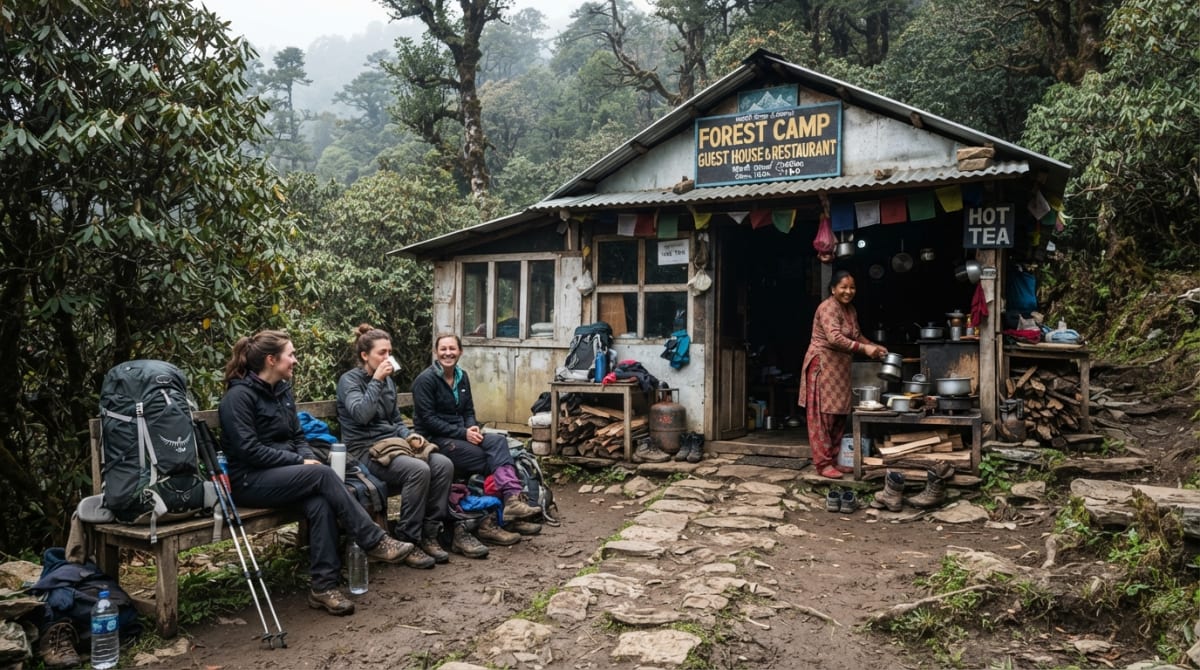
- Forest Camp to High Camp in one day (as on the 9-day trek): A longer day, passing Low Camp and Badal Danda, and arriving at High Camp in the afternoon. It works because the previous night at Forest Camp, at around 2,600 meters, provides some acclimatization.
- Low Camp, then High Camp (as on the 5-day trek): A night at Low Camp, then a three to four hour walk to High Camp. This is a good balance of time and acclimatization.
- Low Camp, Badal Danda, then High Camp: The most gradual approach, spreading the ascent over more nights. It is ideal for trekkers who are new to altitude or have struggled before.
See the 5-day itinerary, the 9-day itinerary and acclimatization on Mardi Himal.
The Night Before the Summit
For almost everyone, the night before the summit should be at High Camp. From there, the climb to the Upper View Point takes two to two and a half hours, and to Base Camp another hour to an hour and a half, which fits comfortably into a pre-dawn start for sunrise. Starting from Badal Danda adds about one and a half to two hours, and from Low Camp three to four, which means starting in the middle of the night and a very long day. Only very fit, well-acclimatized trekkers, or those who cannot get a bed at High Camp, should consider it. See the night before summit day.
After the Summit
After returning from Base Camp to High Camp for breakfast, most itineraries descend further the same day. Sleeping lower helps your body recover, and most trekkers sleep much better at Badal Danda or Low Camp than they did at High Camp.
- Badal Danda (as on the 9-day and 7-day treks): A short one to one and a half hour walk down from High Camp, leaving a relaxed afternoon.
- Low Camp (as on the 5-day trek): Two to two and a half hours down, positioning you for the descent to Siding the next day.
- Siding (as on the 3-day short trek): The whole descent in one very long day.
See coming down from Base Camp.
Comfort and Facilities
All three stops have simple tea houses with twin rooms, shared toilets and a heated dining room. Facilities become more basic as you climb. At Low Camp, you may find hot showers, charging and Wi-Fi, sometimes for a fee. At Badal Danda, facilities are more limited. At High Camp, showers may be unavailable or cold, charging may be limited to solar power, and water can be scarce in winter. Rooms are unheated everywhere, so a good sleeping bag is essential, especially at High Camp. See the tea house guide and staying warm in tea houses.
Food at Each Stop
Menus on the upper ridge are similar at all three stops: dal bhat, noodle soups, fried rice and noodles, pasta, potatoes, eggs, porridge, Tibetan bread and pancakes, with tea, coffee, hot chocolate and soups to drink. Low Camp usually has the widest choice and the freshest ingredients, while menus at High Camp are shorter and prices higher, because every item has to be carried up by porters. Dal bhat, with its free refills, remains the best value and the most filling choice everywhere. Appetite often drops at High Camp because of the altitude, so eat what you can and do not skip meals. See the tea house menu guide and food prices on the trek.
Sleep Quality and Altitude
Where you sleep has a direct effect on how well you sleep. At Low Camp, most trekkers sleep reasonably well, as the altitude is moderate and the lodges relatively warm. At Badal Danda, some people begin to notice lighter, more broken sleep. At High Camp, poor sleep is very common: many trekkers wake frequently, have vivid dreams, notice irregular breathing or wake with a mild headache. This is a normal response to altitude and usually not a cause for concern, but it is one reason not to spend more nights at High Camp than necessary unless you are deliberately acclimatizing. Keep warm, drink water in the evening, avoid alcohol and sleeping pills, and tell your guide if you feel unwell. See sleeping well at altitude.
Where to Spend an Extra Night
If your itinerary has a spare night, where should you spend it? It depends on your goal. For better acclimatization before the summit, an extra night at Low Camp or Badal Danda on the way up is the most effective choice, as it lets your body adjust gradually. For a second chance at clear summit views, an extra night at High Camp gives you two possible sunrise mornings, which is especially useful in spring or the monsoon, when clouds often hide the peaks. For comfort and recovery, an extra night at Low Camp after the summit makes the descent to Siding easier. We generally recommend using a spare night on the way up for acclimatization unless you have a specific photographic goal. See the itinerary with a rest day and the slow trek itinerary.
Solo Trekkers and Room Sharing
Rooms on the ridge are usually twin rooms. Solo trekkers normally get a room to themselves, but in peak season, especially at High Camp, lodges may ask solo trekkers to share with another trekker of the same sex, or may charge extra for a private room. On very busy nights, some trekkers and guides sleep in the dining room. If you prefer a private room, mention it when booking so your agency can plan ahead. See Mardi Himal for solo travelers.
Views and Photography
Each stop offers something different for photographers. Low Camp has a classic view of Machapuchare framed by the forest edge, and a short walk above the lodges reveals a sea of clouds on many evenings. Badal Danda has wide views along the ridge, with dramatic sunsets and clouds. High Camp offers the closest views of the peaks, and sunset and moonlight on Machapuchare from High Camp are unforgettable. See sunset at Low Camp and Badal Danda and stargazing on Mardi Himal.
Availability in Peak Season
In October, November, March and April, lodges on the ridge can fill up, especially High Camp, where demand is concentrated on the night before the summit. Low Camp has the most capacity, Badal Danda less, and High Camp can be fully booked on busy nights. Your guide or agency will usually book ahead. If High Camp is full, the options are to sleep at Badal Danda and start earlier on summit morning, or to share rooms or sleep in the dining room. See booking tea houses in peak season.
Weather Considerations
The higher you sleep, the colder and windier it gets. In winter, nights at High Camp can be well below freezing, and water pipes can freeze. Low Camp, sheltered by the forest, is noticeably milder. In the monsoon, all three stops can be wrapped in cloud and rain for days. Badal Danda, as its name suggests, is often in cloud in the afternoon in any season. If weather is poor, your guide may adjust where you sleep to give you the best chance of clear views on summit morning. See weather safety on the ridge.
Which Is Right for You?
- First-timers at altitude: Sleep at Low Camp and Badal Danda before High Camp for the most gradual ascent.
- Fit trekkers with limited time: Low Camp, then High Camp, is a good balance.
- Comfort seekers: Spend as many nights as possible at Low Camp, and descend to Low Camp after the summit.
- Photographers: Consider an extra night at High Camp for a second sunrise, or at Badal Danda for sunsets.
- Families and older trekkers: Take it slowly, with nights at all three stops if possible.
Plan Your Overnight Stops with Us
Our itineraries use Low Camp, Badal Danda and High Camp in ways that balance acclimatization, comfort and time. See the 5-day Mardi Himal Trek from Pokhara, the 9-day trek from Kathmandu or the 3-day Short Mardi Himal Trek, and contact us to adjust the overnight stops to suit you.