

Many trekkers arrive in Pokhara, walk the Mardi Himal Trek and fly home without ever hearing the name Kaski. Yet everything they experience, from the lakeside cafes and the views of Machapuchare to the rhododendron forest, the ridge and the villages at the end of the trek, lies within this one district of western Nepal. Kaski stretches from warm valleys around Pokhara, at around 800 meters, to the icy summits of the Annapurna range, and it is one of the most diverse and most visited districts in the country. This guide introduces the district and shows how it shapes your trek. For the location of the trek itself, see where Mardi Himal is.
Kaski at a Glance
| Feature | Detail |
|---|---|
| Province | Gandaki Province |
| Headquarters | Pokhara (also the provincial capital) |
| Area | Roughly 2,000 square kilometers |
| Population | Around 600,000, most in and around Pokhara |
| Altitude range | From under 1,000 m in the valleys to over 8,000 m on the Annapurna range |
| Main lakes | Phewa, Begnas, Rupa |
| Protected area | Northern part lies in the Annapurna Conservation Area |
| Famous treks | Mardi Himal, Annapurna Base Camp, Ghandruk, Australian Camp |
Where Kaski Lies
Kaski lies in the center-west of Nepal, in Gandaki Province, about 200 kilometers west of Kathmandu. It is bordered by the districts of Manang and Lamjung to the north and east, Tanahun to the southeast, Syangja to the south, and Parbat and Myagdi to the west. The northern edge of the district runs along the crest of the Annapurna range, while the southern part is made up of the green Middle Hills and the broad Pokhara valley. The Mardi Himal Trek runs through the heart of the district, from the hills west of Pokhara north toward the high peaks. See getting from Kathmandu to Pokhara.
Pokhara: The Heart of the District
Pokhara is the district headquarters and the capital of Gandaki Province, and it is by far the largest city in Kaski. It grew from a small trading town into Nepal's second tourist hub, thanks to its lakes, mild climate and extraordinary mountain views. The Lakeside area, along the eastern shore of Phewa Lake, is the center of tourism, with hotels, restaurants, trekking shops and agencies. The city also has an international airport, a busy bus park and a lively local market. For trekkers, it is the gateway to the Mardi Himal Trek and many others. See the Lakeside guide and where to stay in Pokhara.
Lakes and Rivers
Kaski is famous for its lakes. Phewa Lake, beside Pokhara, is the best known, with the island temple of Tal Barahi and the reflection of Machapuchare on calm mornings. To the east, Begnas and Rupa lakes are quieter, surrounded by forested hills and fish farms. The district is also crossed by several important rivers. The Seti River flows through Pokhara in a dramatic narrow gorge, carrying milky glacial water from the Annapurnas. The Modi Khola drains the Annapurna Sanctuary on the western side of the Mardi Himal ridge, and the Mardi Khola flows down the eastern side. See the Modi and Mardi Khola valleys.
From Valleys to High Peaks
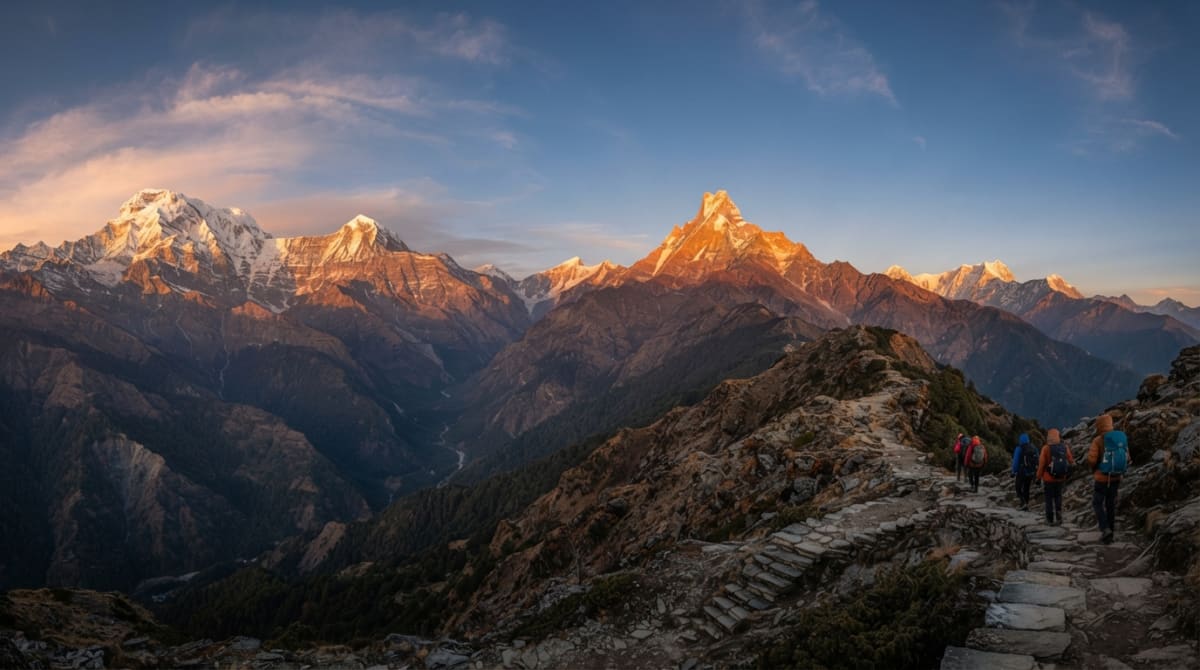
Few districts in the world span such a range of altitudes. In the south, the Pokhara valley enjoys a warm, subtropical climate with rice paddies, banana trees and bougainvillea. Moving north, the land rises through terraced hills and forests of rhododendron and oak into alpine grasslands, glaciers and finally the snow peaks of the Annapurna range, including Machapuchare and Annapurna South. The Mardi Himal Trek crosses much of this range in a few days, from the valleys near Pokhara to around 4,500 meters at Base Camp. See ecosystems by altitude.
People and Communities
Kaski is home to a diverse population. In Pokhara and the valleys, Brahmin, Chhetri and Newar communities are prominent, along with people from across Nepal who have moved to the city. In the hills to the north, Gurung villages are especially important, alongside Magar and other communities. Many Gurung families have a long tradition of service in the British and Indian Gurkha regiments, and remittances from Gurkhas and workers abroad have shaped the district's economy and architecture. Kaski also has Tibetan refugee settlements near Pokhara, established after 1959. See Gurung culture, Gurkha heritage and Tibetan settlements in Pokhara.
Villages Around Mardi Himal
The villages on the lower slopes of the Mardi Himal ridge are part of rural Kaski. Dhampus, strung along a ridge above Phedi, is a long-established village with lodges and wide mountain views. Pothana is a small settlement on the trail. Siding, on the eastern side of the ridge, is a farming village where the trek usually ends, and nearby Lwang is known for its tea gardens. Across the Modi Khola lie Landruk and Ghandruk, two of the best-known Gurung villages in the district. See villages around Mardi Himal, the Siding village guide and starting from Dhampus.
Treks in Kaski
Kaski is one of Nepal's great trekking districts. Besides Mardi Himal, it includes the trek to Annapurna Base Camp, which follows the Modi Khola into the Annapurna Sanctuary; the village trek to Ghandruk; the easy overnight to Australian Camp and Dhampus; and parts of the Poon Hill and Panchase routes. Many shorter hikes around Pokhara, such as the climb to Sarangkot or the World Peace Pagoda, are also popular. See short treks from Pokhara compared, Mardi Himal vs Ghandruk and Mardi Himal vs Panchase.
Sights Around Pokhara
- Sarangkot: A hilltop above Phewa Lake with a classic sunrise view of the Annapurnas and the main launch site for paragliding.
- World Peace Pagoda: A white Buddhist stupa on a ridge across the lake, reached by boat and a short hike.
- Phewa Lake and Tal Barahi Temple: Boating on the lake and a visit to the island temple.
- Seti River Gorge: A narrow, deep gorge cutting through the city.
- Caves and waterfalls: Several caves and a waterfall on the edge of the city are popular with visitors.
- International Mountain Museum: Exhibits on the Himalaya, mountaineering and mountain peoples.
- Gurkha Museum: The history of Gurkha soldiers, many from the hills of Kaski.
- Begnas and Rupa lakes: Quieter lakes east of the city.
See things to do in Pokhara after the trek and the International Mountain Museum.
The District's Economy
Kaski's economy rests on three pillars: tourism, farming and remittances. Tourism centers on Pokhara, with hotels, restaurants, adventure sports and trekking agencies employing tens of thousands of people, and it reaches deep into the hills through lodges, guides and porters on routes like Mardi Himal. Farming remains the backbone of rural life, with rice, maize, millet, vegetables and livestock on terraced hillsides, and tea in places such as Lwang. Remittances, money sent home by family members working abroad or serving in the Gurkhas, have transformed many villages, funding new houses, schools and businesses. On the Mardi Himal Trek, you will see all three at work, from terraced fields and village homes to the lodges built to serve trekkers. See farming and village life and how your trek supports local communities.
Festivals in Kaski
Kaski celebrates the major festivals of Nepal with enthusiasm. Dashain, the biggest Hindu festival, usually in October, brings families together, with bamboo swings erected in villages and kites flying over Pokhara. Tihar, the festival of lights, follows a few weeks later, with oil lamps, marigold garlands and songs. Gurung communities celebrate Tamu Lhosar, their new year, usually in late December, with traditional dress, dances and feasts. Pokhara also hosts street festivals, including a lively new year celebration in Lakeside at the end of December. Trekking during a festival offers a chance to see local culture, but transport can be busy and some businesses close. See trekking during Dashain and Tihar and Tamu Lhosar and Gurung festivals.
Adventure in Kaski
Beyond trekking, Kaski is Nepal's adventure capital. Paragliding from Sarangkot over Phewa Lake is world-famous, with tandem flights offering a bird's-eye view of the lake and mountains. Ultralight flights and zip lines give other perspectives on the landscape. Kayaking and boating on the lakes, rafting on nearby rivers, mountain biking on the trails around Pokhara, and rock climbing are all available. Many trekkers combine the Mardi Himal Trek with a paragliding flight or a day on the lake. See Mardi Himal and paragliding in Pokhara.
Getting Around the District
Pokhara is well connected, with a domestic and international airport, tourist buses to Kathmandu and Chitwan, and local buses to towns across the region. Within the district, roads radiate from Pokhara into the hills. The paved highway toward Baglung passes Phedi and Kande, the main Mardi Himal trailheads. Rural roads, many rough and unpaved, now reach villages such as Dhampus, Siding and Lwang, and even parts of the Modi Khola valley. Jeeps and taxis are the most practical way to reach trailheads, and trekking agencies usually arrange them. See transport from Pokhara to the trailhead and the Siding to Pokhara jeep.
Climate
Kaski's climate varies with altitude. Pokhara is warm for most of the year, and it is one of the wettest places in Nepal during the monsoon, from June to September, when moist air from the south rises against the mountains. Autumn and spring bring clear, pleasant weather, ideal for trekking. Winter is mild in Pokhara but cold in the hills and very cold on the high ridge. See Pokhara weather vs Mardi Himal weather and the monthly weather guide.
Food in Kaski
Pokhara's restaurants serve food from around the world, but it is worth trying local and regional dishes. Dal bhat is everywhere, and Thakali restaurants, serving the refined dal bhat sets of the Thakali people from the Kali Gandaki region, are popular. In Gurung villages, look for dhido, gundruk and millet bread. Freshly caught fish from the lakes is served in some lakeside restaurants. See Thakali food in Pokhara and food in Pokhara.
Kaski's Natural Heritage
The northern half of Kaski lies within the Annapurna Conservation Area, and the district as a whole holds remarkable biodiversity for its size. Subtropical forests of sal and chestnut grow in the lower valleys, giving way to temperate forests of rhododendron, oak and magnolia on the hills, and alpine grasslands higher up. Birdlife is rich, from kingfishers and herons around the lakes to laughing thrushes, sunbirds and the Himalayan monal in the mountain forests. The lakes themselves are important wetlands. Community forests managed by local user groups cover much of the middle hills, and many have recovered strongly in recent decades. See the Annapurna Conservation Area and flora and fauna on the trail.
How the Trek Connects to the District
The Mardi Himal Trek is a journey through the whole of Kaski in miniature. You start in Pokhara, the busy, modern heart of the district. You drive west past rice paddies and roadside towns to the hills. You climb through farmland and community forest into the conservation area, walk the ancient rhododendron forest, and rise onto the alpine ridge at the northern edge of the district, beneath peaks that form its border. Then you descend into the rural east of the district, through the terraced fields of Siding and Lwang, and drive back to the lakes. In a few days, you see the district's full range, from city to summit. See the map and route guide.
Beyond Kaski
If you have more time, the neighboring districts offer further adventures. Myagdi to the west is home to Ghorepani and the Poon Hill viewpoint, and to Dhaulagiri. Parbat and Syangja to the south and southwest have quiet hill villages and the Panchase hills. Tanahun to the southeast includes the preserved hill town of Bandipur. Lamjung and Manang to the east and north are crossed by the Annapurna Circuit. Chitwan, a few hours south, offers jungle safaris. See Mardi Himal and Bandipur and Mardi Himal and Chitwan.
Explore Kaski on the Mardi Himal Trek
The Mardi Himal Trek is one of the best ways to experience Kaski, from the lakes of Pokhara to the high ridge beneath Machapuchare. See the 5-day Mardi Himal Trek from Pokhara or the 9-day trek from Kathmandu, and contact us to plan your trip.