

Poon Hill and Mardi Himal are two of the most popular short treks from Pokhara, and they could hardly be more different. Poon Hill is a classic village trek, climbing through rhododendron forest to Ghorepani and a famous sunrise viewpoint at around 3,210 meters, with a wide panorama stretching from Dhaulagiri to Annapurna. Mardi Himal is a ridge trek that climbs higher and closer to the mountains, ending beneath Machapuchare at around 4,500 meters. Put them together and you get one of the most rewarding medium-length treks in Nepal.
This guide explains how the two routes connect, offers a sample combined itinerary, and helps you decide whether the combination suits your time and fitness. For the Mardi Himal section, see our Mardi Himal Trek packages, which we can extend to include Poon Hill.
Why Combine the Two?
Each trek offers something the other does not. Poon Hill gives you the broad Annapurna and Dhaulagiri panorama from its famous viewpoint, as well as the large Magar and Gurung villages of Ghorepani, Tadapani and Ghandruk, with their stone houses, farms and lodges. Mardi Himal gives you the intimate, close-up experience of walking a ridge toward Machapuchare and standing at Base Camp among glaciers and summits. Combining them means two very different sunrise viewpoints, two different kinds of trail and a much richer picture of the Annapurna foothills.
The combination also makes sense for acclimatization. Poon Hill's maximum altitude is lower, so walking it first helps your body adjust before the higher, steeper Mardi Himal ridge. By the time you reach High Camp, you are well acclimatized and stronger. Read Mardi Himal vs Poon Hill for a detailed comparison of the two treks.
How the Routes Connect
There are two main ways to combine the treks. The first is to link them on foot. After Poon Hill, the classic loop continues from Ghorepani through Tadapani to Ghandruk, a large Gurung village on the western side of the Modi Khola valley. From Ghandruk you descend to the river and cross to Landruk on the eastern side, then climb toward the lower Mardi Himal route near Pitam Deurali or join it via trails through the forest. This creates a continuous trek with no return to Pokhara in between.
The second option is to do the treks back to back: complete the Poon Hill loop, return to Pokhara for a night of rest and laundry, then start Mardi Himal from Kande a day or two later. This is simpler to organise and gives you a comfortable break, at the cost of a little extra transport. See linking Mardi Himal with Landruk.
A Sample Combined Itinerary
| Day | Route | Overnight |
|---|---|---|
| 1 | Drive Pokhara to Nayapul area, trek to Tikhedhunga or Ulleri | Village lodge |
| 2 | Trek to Ghorepani | Ghorepani (about 2,860 m) |
| 3 | Sunrise at Poon Hill, trek to Tadapani | Tadapani |
| 4 | Trek to Ghandruk | Ghandruk |
| 5 | Descend to the Modi Khola, cross to Landruk | Landruk |
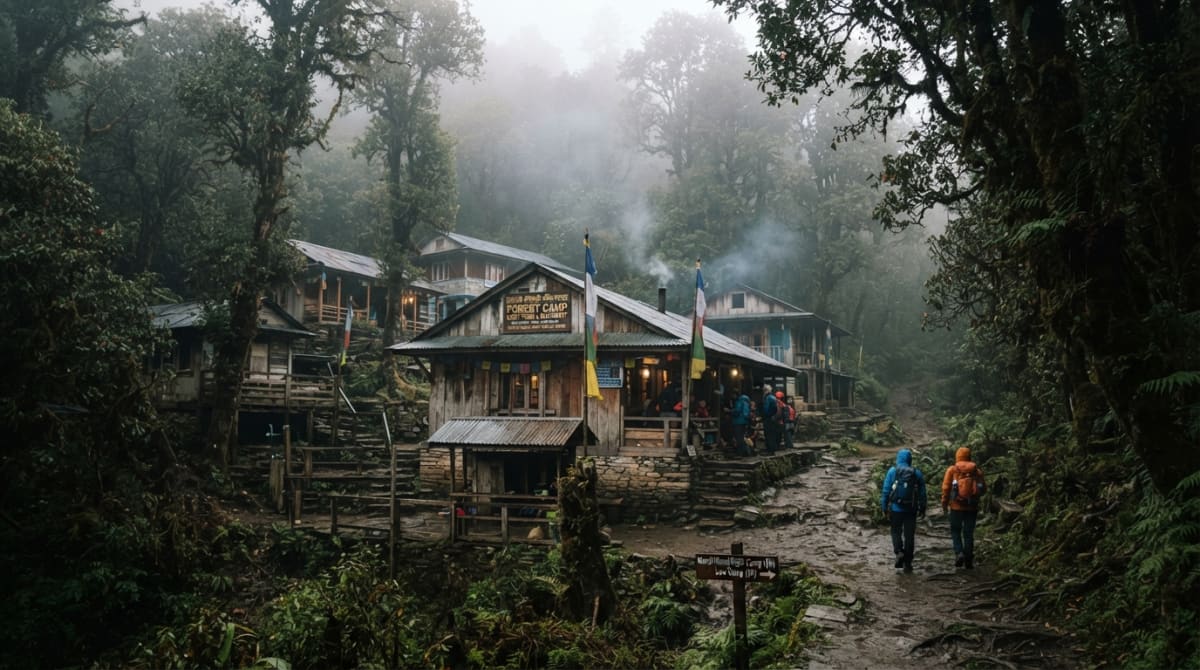
| 6 | Climb to join the Mardi Himal route | Forest Camp area |
| 7 | Trek to High Camp | High Camp (3,580 m) |
| 8 | Base Camp at sunrise, descend to Badal Danda or Low Camp | Badal Danda or Low Camp |
| 9 | Descend to Siding, drive to Pokhara | Pokhara |
This is one possible pattern. Exact stops depend on your pace, the season and lodge availability, and a buffer day is always useful.
The Poon Hill Section
The Poon Hill section begins with a drive from Pokhara toward Nayapul and a climb through terraced farmland and villages. The famous stone staircase up to Ulleri is one of the steepest parts of the whole combined trek, with thousands of steps. Beyond it, the trail enters rhododendron forest and climbs to Ghorepani, a lively village of lodges on a saddle. Before dawn, trekkers climb about an hour to Poon Hill for sunrise over Dhaulagiri, Annapurna South, Machapuchare and many other peaks.
From Ghorepani, the trail continues east through forest to Tadapani and then descends to Ghandruk, one of the region's best-known Gurung villages, with a small museum and traditional architecture. These days are social and varied, with plenty of villages, lodges and fellow trekkers. See Mardi Himal vs the Ghandruk trek.
The Mardi Himal Section
After crossing the Modi Khola to Landruk, you climb through forest to join the Mardi Himal route. From there, the trail follows the familiar pattern: up through rhododendron forest to Low Camp, onto the open ridge past Badal Danda to High Camp, then the pre-dawn hike to the Upper View Point and Base Camp. After the sunrise, you descend to Badal Danda or Low Camp and on to Siding for the drive back to Pokhara. This section is quieter and higher than Poon Hill, with more dramatic close-up views. See our Mardi Himal route guide.
Two Sunrises Compared
The highlight of both treks is sunrise, but the experiences are quite different. At Poon Hill, you climb about an hour from Ghorepani in the dark to a hilltop viewing tower, where dozens or even hundreds of trekkers gather in peak season. As the sun rises, a vast panorama lights up, from the enormous bulk of Dhaulagiri in the west, across the Annapurna range, to Machapuchare in the east. The view is broad and sweeping, a whole range seen from a distance, and the social atmosphere is part of the fun.
At Mardi Himal, you climb much higher, from High Camp at 3,580 meters to the Upper View Point at around 4,200 meters, and the experience is more intimate and intense. Fewer people make the climb, and the mountains are far closer: Machapuchare's sheer face towers above you, and Annapurna South and Hiunchuli fill the western sky. Where Poon Hill shows you the range, Mardi Himal puts you inside it. Having both in one trip gives you a remarkable sense of the Annapurna region's scale. See the Mardi Himal sunrise guide.
Villages and Lodges on the Combined Route
The Poon Hill section passes through larger villages with well-established lodges. Ghorepani has many tea houses, some with bakeries and comfortable dining rooms, and Ghandruk has a range of guesthouses in a traditional Gurung setting. Tadapani, in the forest, is smaller but pleasant. Landruk, across the valley, has several lodges with views of Annapurna South. On the Mardi Himal section, lodges become fewer and simpler as you climb, with the most basic facilities at High Camp. Overall, the combined trek gives you both the social village lodges of Poon Hill and the quieter, more remote feel of the Mardi Himal ridge. See our Mardi Himal tea house guide.
Acclimatization on the Combined Trek
Walking Poon Hill first is an excellent acclimatization strategy. You spend several nights between about 1,500 and 2,900 meters and visit Poon Hill at around 3,210 meters, which prepares your body for the higher Mardi Himal section. By the time you sleep at High Camp, 3,580 meters, you have been at moderate altitude for most of a week, so symptoms are typically milder than on a standalone Mardi Himal trek. Continue to walk slowly, drink plenty and tell your guide about any headaches or nausea. See acclimatization on Mardi Himal.
Who the Combined Trek Suits
The Mardi Himal and Poon Hill combination suits travellers with around two weeks in Nepal who want a varied, medium-length trek without committing to the longer Annapurna Base Camp or Annapurna Circuit routes. It is ideal for those who enjoy both village culture and wild ridge scenery, for photographers who want two contrasting sunrise viewpoints, and for fit trekkers who want to build up to higher altitude gradually. It is less suitable for travellers with only a week, who are better off choosing one of the two treks.
Packing for a Longer Trek
For nine or more days on the trail, pack a little more than for a short trek, but resist the urge to overpack. Bring an extra base layer and socks, a small laundry kit for rinsing clothes at lower lodges, and more blister care. Keep the same warm layers for High Camp and the Base Camp hike: a down jacket, warm hat, gloves and a sleeping bag rated for well below freezing. A porter makes a big difference over nine days, especially on the stone staircases. See our packing list.
Other Combinations to Consider
Poon Hill is not the only trek that pairs well with Mardi Himal. Experienced trekkers with around two weeks can combine Mardi Himal with Annapurna Base Camp, crossing from Landruk into the Modi Khola valley and walking up to the Annapurna Sanctuary, a glacial amphitheatre surrounded by 7,000 and 8,000-meter peaks. Those who want quieter trails can link Mardi Himal with Khopra Danda, a less visited ridge west of Poon Hill with outstanding views of Dhaulagiri and Annapurna South. And travellers who want a gentle end to their trip can finish at the Jhinu Danda hot springs, a short walk from Landruk. See Mardi Himal and ABC, Mardi Himal and Khopra Danda and ending at Jhinu Danda.
Tips for a Successful Combined Trek
- Start slowly. The staircase to Ulleri comes early and is steep; pace yourself so you have energy for the days ahead.
- Look after your feet. Nine or more days of walking magnifies small problems; deal with hot spots immediately.
- Use the lower villages for laundry. Wash small items at Ghorepani or Ghandruk, where they dry more easily than higher up.
- Carry enough cash. There are no ATMs on either trail; withdraw enough in Pokhara for the whole trek.
- Plan a buffer day. One spare day protects both sunrise mornings from bad weather.
- Enjoy the contrast. The busy, sociable Poon Hill trail and the quiet Mardi Himal ridge offer two different moods; savour both.
Crowds on Each Section
The two halves of the combined trek feel very different in terms of company. Poon Hill is one of the busiest treks in Nepal, and in October, November and April the lodges at Ghorepani and the viewpoint at sunrise can be crowded, with a lively, sociable atmosphere. The Mardi Himal ridge is noticeably quieter, although High Camp can be busy on peak-season nights. If you prefer solitude, trek in the shoulder months or winter; if you enjoy meeting fellow trekkers, the Poon Hill section will give you plenty of opportunities. See is Mardi Himal crowded?
Costs
A combined trek costs more than either trek alone because of the extra days of guide and porter wages, accommodation and meals, but it can be better value than doing two separate treks with two sets of transport. Permits are shared across the whole route. Budget for extras such as hot showers, charging, snacks and drinks, and for tips at the end. See our cost comparison of Mardi Himal, ABC and Poon Hill.
Difficulty
The combined trek is moderate but long. The Poon Hill section involves thousands of stone steps, particularly up to Ulleri and down to the Modi Khola around Ghandruk and Landruk, which are hard on the legs. The Mardi Himal section is steeper and higher, with the pre-dawn Base Camp hike and a long descent to Siding. Walking for nine or more consecutive days requires good endurance. Train for at least eight weeks with long hikes, stairs and back-to-back walking days. See our fitness guide.
Permits
Both treks lie inside the Annapurna Conservation Area, so you need one ACAP permit and one TIMS card for the whole trip, as long as your application covers the full route and dates. A licensed guide is required for foreign trekkers. If you book with us, we arrange all permits for the combined route. See Mardi Himal permits.
Best Season
Spring is a wonderful time for this combination, as both Poon Hill and Mardi Himal pass through spectacular rhododendron forests that bloom from March to April. Autumn offers the clearest mountain views from both viewpoints and dry trails. Winter is possible with warm gear, though snow can affect Ghorepani and the Mardi Himal ridge. The monsoon is wet and cloudy on both treks. See the best time for the trek.
Book a Combined Trek
We can extend our Mardi Himal treks to include Poon Hill, either as a continuous route via Ghandruk and Landruk or as two treks back to back. Your package can include permits, a licensed guide, transport and tea house accommodation with meals throughout. Start with the 9-day Mardi Himal Trek or the 5-day trek from Pokhara and contact us to add Poon Hill.