

For the first days of the Mardi Himal Trek, you walk mostly through forest: rhododendron, oak and bamboo, moss hanging from the branches, glimpses of the mountains through gaps in the trees. Then, just above Low Camp, the trees fall away, and the trail steps out onto a long, grassy ridge that climbs north toward the peaks. Machapuchare rises directly ahead, sharp and close. On either side, the land drops away into deep valleys. For the next two days, you follow this ridge all the way to Mardi Himal Base Camp. It is the heart of the trek, the reason many people choose Mardi Himal over other short treks, and for most trekkers it is the section they remember most.
This guide explains what the ridge walk is like, from the landscape and views to exposure, weather, wildlife and safety. For the day-by-day details, see Low Camp to High Camp and High Camp to Base Camp.
The Ridge at a Glance
| Section | Approximate altitude | Typical time | Character |
|---|---|---|---|
| Low Camp to Badal Danda | About 2,970 m → about 3,210 m | 1.5–2 hours | Forest edge giving way to open ridge |
| Badal Danda to High Camp | About 3,210 m → 3,580 m | 1.5–2 hours | Open grassy ridge, some steep pitches |
| High Camp to Upper View Point | 3,580 m → about 4,200 m | 2–2.5 hours | Steep, open slopes |
| Upper View Point to Base Camp | About 4,200 m → about 4,500 m | 1–1.5 hours | High, open ground beneath the peaks |
Leaving the Forest
The transition from forest to ridge happens gradually above Low Camp. The tall rhododendrons and oaks become shorter and more twisted, then give way to dwarf rhododendron and juniper scrub, and finally to open grassland. It is a striking change. After days of enclosed forest, the sky suddenly feels huge, and the mountains that were glimpsed through the trees now dominate the view. Many trekkers stop at the first open viewpoint above Low Camp simply to take it in. See Mardi Himal ecosystems by altitude.
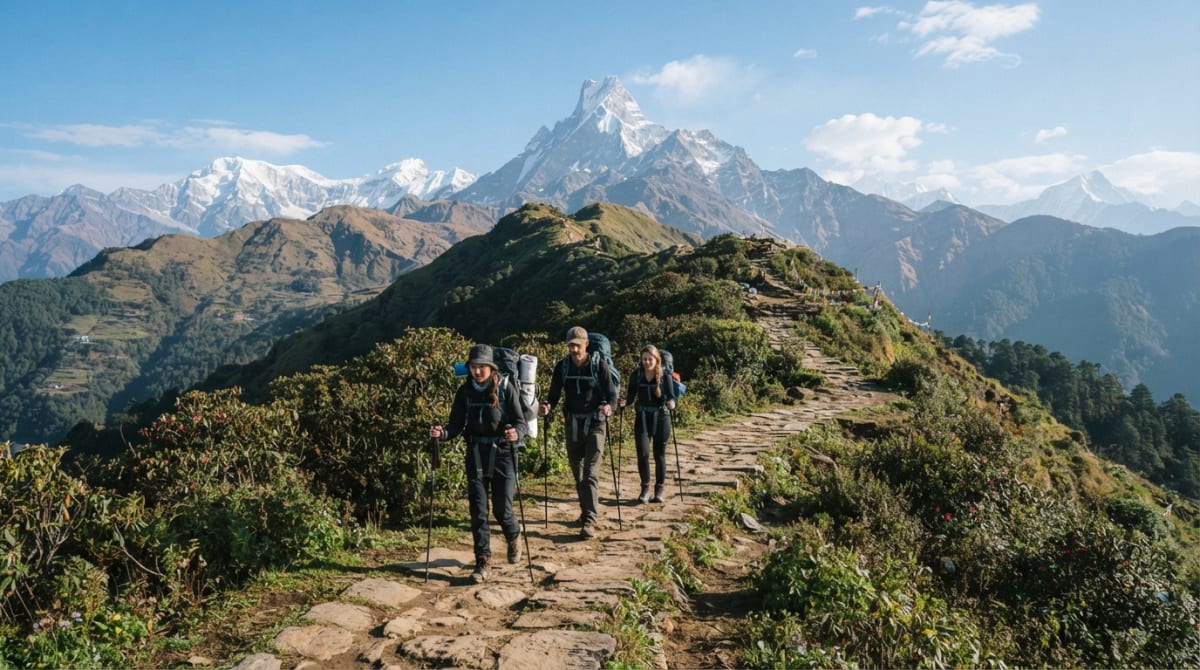
What the Ridge Looks Like
The Mardi Himal ridge is a long spur that runs south from the mountains toward Pokhara, separating two major valleys. To the west lies the deep gorge of the Modi Khola, the river that drains the Annapurna Sanctuary, with the trail to Annapurna Base Camp far below. To the east lies the valley of the Mardi Khola, with villages such as Siding on its slopes. The ridge itself is mostly broad and grassy, rising in a series of steps and humps, with the trail following the crest or traversing just below it.
In autumn, the grass turns golden and brown. In spring, dwarf rhododendrons bloom on the lower ridge, and wildflowers appear. In winter, the upper ridge can be dusted or covered with snow. Throughout the year, prayer flags flutter at viewpoints and lodges, and cairns mark the way. See the Modi and Mardi Khola valleys.
The Views
The views from the ridge are the main reason people trek to Mardi Himal. Machapuchare, the Fishtail, dominates everything, its pointed summit and sheer faces growing larger and more dramatic with every hour. To its left, Mardi Himal, the smaller peak that gives the trek its name, rises in steep snow slopes. To the west, Annapurna South and Hiunchuli form a massive wall of snow and ice, and on clear days you may see other peaks of the Annapurna range beyond. Behind you, the ridge falls away toward the green foothills, Pokhara and, on the clearest days, the plains far to the south.
One of the special features of the ridge is the sea of clouds. On many mornings, the valleys fill with cloud while the ridge stays in sunshine, so you walk above a white ocean with the peaks rising out of it. See the mountains you see from Mardi Himal, Annapurna South and Hiunchuli and the sea of clouds.
Low Camp to Badal Danda
The first section of the ridge climbs from Low Camp through the last of the forest and out onto open slopes. The trail is well defined, with steady climbing and a few steeper sections. As you rise, the views open up in every direction. Badal Danda, whose name means "cloud hill," sits on a shoulder of the ridge with a few simple lodges. It is a popular lunch stop and an overnight stop on some itineraries, and it is aptly named: clouds often swirl around it in the afternoon. See Badal Danda.
Badal Danda to High Camp
Above Badal Danda, the ridge becomes fully open. The trail climbs steadily along the crest, with some steep pitches and a few narrower sections where the ground drops away on both sides. This is where the ridge feels most dramatic, with Machapuchare directly ahead and the valleys far below. High Camp, at 3,580 meters, sits on a broad shoulder of the ridge with several lodges and wide views of the peaks. It is the base for the summit hike. See the High Camp guide.
Above High Camp
The final section of the ridge, from High Camp to Base Camp, is walked in the dark and early morning of summit day. The trail climbs steeply up open slopes to the Upper View Point at around 4,200 meters, then continues more gently across high, rocky ground to Mardi Himal Base Camp at roughly 4,500 meters, directly beneath the peaks. This is the highest and most exposed part of the ridge, where wind, cold and, in some seasons, snow and ice are serious considerations. See Upper View Point vs Base Camp.
How Exposed Is the Ridge?
The word "ridge" makes some trekkers nervous, imagining a narrow knife-edge with sheer drops. The reality is gentler. Most of the Mardi Himal ridge is broad and grassy, with a clear trail and plenty of room. A few sections are narrower, with steep grassy slopes falling away on one or both sides, and there are places where a fall would be serious. But there is no scrambling, no fixed ropes, and no technical terrain in normal conditions.
Exposure increases in bad weather. Strong wind can make narrow sections feel unsettling, fog can hide the trail and the drops, and snow or ice can make steep slopes slippery. In these conditions, stay close to your guide, keep to the trail, and do not take risks for a photograph. See steep sections on Mardi Himal and weather safety on the ridge.
For Trekkers Afraid of Heights
If you have a fear of heights, the Mardi Himal ridge is usually manageable. The trail is rarely narrow for long, and the drops are grassy slopes rather than vertical cliffs, which feels less intimidating. Many trekkers with a mild fear of heights walk the ridge happily. If you are nervous, tell your guide in advance. They can walk beside you on narrower sections, help you focus on the trail rather than the drop, and choose the best line. Take your time, breathe steadily, and remember that the trail is wide enough for your feet. See Mardi Himal with a fear of heights.
Wind, Fog and Weather
The ridge is exposed to weather in a way the forest is not. Wind can be strong, especially in the afternoon and in winter, and it makes the temperature feel much colder. Carry a windproof jacket, a warm hat and gloves even on a sunny day. Fog and cloud are common from late morning onward, rising from the valleys and swallowing the ridge. In fog, visibility can drop to a few meters, and the trail can be hard to follow, so stay close to your group and guide.
The best weather on the ridge is usually in the early morning, which is why the summit hike starts before dawn. In autumn, clear mornings are the norm. In spring, cloud often builds earlier. In the monsoon, rain and fog are frequent, and views are unreliable. In winter, skies are often clear but the wind and cold are intense. See fog and clouds on Mardi Himal, wind and cold at Base Camp and trekking in fog.
Wildlife on the Ridge
The open ridge is a good place to watch for wildlife. The Himalayan monal, Nepal's colorful national bird, is sometimes seen on the slopes near the forest edge, especially in the early morning. Large birds of prey, including Himalayan griffon vultures and, occasionally, the lammergeier or bearded vulture, soar on the updrafts along the ridge. On the higher slopes, you may spot Himalayan tahr, a wild goat, grazing on steep ground. Keep a respectful distance and never feed wildlife. See the Himalayan monal, birds of prey on Mardi Himal and Himalayan tahr.
Photography on the Ridge
The ridge offers some of the best photography of the trek. Early morning and late afternoon light are ideal, when the peaks glow and the grassy ridge is lit from the side. The trail itself makes a strong leading line, winding along the crest toward Machapuchare. Include trekkers or prayer flags in your frame for scale. The sea of clouds in the morning is spectacular, and sunsets from Badal Danda and High Camp can be superb. Be careful near edges when composing shots, especially in wind. See the photography guide and sunset at Low Camp and Badal Danda.
Altitude on the Ridge
The ridge takes you from around 3,000 meters to around 4,500 meters, the altitude range where many people start to feel the effects of thinner air. Breathlessness on the steeper sections is normal. Headaches, loss of appetite and poor sleep are common at High Camp. Walk slowly, drink plenty of water, eat well, and tell your guide about any symptoms. Most itineraries spend a night at Low Camp or Badal Danda before High Camp, which helps acclimatization. See acclimatization on Mardi Himal and our altitude sickness guide.
What to Wear and Carry
- Layered clothing: base layer, fleece, windproof shell and a down jacket for stops
- Warm hat, buff and gloves, even on sunny days
- Sunglasses and high-factor sunscreen; the sun is strong at altitude
- Water (at least 1.5 liters) and snacks; there are few stops between lodges
- Trekking poles for the steep sections and descents
- Rain gear and pack cover, especially in spring and the monsoon
- Microspikes in winter or after snow
- Headlamp for the pre-dawn summit hike
See the complete packing list and sun protection at altitude.
Why the Ridge Makes Mardi Himal Special
Many treks in Nepal follow valley floors, with the mountains towering above on either side. The Mardi Himal Trek is different, because for its best section you walk along the top of a ridge rather than at the bottom of a valley. That gives you views in every direction for hours at a time, rather than only at the end of the day, and it brings you face to face with Machapuchare in a way few other treks do. It is also why the trek packs so much scenery into so few days, and why it is often recommended as one of the best short treks in the country. See why Mardi Himal is Nepal's best short trek and the trek's highlights.
Where to Sleep on the Ridge
There are three places to sleep on the open ridge: Low Camp at the forest edge, Badal Danda in the middle, and High Camp at the top. Each has simple lodges with basic rooms and hearty food. Low Camp is the most comfortable and warmest, High Camp the coldest but closest to the summit. Many itineraries sleep at Low Camp or Badal Danda on the way up and at High Camp the night before the summit, then descend to Badal Danda or Low Camp afterward. See Low Camp, Badal Danda or High Camp: where should you sleep?
Walk the Mardi Himal Ridge with Us
The ridge walk is the highlight of every Mardi Himal itinerary. To enjoy it at a comfortable pace, with time to acclimatize and take in the views, choose the 5-day Mardi Himal Trek from Pokhara or the 9-day trek from Kathmandu. For a faster trip, the 3-day Short Mardi Himal Trek covers the ridge in a single push. Contact us to plan your trek.