

If this is your first visit to Nepal, the 9-day Mardi Himal Trek is the easiest way to experience the ridge without worrying about logistics. It begins the moment you land in Kathmandu and ends when you fly home, with everything in between arranged: airport transfers, hotels, the journey to Pokhara, permits, a licensed guide, transport to and from the trailhead, and your lodges and meals on the trail. The trekking days follow the gentlest pattern of any Mardi Himal itinerary, with a night at Forest Camp and a night at Badal Danda, giving your body time to adjust to the altitude.
This guide explains the 9-day itinerary day by day, what each day involves, who it suits and how to prepare. For prices, inclusions and departure dates, see the 9-day Mardi Himal Trek. For how all our versions compare, read the Mardi Himal itinerary guide.
The 9-Day Itinerary at a Glance
| Day | Plan | Overnight |
|---|---|---|
| 1 | Arrive in Kathmandu, transfer to hotel | Kathmandu (1,400 m) |
| 2 | Tourist bus to Pokhara | Pokhara (822 m) |
| 3 | Drive to Kande, trek to Pitam Deurali | Pitam Deurali (2,100 m) |
| 4 | Trek to Forest Camp | Forest Camp (2,600 m) |
| 5 | Trek to High Camp | High Camp (3,580 m) |
| 6 | Base Camp at sunrise, descend to Badal Danda | Badal Danda (3,210 m) |
| 7 | Descend to Siding, drive to Pokhara | Pokhara |
| 8 | Tourist bus to Kathmandu | Kathmandu |
| 9 | Transfer to the airport for departure | — |
Day 1: Arrival in Kathmandu
When you land at Tribhuvan International Airport, you complete visa and immigration formalities, collect your bags and walk out to find our representative waiting with your name. After the short drive to your hotel, the rest of the day is free to rest after your journey. Kathmandu can feel overwhelming at first, with its busy streets, motorbikes and noise, so many travellers simply relax at the hotel, take a short walk around Thamel or enjoy a first plate of momos.
If you arrive early enough, you may want to visit a nearby sight such as the Garden of Dreams or take a short evening stroll. Otherwise, have an early night, as the next morning starts early for the journey to Pokhara. See our guide to arriving at Kathmandu airport and where to stay in Kathmandu.
Day 2: Kathmandu to Pokhara
After an early breakfast, you board a tourist bus for the journey west to Pokhara, about 200 kilometers along the Prithvi Highway. The road climbs out of the Kathmandu valley, drops to the Trishuli River and follows it through green gorges, then turns toward Pokhara along the Marsyangdi and Seti valleys. Buses stop for breakfast and lunch along the way, and the journey usually takes six to eight hours depending on traffic.
You arrive in Pokhara in the afternoon and transfer to your hotel in Lakeside. In the evening, your guide holds a briefing to explain the route, check your gear and answer questions. If you need to rent a sleeping bag, down jacket or trekking poles, Lakeside's shops are close by. If you prefer, you can fly between Kathmandu and Pokhara at extra cost. See Kathmandu to Pokhara by tourist bus.
Day 3: Pokhara to Kande and Pitam Deurali
The trek begins. A private vehicle drives you about an hour west to Kande, where a stone staircase climbs through farmland to the ridge at Australian Camp and its first sweeping view of the Annapurna range. The trail then drops gently to Pothana, where your permits are checked, and continues through forest to Pitam Deurali at around 2,100 meters. It is a relatively short day of three to four hours, easing you into life on the trail.
At Pitam Deurali you have the afternoon to rest and settle in. The lodges here are among the best equipped on the route, and on clear evenings you can see Machapuchare and the Annapurnas turning gold. See Kande to Pitam Deurali.
Day 4: Pitam Deurali to Forest Camp
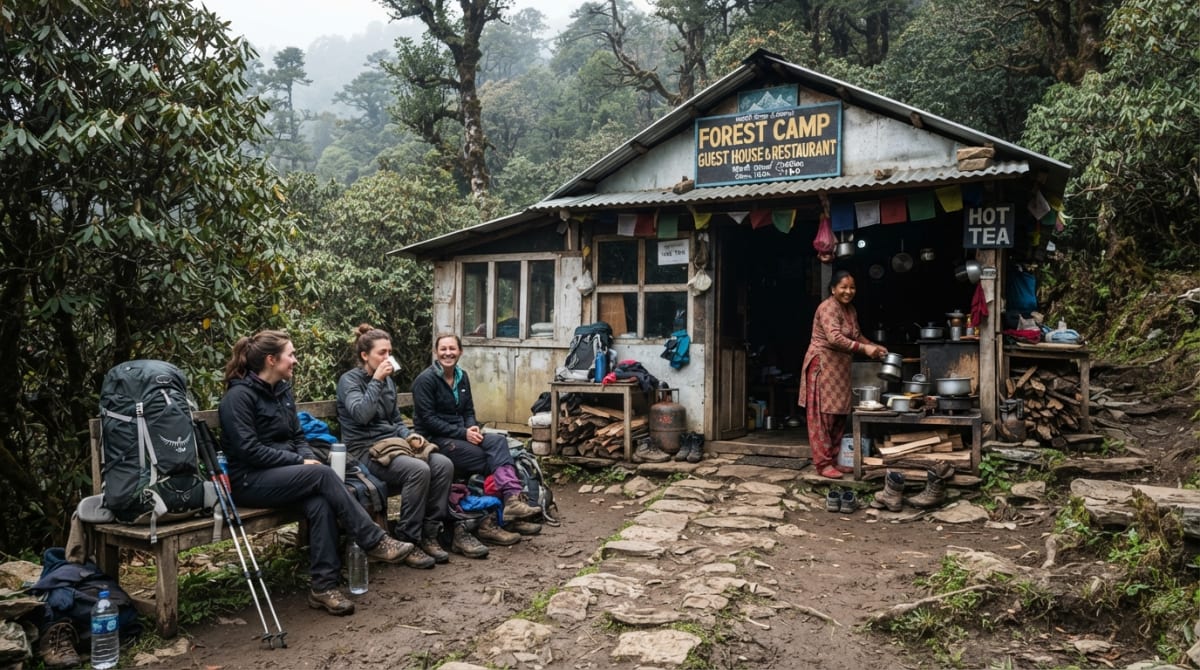
Day four is a gentle forest day. The trail climbs gradually through rhododendron, oak and maple woodland, draped in moss and ferns, to Forest Camp at around 2,600 meters. In spring the rhododendrons turn the forest red and pink; in autumn it is green and quiet. You walk around four to five hours, and because this itinerary splits the forest section in two, you arrive with energy to spare.
Forest Camp is a peaceful clearing with a small cluster of lodges surrounded by tall trees. Spending the night here adds an important step in acclimatization before you climb to High Camp. See Pitam Deurali to Forest Camp and our Forest Camp guide.
Day 5: Forest Camp to High Camp
This is the biggest climbing day of the trek. You continue through the forest past Rest Camp to Low Camp, where Machapuchare appears directly ahead, then leave the trees behind and climb the open ridge past Badal Danda to High Camp at 3,580 meters. Expect five to six hours of walking and nearly 1,000 meters of ascent, with the views getting more dramatic with every step.
At High Camp, rest, drink plenty of water and take a gentle walk above the lodges to help your body adjust. Enjoy sunset over the peaks, eat an early dinner, and prepare your warm clothes and headlamp for the morning. See our High Camp guide.
Day 6: Mardi Himal Base Camp and Badal Danda
You rise before dawn and climb by headlamp to the Upper View Point, around 4,200 meters, in time for sunrise over Annapurna South, Hiunchuli, Mardi Himal and Machapuchare. When the light has settled, you continue to Mardi Himal Base Camp at roughly 4,500 meters, the highest point of the trek, for close-up views of glaciers and summits. After returning to High Camp for breakfast, you descend the ridge to Badal Danda at around 3,210 meters.
Sleeping at Badal Danda instead of continuing further down gives you a relaxed afternoon after the summit hike and a quiet night at a small lodge stop, often with a sea of clouds below. See the Base Camp hike guide and our Badal Danda guide.
Day 7: Descent to Siding and Pokhara
The last trekking day drops steeply from the ridge through forest and farmland to Siding, a traditional Gurung village at the road head. The descent is long and hard on the knees, so take it steadily with trekking poles. At Siding, a jeep waits to drive you back to Pokhara along a rough road. You arrive in the afternoon with time for a hot shower and a celebratory dinner by the lake. See Badal Danda to Siding.
If you have energy in the evening, stroll along Phewa Lake, where boats drift on the water and the mountains you have just walked beneath rise above the city on clear evenings.
Day 8: Pokhara to Kathmandu
After breakfast, you take the tourist bus back to Kathmandu, retracing the scenic route along the rivers. You arrive in the afternoon and transfer to your hotel. In the evening, you might explore Thamel's shops for souvenirs or enjoy a farewell dinner. If you would prefer more time in Pokhara, you can fly back to Kathmandu instead, or extend your stay. See Thamel for trekkers.
Day 9: Departure
Our representative drives you to Tribhuvan International Airport in time for your flight home. If your flight is late in the day, you may have time for a short visit to one of Kathmandu's heritage sites, such as Boudhanath Stupa or Swayambhunath. See combining the trek with a Kathmandu heritage tour.
Best Season for the 9-Day Trek
The 9-day itinerary runs year-round, but conditions vary. Autumn, from late September to November, offers the clearest mountain views, dry trails and stable weather, making it the most popular season; book early for October. Spring, from March to May, brings rhododendron blooms to the forest days, warm weather and slightly hazier views. Winter, from December to February, is quiet and clear but cold, with ice above High Camp, so warm gear and microspikes are needed. The monsoon, from June to August, brings rain, leeches and unreliable views, although the extra days in Pokhara and Kathmandu give useful flexibility. See the best time for the trek.
What Is Included and What Is Not
The 9-day package covers the main costs of the trip: airport transfers in Kathmandu, tourist bus travel between Kathmandu and Pokhara, hotel nights in both cities with breakfast, private transport to Kande and from Siding, ACAP and TIMS permits, a licensed guide, tea house accommodation and three meals a day during the trek, a group trekking map and a first aid kit carried by your guide. Not included are international flights, your Nepal visa, travel insurance, personal gear, porter services unless added, lunch and dinner in Kathmandu and Pokhara, snacks and drinks, hot showers, Wi-Fi and charging on the trail, and tips. Knowing this helps you budget accurately. See what's included in a Mardi Himal package.
Useful Upgrades
Several upgrades can make the 9-day trip more comfortable or flexible. Flying between Kathmandu and Pokhara instead of taking the bus saves most of a day each way and offers superb mountain views, though flights can be delayed by weather. Adding a porter lets you walk with only a light daypack, which makes the climbs and the descent to Siding much easier. Adding a spare day, either on the trail or in Pokhara, protects against weather delays and gives you time to relax after the trek. And extending the trip with Chitwan or a heritage tour turns it into a well-rounded Nepal holiday. See Kathmandu to Pokhara by flight and two weeks in Nepal.
Preparing for the 9-Day Trek
Although the pace is gentle, you still need to prepare. Train for six to eight weeks with brisk walks, stairs, leg strength and weekend hikes with a daypack. Break in your boots. Buy travel insurance that covers trekking to at least 4,500 meters and helicopter evacuation. Check your passport validity and visa requirements. Pack a layering system with a down jacket and a warm sleeping bag, or plan to rent them in Pokhara. See our preparation guide and packing list.
Budgeting for Extras
With most costs included, your extra spending on the 9-day trip is modest. Budget for lunches and dinners in Kathmandu and Pokhara, which range from inexpensive local cafés to international restaurants. On the trail, carry Nepali rupees for hot showers, charging, Wi-Fi, snacks and extra drinks, which cost more the higher you go. Set aside money for tips for your guide and porter at the end of the trek, and for souvenirs in Pokhara or Thamel. There are no ATMs on the trail, so withdraw cash in Pokhara before you start. See how much cash to carry and our tipping guide.
Who the 9-Day Trek Suits
This itinerary is ideal for first-time visitors to Nepal who want every detail taken care of, for beginners who appreciate a gentle trekking pace, and for travellers who prefer to experience both Kathmandu and Pokhara. It suits couples, families with older children, groups of friends, older trekkers and anyone who values comfort and reassurance. The extra night at Forest Camp and the lower overnight at Badal Danda make acclimatization easier than on the shorter itineraries.
If you are already in Pokhara or can fly there directly, the 5-day Mardi Himal Trek from Pokhara or the 7-day direct-flight itinerary may suit you better. See which Mardi Himal trek is right for you.
Book the 9-Day Mardi Himal Trek
The 9-day Mardi Himal Trek includes airport transfers in Kathmandu, tourist bus transport between Kathmandu and Pokhara, hotels in Kathmandu and Pokhara on a twin-sharing basis with breakfast, private transport between Pokhara, Kande and Siding, ACAP and TIMS permits, a licensed English-speaking guide, and tea house accommodation with three meals a day while trekking. Porters and flights between Kathmandu and Pokhara can be added. Contact us to check dates and tailor the trip.