

One of the great advantages of the Mardi Himal Trek is how close it is to Pokhara. Many Himalayan treks begin with a long bus ride, a domestic flight or a day or more of travel just to reach the trailhead. Mardi Himal starts barely an hour from the lakeside cafes of Pokhara. You can have breakfast by Phewa Lake, be walking uphill through the forest by mid-morning, and be standing beneath Machapuchare at Base Camp a few days later. At the end, a jeep brings you back to the city in time for dinner.
This guide follows the whole journey from Pokhara to Mardi Himal Base Camp and back, door to door: how to reach the trailheads, the trekking stages, the return, and the practical details of permits, luggage, money and timing. For the trek from Pokhara as a package, see the 5-day Mardi Himal Trek from Pokhara.
The Journey at a Glance
| Stage | How | Typical time |
|---|---|---|
| Pokhara to Kande | Jeep, taxi or bus on the Baglung highway | 1–1.5 hours |
| Kande to Pitam Deurali | On foot via Australian Camp and Pothana | 3–4 hours |
| Pitam Deurali to Low Camp | On foot via Forest Camp and Rest Camp | 7–9 hours, often split over two days |
| Low Camp to High Camp | On foot via Badal Danda along the ridge | 3–4 hours |
| High Camp to Base Camp and back | On foot, pre-dawn start | 5–7 hours |
| Low Camp to Siding | On foot through forest and farmland | 4–5 hours |
| Siding to Pokhara | Jeep on a rural road via Lumre | 2–3 hours |
Pokhara: The Gateway
Pokhara, at around 822 meters, is Nepal's second tourist hub after Kathmandu and the base for most treks in the Annapurna region. The Lakeside area, along the eastern shore of Phewa Lake, is packed with hotels, restaurants, trekking shops, gear rental outlets, pharmacies and ATMs. On clear mornings, the Annapurna range, including Machapuchare, rises directly above the city. Most trekkers spend at least one night in Pokhara before the trek to rest, buy or rent gear, arrange permits and meet their guide. See where to stay in Pokhara and the Lakeside guide for trekkers.
Getting to Pokhara
If you are coming from Kathmandu, you can reach Pokhara by tourist bus (six to eight hours), private vehicle (five to seven hours) or a short domestic flight of about 25 minutes. Pokhara also has an international airport, and some trekkers now fly in directly from abroad. See the Kathmandu to Pokhara tourist bus, the Kathmandu to Pokhara flight and flying directly to Pokhara.
Pokhara to the Trailhead
The main trailheads, Kande and Phedi, lie west of Pokhara on the highway toward Baglung. Leaving the city, the road crosses the valley and begins to climb. Phedi, at the foot of the ridge below Dhampus, comes first, about 45 minutes to an hour from Lakeside. Kande, higher up the road, takes about an hour to an hour and a half, depending on traffic and road works.
Private jeep or taxi. The easiest option, and the one we use on our treks. Your guide arranges a vehicle to pick you up from your hotel and drop you at the trailhead. It is comfortable, flexible, and lets you start walking early. See transport from Pokhara to Kande.
Local bus. Buses toward Baglung and Nayapul leave from Pokhara's bus park and stop at Phedi and Kande on request. They are cheap but slow, crowded and less convenient with luggage, and schedules are irregular. See bus travel in Nepal for trekkers.
Which Trailhead?
Most itineraries start at Kande, which is the quickest route onto the trail. From Kande, a stone trail climbs to Australian Camp and continues to Pothana and Pitam Deurali. An alternative is to start at Phedi and climb to Dhampus, a larger village with fine views, joining the Kande trail at Pothana. Some very short itineraries drive to Siding on the eastern side of the ridge and climb directly to Low Camp. See Phedi vs Kande, starting from Dhampus and starting from Siding.
Day One: Kande to Pitam Deurali
From Kande, the trail climbs steeply for an hour to an hour and a half through fields and forest to Australian Camp at around 2,060 meters, a grassy ridge with a superb view of Machapuchare, Annapurna South and Hiunchuli. From there, it descends gently to Pothana, where permits are checked, and continues through forest to Pitam Deurali at around 2,100 meters, where most groups spend the first night. Total walking time is three to four hours. See Kande to Pitam Deurali.
Day Two: Pitam Deurali to Forest Camp or Low Camp
At Pitam Deurali, the Mardi Himal trail turns north into the forest, leaving the trail to Landruk and Annapurna Base Camp. The day is spent climbing through a beautiful forest of rhododendron, oak and magnolia, draped in moss. Forest Camp, at around 2,600 meters, is reached in five to six hours. Faster itineraries, such as the 5-day trek, continue past Rest Camp to Low Camp at around 2,970 meters, a longer day of seven to nine hours. See Pitam Deurali to Forest Camp and Forest Camp to Low Camp.
Day Three: Up the Ridge to High Camp
From Low Camp, the trail leaves the forest and climbs the open ridge, with Machapuchare directly ahead. It passes Badal Danda and continues to High Camp at 3,580 meters, a walk of three to four hours. The views along the ridge are spectacular, often above a sea of clouds. Afternoons at High Camp are for resting, acclimatizing and watching the sunset. See Low Camp to High Camp and the High Camp guide.
Day Four: Base Camp and Descent
Summit day starts before dawn. You climb by headlamp to the Upper View Point at around 4,200 meters for sunrise, then continue to Mardi Himal Base Camp at roughly 4,500 meters, beneath the faces of Mardi Himal and Machapuchare. After returning to High Camp for breakfast, you descend the ridge to Low Camp or Badal Danda for the night. See High Camp to Base Camp.
Day Five: Descent to Siding and Back to Pokhara
The final day descends steeply east from Low Camp through forest and farmland to Siding, at around 1,750 meters, in four to five hours. After lunch in the village, a jeep takes you back to Pokhara on a rough rural road that joins a better road near Lumre, a drive of two to three hours. You arrive in Pokhara by late afternoon. See Low Camp to Siding and the Siding to Pokhara jeep.
Itineraries from Pokhara
The 5-day trek described above is the most popular itinerary from Pokhara, balancing time and acclimatization. For trekkers short on time, the 3-day Short Mardi Himal Trek uses faster routes and longer days. For those flying directly into Pokhara from abroad, the 7-day trek adds arrival and departure days and a gentler pace. If you are starting from Kathmandu, the 9-day trek includes the journey to and from Pokhara. See the 5-day itinerary, the 3-day itinerary and how many days you need.
Permits
The Mardi Himal Trek lies within the Annapurna Conservation Area, so you need an ACAP entry permit and, where required, a TIMS card. Both can be arranged in Pokhara at the relevant tourism offices, or in Kathmandu before you travel. You will need your passport and passport photos or digital copies. Most trekking agencies, including us, arrange permits on your behalf. Since 2023, foreign trekkers have also been required to trek with a licensed guide. See getting permits in Pokhara and Mardi Himal permits.
Luggage Storage
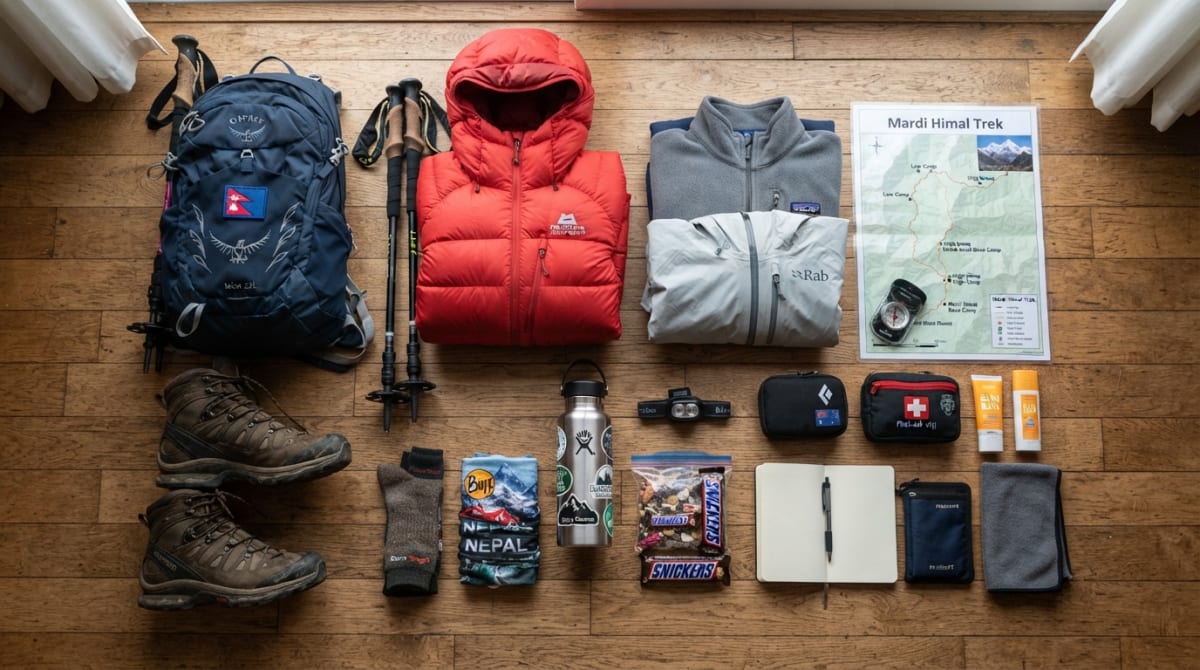
You do not need to carry everything you brought to Nepal on the trek. Most hotels in Pokhara will store extra luggage free or for a small fee while you are away, so you can leave behind city clothes, electronics you do not need, and souvenirs. Pack a trekking bag of no more than about 10 to 12 kilograms if you have a porter, or less if you are carrying it yourself, and a daypack for essentials. See luggage storage in Pokhara and porter bag weight limits.
Money and ATMs
Pokhara has plenty of ATMs and money exchangers, but there are none on the trail. Withdraw enough Nepali rupees in Pokhara for the whole trek: lodge extras such as hot showers, charging, Wi-Fi, snacks and drinks, plus tips for your guide and porter. Cards are rarely accepted on the trail. See how much cash to carry and ATMs and money.
Gear from Pokhara
Pokhara's trekking shops sell and rent almost everything you might need, from down jackets and sleeping bags to trekking poles and microspikes. Renting is a good option for bulky items you will rarely use at home. Check quality carefully, especially for sleeping bags and down jackets. See renting gear in Pokhara and buying gear in Pokhara and Kathmandu.
Briefing and Timing
On our treks, your guide meets you in Pokhara the day before the trek for a briefing, to check your gear, go over the itinerary and answer questions. On trekking day, most groups leave Lakeside between 7 and 8 a.m. to start walking before the midday heat. At the end of the trek, allow a buffer day in Pokhara before any onward flight or long journey, in case of road delays or weather. See the arrival day briefing.
What the Drive to the Trailhead Is Like
The drive from Pokhara to Kande is short but scenic. Leaving Lakeside, you pass through the busy streets of the city, then follow the highway west across the valley floor, past rice fields and small settlements. Beyond Phedi, the road begins to climb in wide bends up the hillside, with views back over the Pokhara valley and, on clear mornings, the Annapurna range to the north. The road is paved but narrow in places, and trucks and buses bound for Baglung share it, so progress can be slow behind heavy vehicles. At Kande, a small cluster of shops and tea houses marks the start of the trail. Your guide will usually buy water or snacks here, check your permits once more, and set off up the stone steps. See road safety for trekkers and the Kande trailhead guide.
What the Return Drive Is Like
The drive back from Siding is rougher. The first part follows an unpaved rural road that winds down the valley through villages and terraced hillsides, bumpy and dusty in the dry season and muddy after rain. Near Lumre, the road improves, and the final stretch into Pokhara is paved. The whole journey usually takes two to three hours, depending on the state of the road and how often the jeep stops for traffic or livestock. If you are prone to motion sickness, sit in the front and take medication before setting off. In the monsoon, landslides occasionally block the road, and your guide may arrange for a vehicle to meet you further down the valley. See motion sickness on Nepal's roads.
Best Time to Trek from Pokhara
The best seasons for the trek are autumn, from late September to November, when skies are clearest, and spring, from March to May, when rhododendrons bloom in the forest. Winter, from December to February, brings cold nights on the ridge but often excellent visibility, and Pokhara itself stays mild. The monsoon, from June to August, brings rain, mud, leeches and cloud, though the forest is lush and the trail quiet. Pokhara's own weather is a poor guide to conditions on the ridge, which is much colder, windier and often cloudier. See the best time for the Mardi Himal Trek and Pokhara weather vs Mardi Himal weather.
Back in Pokhara
After the trek, Pokhara is the perfect place to recover. Take a boat on Phewa Lake, visit the World Peace Pagoda, watch the sunrise from Sarangkot, fly tandem with a paraglider, or simply relax in a lakeside cafe with a view of the mountains you just walked beneath. See things to do in Pokhara after the trek and food in Pokhara.
Plan Your Trek from Pokhara
We handle the whole journey from your Pokhara hotel to Base Camp and back, including transport, permits, guide, porter and lodges. See the 5-day Mardi Himal Trek from Pokhara or the 3-day Short Mardi Himal Trek, and contact us to book.