

Most trekkers on the Mardi Himal Trek follow the same rhythm: walk, eat, sleep, and climb to the Upper View Point at dawn. It is a wonderful trek done that way. But along the trail, and just off it, lie quieter treasures that many people walk straight past without noticing: a hill above the lodges where the sunset is even better, a forest stop where the birds sing loudest, a village where you can sleep in a family home, a stretch of trail beyond the crowds. Here are the hidden gems our guides love most, and how to find them. For the famous highlights, see the trek highlights.
A Night at Australian Camp
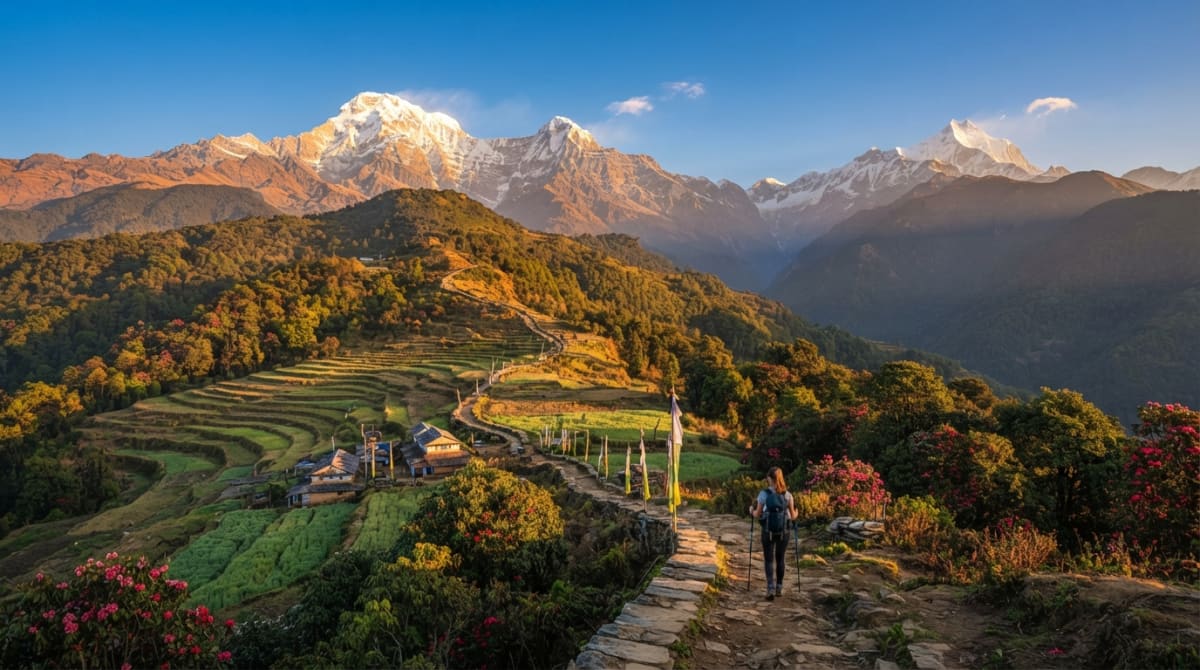
Most trekkers pass through Australian Camp in the late morning of the first day, when clouds may already be gathering, and continue to Pitam Deurali. Few stay the night. Yet the broad, grassy ridge at Australian Camp has one of the finest views of the lower trek, looking directly at Machapuchare, Annapurna South and Hiunchuli, and sunset and sunrise here can be magical. If you have an extra half day, sleeping at Australian Camp gives you the mountains at their best light, without the altitude of the upper ridge. See Australian Camp.
Dhampus at Dawn
Starting the trek from Dhampus instead of Kande is a hidden gem in itself. This long-established village strung along a ridge above Phedi has farmhouses, terraces and wide views of the Annapurna range. Spend the night before the trek in a lodge or homestay, and wake to watch the first light hit the peaks while village life stirs around you: smoke rising from kitchens, farmers heading to the fields, children on their way to school. Then walk through quiet forest to Pothana, avoiding the busier trail from Kande. See starting from Dhampus.
The Moss Forest Around Rest Camp
Between Forest Camp and Low Camp, the forest grows older and wilder. The rhododendrons and oaks here are gnarled and twisted, their branches hung with thick moss and long beards of lichen, and mist often drifts between the trunks. Rest Camp, a small lodge stop in the middle of this forest, is often overlooked as just a tea break, but it is one of the most atmospheric places on the trek. Sit outside with a cup of tea, listen to the birds, and watch the mist move through the trees. If you have time, a night here instead of Forest Camp or Low Camp offers real peace. See Rest Camp and oak, bamboo and moss forests.
Birdsong at First Light
The forest between Pitam Deurali and Low Camp is one of the richest bird habitats on the trek, but most trekkers pass through in the middle of the day, when birds are quiet. Get up at dawn at Forest Camp or Rest Camp and take a slow, quiet walk along the trail. You may hear the chorus of laughing thrushes, see sunbirds flitting among the rhododendron flowers in spring, and, with luck, spot langur monkeys moving through the canopy. Bring binoculars. See birdwatching on Mardi Himal.
Looking for the Monal Near Low Camp
The Himalayan monal, Nepal's dazzling national bird, lives near the forest edge and on open slopes around Low Camp and the lower ridge. Most trekkers never see one, simply because they are not looking at the right time. Early morning, just after sunrise, is best. Walk quietly along the trail above Low Camp, scan the slopes and clearings, and listen for the monal's distinctive call. A male in full plumage, shimmering green, blue and copper, is a sight you will not forget. See the Himalayan monal.
The Sunset Hill Above Low Camp
From the lodges at Low Camp, the view of Machapuchare is already superb. But a short walk up the trail above the lodges, perhaps 30 to 60 minutes round trip, brings you onto open ground with an even wider view, often above a sea of clouds filling the valleys below. At sunset, the Fishtail turns gold and then pink, and the clouds glow beneath it. Few trekkers make the effort after a long day, so you may have it to yourself. Take a warm layer and a headlamp. See sunset at Low Camp and Badal Danda.
A Night at Badal Danda
Badal Danda, the "cloud hill" between Low Camp and High Camp, is often treated as just a lunch stop. But it has a few simple lodges, and spending a night here is a gem. It is quieter than Low Camp or High Camp, the views along the ridge are wide, and clouds swirl dramatically around the hill in the afternoon and evening, creating spectacular sunsets. It is also a good acclimatization step before High Camp. See Badal Danda.
Stars Above High Camp
Far from any city lights, the night sky above High Camp is extraordinary. Many trekkers are in bed early and never see it. On a clear night, especially around the new moon, step outside the lodge for a few minutes before bed. Let your eyes adjust, and the Milky Way appears, arcing over the ridge. On moonlit nights, Machapuchare glows silver. It is cold, but unforgettable. See stargazing on Mardi Himal and timing your trek with the moon.
Beyond the Viewpoint
On summit morning, many trekkers stop at the Upper View Point, around 4,200 meters, watch the sunrise and turn back. The walk from there to Base Camp, around 4,500 meters, is one of the trek's best-kept secrets. It is far quieter, with open ground, prayer flags and the peaks growing ever closer. At Base Camp, you stand directly beneath Mardi Himal's slopes, with glaciers and Machapuchare's sheer faces in front of you, often with only a few other people around. If you feel well and the weather is good, keep going. See Upper View Point vs Base Camp.
Lwang's Tea Gardens
On the eastern side of the ridge, near Siding, the village of Lwang is known for its hillside tea gardens, a surprising sight in the Annapurna foothills. Extending your descent to Lwang, with a night in a homestay in Lwang or nearby Ghalel, offers a peaceful cultural finale. Walk between the rows of tea bushes in the morning mist, meet your host family, and taste local tea. See Mardi Himal via Lwang.
Village Life in Siding
Most trekkers treat Siding as a lunch stop and jeep pickup. But the village itself is a traditional farming community with terraced fields, stone farmhouses, livestock and daily rhythms that are worth pausing for. Take half an hour to walk through the village before your jeep, or spend the night and watch evening life unfold. See the Siding village guide.
Local Flavors
Dal bhat is the trekkers' staple, but the villages around Mardi Himal offer more. Look for gundruk, fermented and dried leafy greens with a tangy flavor; dhido, a thick porridge of millet or buckwheat flour eaten with curry; millet bread; homemade pickles; and local honey. These are more common in village homes and homestays at the start and end of the trek than in the lodges on the upper ridge. Ask your guide where to find them. See Nepali dishes to try and Thakali food in Pokhara.
The Herders' Kharka
On the open slopes of the ridge, keep an eye out for simple stone walls and shelters. These are kharka, seasonal pastures and herders' camps used for generations by villagers who bring livestock up to the high grasslands in summer. In some seasons, you may meet herders with their animals. They are a reminder that the ridge was a working landscape long before it became a trekking route. See the history of the trek.
Landruk and the Hot Springs
For those with more time, linking from Pitam Deurali to Landruk, a traditional Gurung village above the Modi Khola, and then on to the hot springs at Jhinu Danda, offers a completely different finale to the trek. Soaking tired legs in natural hot pools beside a roaring river after days on the ridge is pure joy. See linking Mardi Himal with Landruk and the Jhinu Danda hot springs.
Pitam Deurali at Dusk
Pitam Deurali, the first overnight stop on most itineraries, is often seen as simply a place to sleep before the forest. But its position on a forested saddle gives it a lovely evening atmosphere. As the day cools, the trekkers heading to Landruk and those heading to Mardi Himal mingle in the lodges, and on clear evenings the tip of Machapuchare glows above the trees. Walk a few minutes along either trail at dusk and you will find quiet spots with views over the forested hills. It is a gentle, understated start to the adventure. See Pitam Deurali.
The View Back Toward Pokhara
Most trekkers spend the ridge days looking ahead at Machapuchare, and understandably so. But turn around. From High Camp and Badal Danda, the ridge falls away toward the south, and on clear days you can trace your route back through the forest to the green foothills, the Pokhara valley and, on the clearest mornings, the hazy line of the plains far beyond. At night, the lights of Pokhara twinkle far below. Seeing how far you have come is a quiet, satisfying moment that many people miss. See the Mardi Himal ridge.
Snow on the Ridge in Winter
Winter, from December to February, is the quietest season on the trek, and it has its own hidden beauty. After snowfall, the upper ridge turns white, the rhododendron forest near Low Camp is dusted with frost, and the peaks stand crisp against deep blue skies. The trail is almost empty, and the lodges feel cozy around the stove. It is cold and demanding, and snow can limit how far you go above High Camp, but for well-prepared trekkers it is a magical time. See snow on the Mardi Himal Trek and the winter packing list.
The Monsoon Forest
The monsoon, from June to August, is dismissed by many as a bad time to trek, and for mountain views, it often is. But the forest in the monsoon is a hidden gem of its own. Moss swells with moisture, ferns unfurl, orchids flower on the branches, waterfalls appear on the hillsides, and the rice terraces around Siding are a vivid green. The trail is quiet, lodge owners are glad of company, and on the rare clear morning, the mountains appear washed and brilliant. Bring good rain gear and leech socks, and keep your expectations flexible. See Mardi Himal in the monsoon.
How to Build Gems into Your Trek
Some of these hidden gems need no extra time: the sunset hill above Low Camp, stargazing at High Camp, looking back toward Pokhara, and continuing from the viewpoint to Base Camp can all fit into a standard itinerary if you have the energy. Others, such as a night at Australian Camp, Dhampus, Rest Camp or Badal Danda, or a village stay in Lwang, need one additional day each. The Landruk and hot springs extension needs one or two. If you have a flexible schedule, tell us which gems appeal to you, and we will build them into a custom itinerary. See the custom itinerary guide and side trips worth taking.
Conversations with Your Team
Perhaps the most overlooked gem of all is the people you trek with. Your guide and porter often come from villages in the hills around Pokhara, and many have walked the Mardi Himal ridge dozens of times. Ask about their families, their villages, the festivals they celebrate, the names they use for the mountains, and how the trek has changed over the years. Evenings by the stove are the perfect time. These conversations often become the memories trekkers treasure most. See a day in the life of a guide.
Find the Hidden Gems with Us
Our guides know every quiet corner of the Mardi Himal Trek and are happy to build hidden gems into your itinerary. See the 5-day Mardi Himal Trek from Pokhara or the 9-day trek from Kathmandu, and contact us to plan a trip beyond the ordinary.